


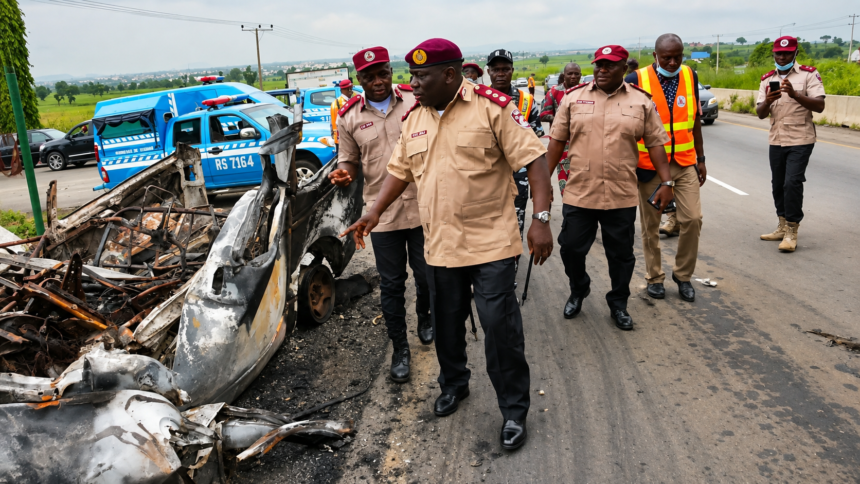
Fifteen travellers were killed and 25 others injured after two buses collided and caught fire along the Enagi-Mokwa Road in Niger State.
The fatal crash occurred on Saturday evening and involved two buses travelling in the same direction, according to the Sector Commander of the Federal Road Safety Corps in the state, Aishatu Sa’adu.
Sa’adu confirmed the incident in an interview with the News Agency of Nigeria in Minna on Sunday, saying preliminary findings indicated that one of the drivers attempted to overtake at a bend before the collision occurred.
She said the impact of the crash resulted in both vehicles catching fire, leaving several passengers trapped and unable to escape.
“Fifteen people were burnt to death in the crash, while 25 others sustained injuries,” Sa’adu said.
The crash adds to concerns over road safety on major highways in the state, particularly incidents linked to speeding and dangerous overtaking by motorists.
According to the FRSC commander, the two buses were travelling in the same direction when one of the drivers allegedly attempted to overtake wrongly at a bend.
The manoeuvre reportedly resulted in a collision between the vehicles, after which fire engulfed both buses.
Sa’adu said emergency responders evacuated the injured victims from the scene and transported them to two healthcare facilities for immediate medical attention.
The victims were taken to the Federal Medical Centre, Bida, and General Hospital, Kutigi, where they were receiving treatment as of Sunday.
She did not immediately disclose the identities of the deceased or provide details on the severity of the injuries sustained by the survivors.
The road crash occurred along the Enagi-Mokwa corridor, a route used by travellers moving between communities in Niger State and other parts of the country.
The incident has raised fresh concerns about motorists’ compliance with traffic regulations, particularly the dangers associated with excessive speed and risky overtaking.
The FRSC attributed the crash primarily to speeding and wrongful overtaking, stressing that motorists must exercise greater caution when approaching bends and other potentially dangerous sections of highways.
“The accident was as a result of over speeding and wrongfully overtaking,” Sa’adu said.
She urged drivers to avoid dangerous manoeuvres and maintain appropriate speeds throughout their journeys.
“I advise motorists to always maintain a good speed limit and avoid wrongful overtaking,” she added.
The FRSC has repeatedly warned motorists that overtaking at bends and other areas where visibility is restricted can result in head-on collisions or loss of control, particularly when vehicles are travelling at high speeds.
The Niger crash also highlights the potentially devastating consequences of road traffic violations, as a single dangerous manoeuvre resulted in multiple deaths and injuries within seconds.
For the families of those who died, the incident represents another painful loss, while survivors are now receiving treatment for injuries sustained in the collision.
Authorities are expected to continue examining the circumstances surrounding the crash to establish the full sequence of events and determine whether additional factors contributed to the collision.
The incident also places renewed emphasis on the need for motorists to exercise caution on highways, particularly during periods of heavy traffic when dangerous overtaking can have fatal consequences.
The FRSC has urged motorists across Niger State to comply with speed limits, avoid driving recklessly and refrain from overtaking in unsafe locations.
Road safety officials have consistently identified speeding, dangerous overtaking, fatigue, poor vehicle maintenance and disregard for traffic regulations among major contributors to fatal crashes on Nigerian roads.
The latest incident reinforces the need for motorists to prioritise safety over speed, particularly when carrying large numbers of passengers.
West Trybe reports that the Niger crash underscores the continuing road safety challenges facing travellers on major highways, with 15 lives lost in a single incident and 25 others left injured. The tragedy further highlights the importance of responsible driving, strict enforcement of traffic regulations and sustained public education to reduce preventable deaths on Nigeria’s roads.