


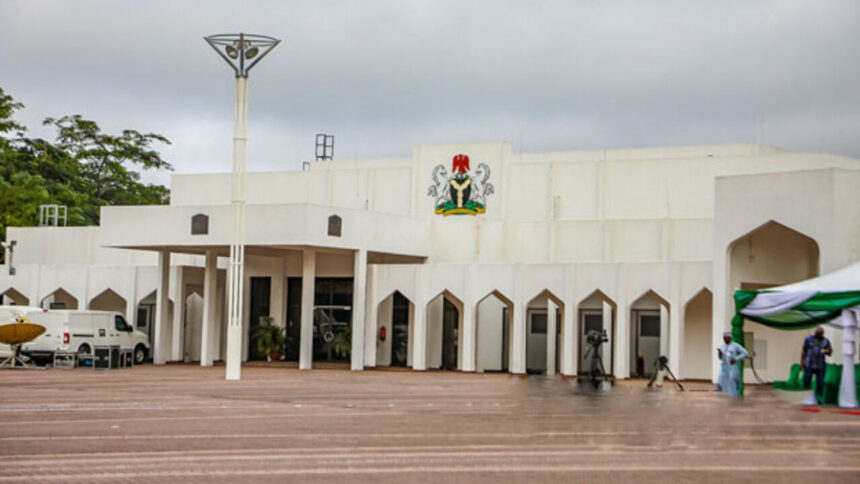
Aso Rock is set to disconnect from Nigeria’s national grid after accumulating an unpaid electricity bill of ₦47 billion, the presidency confirmed Friday. The decision, announced on June 12, 2026, would see the presidential villa install dedicated solar and gas-powered generation infrastructure to meet its energy needs independently, ending decades of dependence on the Abuja Electricity Distribution Company, known as AEDC.
Aso Rock Electricity Bill: How ₦47 Billion Piled Up
It did not happen overnight. According to documents seen by Westtrybe, the outstanding charges accumulated across seven consecutive fiscal years, beginning in 2019, with the largest single-year addition, ₦11.3 billion, recorded in 2024 when the naira’s collapse inflated electricity tariffs across every distribution zone in the country. Bayo Onanuga, the Special Adviser to the President on Information and Strategy, told reporters at the State House in Abuja on Friday morning that the federal government had resolved to “end the cycle of dependency on a grid that cannot guarantee stable supply to the nation’s most sensitive facilities.”
The presidential complex at Three Arms Zone, Maitama, houses the Aso Rock Villa, the offices of the president and vice president, the Nigerian Army’s Presidential Guards Brigade barracks, and a network of guest lodges that together draw an estimated 12 megawatts of power at peak load. AEDC, which supplied that power, confirmed by phone Friday afternoon that the debt figure of ₦47 billion was accurate and that formal disconnection proceedings had already been suspended pending a structured exit agreement with the presidency.
The Grid Failure Problem Behind the Aso Rock Power Decision
Load-shedding is the blunter truth here. Nigeria’s national grid collapsed or shed significant load on 87 separate occasions between January 2025 and May 2026, according to data published by the Transmission Company of Nigeria. The grid’s total installed capacity sits at roughly 13,000 megawatts, but actual available capacity has rarely exceeded 4,200 megawatts in the past 18 months, leaving homes, hospitals, and even the presidency running on backup generation for large portions of each day. Aso Rock’s generators, fuelled by diesel sourced through the Nigerian National Petroleum Company Limited, cost the State House an additional ₦2.1 billion in fuel expenses in 2025 alone, according to budget implementation reports submitted to the National Assembly in March 2026. That figure, Onanuga stated in a written response distributed after the press briefing, “makes the current arrangement both fiscally irrational and operationally dangerous.”
Presidency Plans Solar and Gas Hybrid System for Aso Rock
The replacement plan calls for a 20-megawatt solar photovoltaic array combined with a 15-megawatt gas-fired backup plant, all to be sited on the 150-hectare grounds of the villa complex. Rabiu Olawale Musa, the Director of Special Projects at the State House, noted during a press briefing that procurement documents had been forwarded to the Bureau of Public Procurement for a certificate of no objection and that construction was expected to begin by the first quarter of 2027. Nobody came when NaijaDesk called AEDC’s public affairs office Saturday morning.
A junior official who answered briefly stated that “management is reviewing the official communication from the presidency” before ending the call. Opposition voices moved fast. Danlami Garba, a spokesman for the Peoples Democratic Party’s National Working Committee, stated in a written response Saturday that the government “should be fixing the grid for 220 million Nigerians, not building a private power station for one address.” He placed the cost of the proposed hybrid system at between ₦85 billion and ₦100 billion based on open-market equipment rates, a figure the presidency has not publicly disputed or confirmed.
What Aso Rock’s Exit Means for the National Grid Debate
The Manufacturers Association of Nigeria, whose members lost an estimated ₦1.4 trillion to production downtime caused by grid failures in 2025, welcomed the announcement but called it insufficient. In a statement signed by its Director-General, Segun Ajayi-Kadir, the association said the presidency’s decision “exposes the absurdity of a national power policy that has failed every sector without exception.” Fourteen days earlier, the Minister of Power, Adebayo Adelabu, had told the Senate Committee on Power that grid stability would reach 6,000 megawatts by December 2026. Aso Rock’s exit from the national grid now sits as the loudest rebuke of that promise yet.