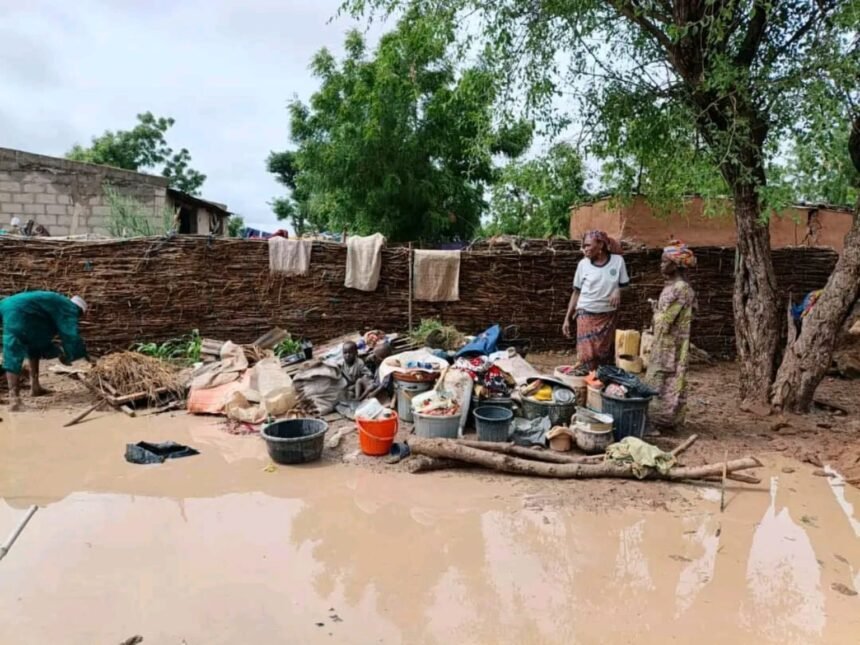
Scores of residents have been displaced and several homes destroyed after heavy flooding swept through communities in four local government areas of Yobe State following hours of intense rainfall, forcing many families to flee their homes and seek temporary shelter.
The flooding affected parts of Damaturu, Nguru, Machina and Bursari local government areas, submerging residential buildings, destroying household property and disrupting normal activities as residents struggled to salvage their belongings from rising floodwaters.
The latest incident has heightened concerns over the impact of seasonal flooding in Yobe, where inadequate drainage infrastructure and changing weather patterns have continued to expose many communities to recurring disasters during the rainy season.
Residents said the floodwaters surged into their homes with little warning, leaving many families with no option but to abandon their residences overnight.
One of the affected residents, Musa Goni, from Nguru, said the disaster overwhelmed entire neighbourhoods, destroying homes and sanitation facilities while leaving many households stranded.
“People watched the water pour into their houses within a short time. Several toilets collapsed and many families could no longer remain in their homes. We urgently need government assistance because the losses are enormous,” Goni said.
He blamed the recurring floods on poor drainage systems, saying the absence of proper channels for rainwater had continued to worsen the situation each year.
“This problem keeps repeating itself because there are no effective drainage channels. Once it rains heavily, the water spreads into residential areas and destroys property. Unless something is done, we will continue to suffer these losses every rainy season,” he added.
Another resident, Auwalu Bukar, from Damaturu, said many victims were forced to spend the night in schools, public buildings and the homes of relatives after floodwaters rendered their houses inaccessible.
“Some families had no choice but to move into schools and other public places, while others sought refuge with relatives. Every rainy season brings the same hardship, and some residents have already abandoned their homes because they can no longer cope,” Bukar said.
He appealed to the state government and humanitarian organisations to provide emergency relief materials, including food, mattresses and temporary shelter for displaced families.
The Yobe State Emergency Management Agency confirmed the incident, saying it had commenced an extensive assessment of the affected communities after receiving reports from local authorities, security agencies and community leaders.
According to the agency, communities already verified as affected include Moduri, Abbari Sabon Kwalta, Malari Sabon Kwalta, Pompomari, Sumsumma and Nayinawa in Damaturu Local Government Area.
Other affected areas are New Side Best Centre along Balanguwa Road and several communities across nine wards in Nguru Local Government Area, Turbangini and Dinani/Lawanti Ward in Bursari Local Government Area, as well as Alhaji Madi Street, Hausari and Machina town in Machina Local Government Area.
SEMA explained that the list covered only communities so far verified by its assessment teams, adding that additional affected locations could be identified as officials continued their field operations.
The agency disclosed that preliminary findings indicated that numerous residential buildings had been damaged, while the total number of displaced persons, affected households and possible casualties was still being compiled.
“The assessment is still ongoing, and verified figures on those affected will be made public after the exercise has been concluded,” the agency said.
It added that a Rapid Assessment Team comprising SEMA officials, local government representatives and trained community volunteers had been deployed to evaluate the scale of destruction and identify immediate humanitarian needs across the affected communities.
The agency urged residents to remain vigilant throughout the rainy season by avoiding flood-prone areas, staying away from fast-flowing floodwaters and keeping clear of damaged electrical installations that could pose additional risks.
SEMA also advised households to maintain proper environmental sanitation to reduce the risk of cholera and other water-borne diseases often associated with flooding.
It further appealed to community members to support displaced families while government intervention and relief efforts were being coordinated.
Yobe has experienced repeated flooding in recent years, with experts attributing many of the incidents to blocked waterways, poor urban drainage systems, rapid population growth and the increasing intensity of rainfall linked to climate change. The recurring disasters have continued to threaten lives, damage infrastructure, disrupt farming activities and worsen the humanitarian challenges facing vulnerable communities.
West Trybe reports that flooding remains one of the most persistent natural disasters affecting communities across Northern Nigeria during the rainy season, with governments increasingly under pressure to strengthen drainage infrastructure, improve early warning systems and expand emergency response mechanisms to reduce the impact on lives and livelihoods.