



Nigeria has recorded the sharpest petrol price increase in Africa in 2026, and one of the highest globally, as a combination of subsidy removal, currency devaluation and Middle East tensions pushed pump prices to record highs.
Data from Global Petrol Prices and the National Bureau of Statistics shows prices rose by 39.5% between February 23 and March 16, 2026, making Nigeria the only African country in the world’s top 20 for fuel hikes during that period.
Sharpest Jump On The Continent
According to InvestorSight citing Global Petrol Prices, Nigeria’s 39.5% surge placed it second globally behind Vietnam, which saw a 50% spike. Laos recorded 32.9%, while Australia and Vietnam each had 31.8%.In Africa, no other country came close. South Africa recorded just a 1.0% increase, Egypt 14.3%, Ethiopia 7.9% and Liberia 4.9%.
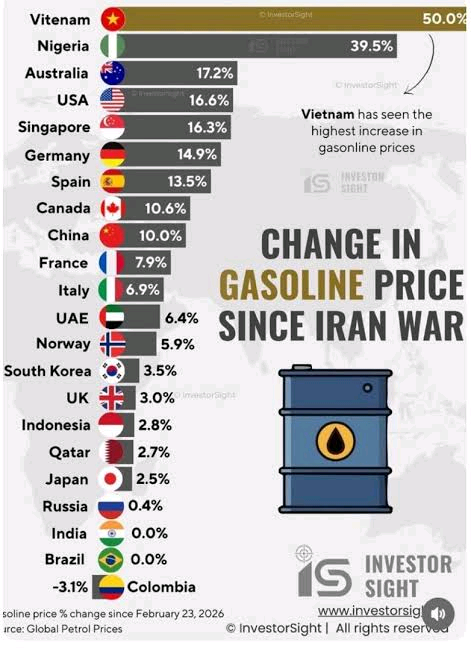
Zawya’s April 2026 ranking listed Nigeria’s average price at N1,215.19 per litre, confirming it as the largest petrol price increase in Africa for the period.“The nearly 40 percent increase in petrol prices reflected this exposure, amplifying inflationary pressures in an already fragile economy where energy costs directly influence transportation, food prices, and overall cost of living”.
From N1,051 To N1,596 In Three Months
The spike accelerated through the year. NBS data shows the average retail price of Premium Motor Spirit rose to N1,532.93 per litre in April 2026, an 18.97% month-on-month increase from N1,288.54 in March.By May 2026, the national average hit N1,596.25 per litre, a 55.31% year-on-year increase from N1,027.76 in May 2025 and a 4.13% rise from April.
State breakdowns show Edo led at N1,722.91, followed by Bauchi at N1,715.47 and Benue at N1,698.57. The lowest was Adamawa at N1,469.83. Regionally, the South-South recorded the highest zonal average at N1,566.76, while the North-West had the lowest at N1,508.81.
Why Prices Are Rising Despite Dangote Refinery
Nigeria remains Africa’s largest crude oil producer, yet it imports most of its refined fuel. That structural gap has left pump prices highly sensitive to global shocks.The 650,000 barrels-per-day Dangote Refinery became fully operational early in 2026 and raised supply by 19% to 40.7 million litres per day in April. However, analysts say its impact has been limited.
Dangote can only source about five crude cargoes a month locally, far short of the 13–15 needed. The rest must be imported at prices driven up by the Iran war and Strait of Hormuz disruptions.
Compounding the problem, much of Nigeria’s 1.5 million bpd production is tied to oil-backed loans and pre-export deals. NNPC obligations are estimated at about 400,000 bpd, meaning less crude is available for local refining.

Subsidy Removal And Naira Devaluation Still Bite
The root of the crisis traces back to May 2023 when President Bola Tinubu announced “the fuel subsidy is gone”. Pump prices immediately jumped from N175 to over N500. The naira float in June 2023 pushed costs above N1,000. By May 2026, prices had risen 643% in three years to between N1,300 and N1,400, and now average N1,596.
The removal of subsidies was meant to free fiscal space and attract investment. But without adequate domestic refining and a strategic fuel reserve, consumers have borne the full impact of global volatility.
Impact On Households And The Economy
The price surge has doubled transport costs on some major routes and is feeding directly into inflation. Headline inflation climbed to 15.69% in April 2026, with food inflation at 16.06%.
Despite the higher prices, consumption rose 10.78% in April to 52.4 million litres per day, from 47.3 million litres in March, according to NMDPRA. Supply from Dangote and imports also rose 10.7% to 44.4 million litres per day.
Experts say the pressure is forcing a shift toward alternatives. A manager with the Presidential Initiative on CNG and EVs noted that charging an EV for 200km costs about N4,500, compared to N22,500 for petrol. Government officials have said they will respond with targeted policy measures rather than price controls, as the Middle East crisis continues to affect global oil markets.
Nigeria’s case highlights a paradox: Africa’s biggest oil producer remains vulnerable to external refined product markets.With subsidy gone, naira deregulated, and global crude benchmarks elevated by geopolitical tensions, the country has recorded Africa’s biggest petrol price rise in 2026. Until local refining capacity fully meets demand and strategic reserves are built, analysts warn that pump prices will remain exposed to international shocks.
For now, Nigerians are paying the price, with fuel at N1,596 per litre and the cost of transport, food and business operations climbing in tandem.