


New data from the Central Bank of Nigeria, CBN, shows the Federal Government’s borrowing from banks accelerated sharply in May 2026, raising concerns about debt sustainability and private sector access to credit.
The Numbers: ₦40.38tn, Up 75.6% Year-on-Year
According to the CBN’s latest monetary and credit statistics, credit to the Federal Government rose to ₦40.38 trillion in May 2026, from ₦22.99 trillion in May 2025. That represents an increase of ₦17.39 trillion, or 75.6% year-on-year.
The borrowing also continued on a monthly basis. Government credit climbed by ₦779.7 billion in just one month, from ₦39.60 trillion in April 2026 to ₦40.38 trillion in May 2026.
What’s Driving It: Treasury Bills and FGN Bonds
CBN data shows banks are channelling significant liquidity into government securities. Analysts say financial institutions have heavily favoured low-risk instruments like Treasury Bills and Federal Government bonds to finance ongoing fiscal operations. This reflects “the government’s increasing reliance on the domestic debt market to fund its fiscal operations”. The shift comes as authorities move away from direct funding from the apex bank toward market-based domestic debt instruments.
Private Sector vs Public Sector: The Crowding-Out Risk
While government borrowing surged, private sector credit grew only modestly. Lending to businesses and households rose from ₦80.59 trillion in April to ₦81.04 trillion in May 2026. In absolute terms, private sector credit remains about twice the size of government borrowing. But economists are warning about the trend. “The banking industry’s increasing inclination for government assets may push out private companies by restricting access to reasonably priced financing, which could impede investment and economic expansion”.
Analysts also caution that the growing appetite for government securities “could crowd out private sector borrowing by reducing access to affordable credit for businesses”.
Rising Debt Pressure in 2026
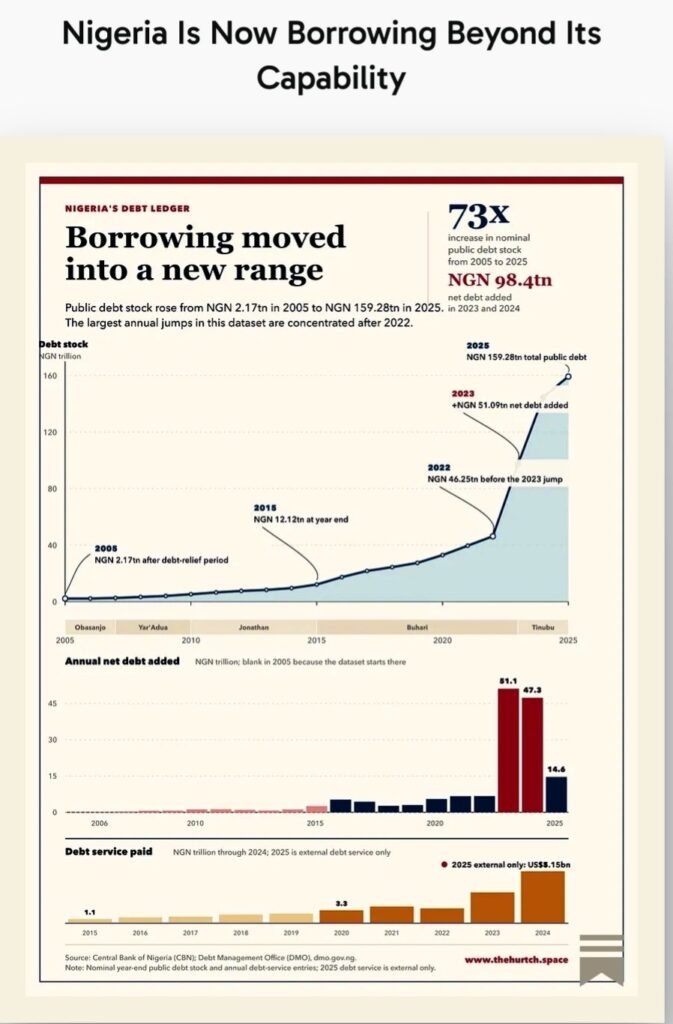
The May surge adds to an already rising debt trajectory this year. The Federal Government increased its domestic borrowing by ₦8.1 trillion in Q1 2026, a 7.4% year-on-year rise from Q1 2025. Analysts attribute this to revenue gaps and fiscal indiscipline, urging the government to cut waste and boost revenue.
The World Bank has also warned that rising debt service is “reducing its ability to fund critical infrastructure”. For 2026, the budget plans to borrow ₦29.2 trillion to fund the deficit, with revenue projected at ₦68.32 trillion against expenditure of ₦36.87 trillion.
CBN’s Monetary Backdrop: Tight Policy, High Rates
The surge comes despite the CBN maintaining a restrictive monetary stance to curb inflation. Analysts note the rapid growth in government borrowing could have implications for liquidity conditions, interest rates, and private sector access to credit. Banks also appear to be preferring government debt because it is seen as less risky. “Where prime borrowers are not largely available in good numbers, banks reprice risks… In the absence of these viable opportunities, banks resort to… CBN’s standing deposit window”.
Bottom Line
As of May 2026, the Federal Government owes banks ₦40.38 trillion, up 75.6% from a year earlier. The increase was driven largely by Treasury Bills and bonds.
While borrowing has helped fund expenditures, economists are monitoring its impact on debt sustainability and private sector growth. With borrowing nearing ₦41 trillion, focus will remain on the government’s fiscal strategy and revenue efforts in the months ahead.