
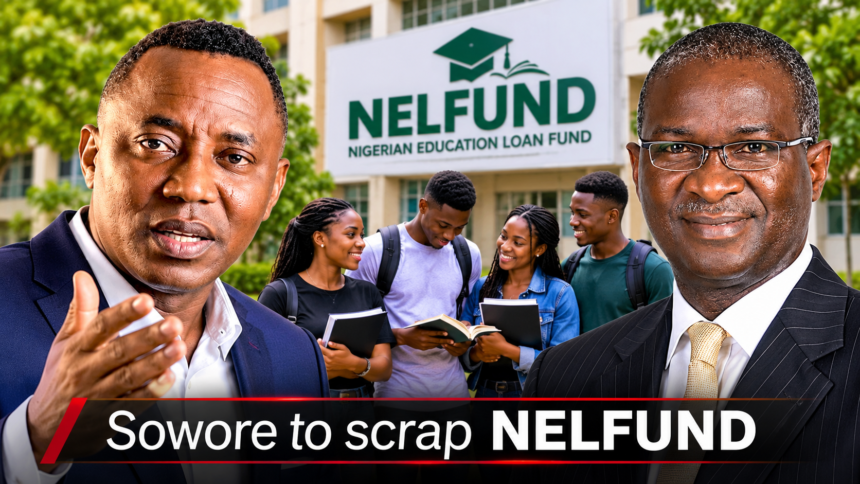
Omoyele Sowore has vowed to abolish the Nigerian Education Loan Fund (NELFUND) and replace it with study grants if elected president in 2027, setting up a fresh debate over how Nigerian students should finance their higher education.
The African Action Congress (AAC) presidential candidate made the declaration on Thursday, November 19, in a Facebook post responding to former Lagos State Governor Babatunde Fashola, who had challenged opposition politicians to openly promise to scrap the student loan programme introduced by President Bola Tinubu’s administration.
Sowore accepted the challenge, but argued that Nigerian students should not have to borrow money to obtain university degrees, insisting that education should be treated as a right rather than a privilege.
Sowore’s NELFUND alternative: Study grants

In his response, Sowore made it clear that his proposed administration would discontinue the existing student loan arrangement and introduce a grant-based education funding system.
He wrote:
“#Sowore2027 will abolish NELFUND’s student loan scheme and replace it with study grants.“For the avoidance of doubt, under an @aacparty-run government, education will be a right, not a privilege, and young Nigerians should not have to mortgage their future to obtain a degree.”
The AAC candidate also criticised government officials for encouraging students to borrow money to finance their education while, according to him, their own children attend expensive schools abroad using proceeds of public funds allegedly stolen from Nigerians.
“We reject the peonage they package as student loans. Our commitment is clear: study grants and publicly funded education,” he added.
His proposal therefore goes beyond removing NELFUND. It places publicly funded education and financial grants at the centre of his proposed alternative.
However, Sowore’s statement did not provide details of the proposed grant system, including its funding arrangements, eligibility requirements, coverage or how much individual students would receive.
Why Fashola challenged opposition candidates

The disagreement followed comments by Fashola during an appearance on Channels Television’s Politics Today programme on Tuesday, November 17.
The former governor defended NELFUND as one of the interventions introduced by the Tinubu administration to reduce the financial pressure on Nigerian households.
According to him, the programme was established to help families manage competing expenses, including rent, transportation, healthcare and education.
Fashola argued that students and their families who benefit from the scheme would have a reason to consider its continuation when making political decisions.
He challenged opposition candidates to openly campaign against the initiative.
“I challenge the opponents to promise to scrap NELFUND and see how beneficiaries and their families react. They won’t dare,” he said.
Sowore’s response has now brought the question Fashola raised directly into the 2027 presidential campaign conversation: whether the existing student loan arrangement should continue or be replaced with another funding model.
What Nigerians should know about NELFUND
NELFUND was established under the Students Loans (Access to Higher Education) Act, which was signed into law by President Tinubu in April 2024.
The initiative was introduced to provide eligible Nigerian students with interest-free loans to cover institutional charges and upkeep expenses while pursuing higher education.
According to the fund’s official website, payments for approved institutional charges are made directly to the student’s institution, while approved upkeep payments are transferred to the student’s designated bank account.
Although the loans are interest-free, they are not automatically grants or scholarships. Beneficiaries are expected to repay the money under the programme’s conditions.
NELFUND’s published loan terms state that beneficiaries who participate in the National Youth Service Corps (NYSC) are expected to begin repayment two years after completing their service.
The terms also provide for deductions of 10 per cent of a beneficiary’s monthly salary once repayment becomes due.
This distinction is central to the disagreement between Sowore and Fashola. While the current programme provides financial assistance through repayable loans, Sowore is proposing grants that would not place the same repayment obligation on students.
What Sowore’s 2027 promise means for students

Sowore’s declaration introduces an important education policy question ahead of the 2027 presidential election, particularly for students who depend on government assistance to meet the cost of tertiary education.
Under his proposal, the government would move away from the existing loan arrangement towards study grants and publicly funded education.
However, the practical details remain unclear. Sowore has yet to explain how the proposed grants would be financed, whether they would cover tuition alone or include living expenses, and whether all students in public tertiary institutions would qualify.
Another question concerns existing NELFUND beneficiaries. His announcement does not explain what would happen to loans already disbursed or repayment obligations incurred before any possible policy change.
The proposal would also require more than a presidential declaration to dismantle the existing legal framework. The Students Loans Act provides the statutory foundation for NELFUND, meaning any decision to replace the programme would have to address the law governing its operations.
With Sowore listed by the Independent National Electoral Commission (INEC) as the AAC presidential candidate for the January 2027 election, his position adds a specific education financing proposal to the campaign debate.
For Nigerian students and their families, the issue is no longer simply whether NELFUND should remain. It is also whether government-backed study grants can provide a sustainable alternative to borrowing for higher education.