

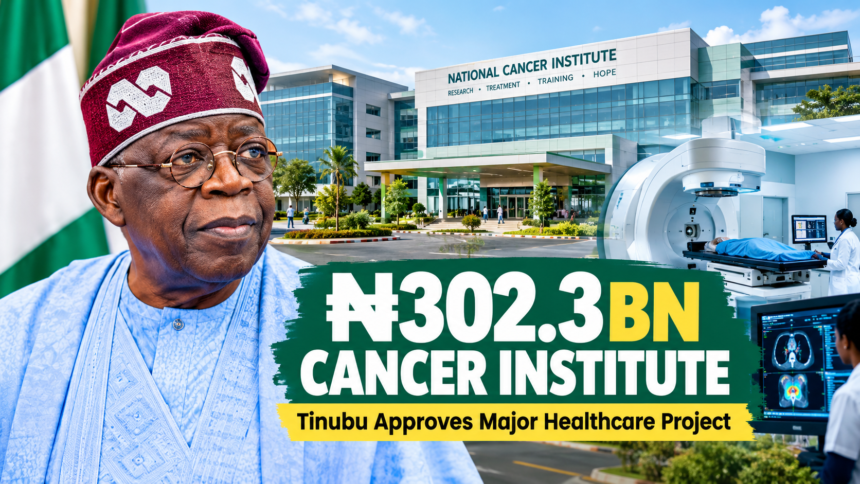
National Cancer Institute funding: President Bola Tinubu has approved about ₦302.3 billion for the construction, furnishing and equipping of a flagship cancer institute aimed at strengthening cancer research, diagnosis and treatment in Nigeria.
National Cancer Institute funding has received a major boost under President Bola Ahmed Tinubu, with the Federal Government approving about ₦302.3 billion for the construction, furnishing and equipping of a flagship facility expected to reshape cancer care in Nigeria.
The approval was made by the Federal Executive Council (FEC), with the project covering the design, construction, furnishing, equipping, supervision and commissioning of the proposed National Cancer Institute. The development has been welcomed by the National Institute for Cancer Research and Treatment (NICRAT), which described the project as a major step forward for the country’s fight against cancer.
National Cancer Institute funding targets a major healthcare gap
The scale of the investment comes against the backdrop of Nigeria’s continuing cancer burden and longstanding challenges in accessing specialised treatment.
NICRAT, the federal agency responsible for providing national leadership in cancer research, treatment and control, says its mandate includes improving cancer care, supporting research and development, maintaining cancer registries, promoting public awareness and developing capacity among healthcare professionals.
The agency was established under the National Institute for Cancer Research and Treatment Act 2017 to coordinate a more comprehensive national response to cancer. Its responsibilities cover not only treatment but also prevention, research, policy development and efforts to improve access to cancer services.
That broader role is important because a modern cancer system requires more than individual hospitals. It depends on early detection, accurate diagnosis, specialised treatment, research, trained personnel, reliable cancer data and long-term follow-up care.
₦302.3 billion project expected to strengthen cancer care
According to reports on the FEC approval, the ₦302.3 billion allocation is not limited to putting up a building. The approved project includes construction, furnishing, medical equipment, supervision and commissioning.
NICRAT has presented the planned institute as part of President Tinubu’s healthcare agenda and says Nigeria is set to build what it describes as West Africa’s largest and best-equipped cancer institute. The agency’s leadership has also described the approval as a “game changer” for cancer care in the country.
If fully delivered, such a facility could give Nigeria a stronger national platform for specialised oncology services while also supporting research and professional training. The significance goes beyond the proposed institute itself.
Cancer treatment often requires several areas of expertise working together, including oncology, surgery, radiology, pathology, nuclear medicine and other specialised services. Bringing more of these capabilities into a coordinated national centre could help improve the way patients are diagnosed and treated.
Why the cancer investment matters to Nigeria
Cancer remains a major health challenge worldwide, with the World Health Organization identifying it as one of the leading causes of death globally. NICRAT notes that low- and middle-income countries carry a particularly heavy share of cancer deaths.
Nigeria has also faced significant gaps in cancer infrastructure and access to specialised care. NICRAT’s own published information highlights the country’s need for stronger prevention, early detection, treatment and research systems.
For patients and their families, the availability of advanced cancer services closer to home can make a major difference. Treatment can be financially and emotionally demanding, particularly when patients have to travel long distances or seek specialised care outside Nigeria.

The proposed institute therefore represents an attempt to address infrastructure at the national level rather than relying solely on scattered cancer services.
Research and training form part of the bigger picture
The National Cancer Institute is also expected to have significance beyond clinical treatment.
NICRAT’s stated objectives include research and development in cancer prevention and control, cancer registry management, public education and awareness, resource mobilisation and capacity development.
The agency has already been pursuing partnerships and programmes aimed at strengthening research, clinical trials, cancer data and professional capacity. Its recent activities include collaboration on cancer research and technology transfer, training for cancer registry personnel, and efforts to improve early detection and cancer services across Nigeria.
A flagship national facility could provide a central base for expanding those efforts.
For Nigeria, that matters because better cancer outcomes depend heavily on catching diseases earlier, understanding patterns of cancer through reliable data and ensuring that medical professionals have access to modern equipment and training.

From approval to impact
The ₦302.3 billion approval is a significant policy and financial commitment, but the real test will come with implementation.
The project still has to move from approval through construction, procurement, installation of equipment, staffing and eventual commissioning. How quickly those stages are completed will determine when Nigerians begin to see the practical benefits of the investment.
There will also be an ongoing need to ensure that the facility remains properly equipped and staffed after construction. Cancer care involves expensive technologies, highly trained professionals and continuous investment in research and maintenance.
For now, however, the Federal Government’s approval marks an important development in Nigeria’s cancer-control efforts.

With NICRAT already tasked with coordinating cancer research, treatment and control nationally, the proposed institute could become a central pillar of that mandate if the project is delivered as planned.
The ₦302.3 billion commitment therefore carries expectations beyond the construction of another medical facility. It is a test of whether Nigeria can turn a major healthcare investment into improved diagnosis, better treatment, stronger research and greater access to specialised cancer care for patients across the country.