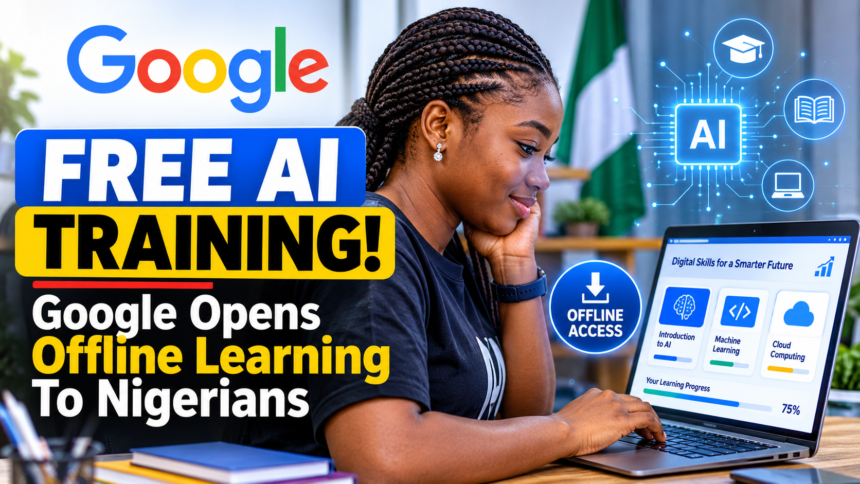
Google’s free offline AI training platform is now available to Nigerians, giving students, job seekers, entrepreneurs and technology enthusiasts an opportunity to acquire valuable digital skills without paying course fees or depending on continuous internet access.
The initiative, known as Skilling Africa with Google, was launched on Monday, November 2, 2026, as part of Google’s wider effort to equip three million people across Africa with digital and artificial intelligence skills by 2030.
Unlike conventional online learning platforms that require users to remain connected throughout their lessons, Google’s new learning hub allows participants to download selected learning materials over Wi-Fi and continue studying offline.
The development could make digital education more accessible to people who struggle with expensive mobile data, inconsistent internet connections and limited access to advanced devices.
Google Brings Over 15 Training Programmes Together

One of the major features of Skilling Africa with Google is its decision to bring more than 15 existing Google training initiatives into one learning platform.
Rather than requiring learners to search through different programmes, the company has created a central destination where users can explore courses across several areas of technology, business and professional development.
According to Google’s official announcement, the platform includes Google Career Certificates, Hustle Academy and Google Cloud Skills.
Google Career Certificates provide professional training in areas such as information technology support, data analytics and cybersecurity.
Hustle Academy focuses on helping small and medium-sized business owners develop their businesses, improve resilience and acquire relevant entrepreneurial skills.
Meanwhile, Google Cloud Skills provides technical learning opportunities for developers and IT professionals interested in cloud computing and building scalable technology solutions.
Other learning areas available through the platform include artificial intelligence, cloud architecture, entrepreneurship and career development.
This range means the initiative is not restricted to people who already have technical backgrounds. Students, business owners and individuals exploring new career opportunities can also find relevant learning pathways.
How Nigerians Can Learn AI Skills Offline
The offline learning feature is one of the most significant aspects of Google’s new initiative, particularly in countries where internet access remains expensive or unreliable.
Google explained that users can download short lessons whenever they have access to Wi-Fi and complete the learning modules later without requiring an active internet connection.
In its announcement, the company stated: “Download short lessons when connected to Wi-Fi, then complete modules entirely offline without using mobile data.”
This arrangement could benefit Nigerians who cannot afford to purchase mobile data regularly but still want to develop skills that can improve their employment and business opportunities.
The platform also features a lightweight design intended to load quickly under different network conditions.
Google said it was developed to work across devices, including entry-level smartphones and desktop computers.
Another advantage is that learners do not need to download a separate application from an app store. They can access the learning hub through a web browser and sign in using their Google accounts.
Google Introduces SCOUT, an AI-Powered Study Companion
Beyond providing access to courses, Google has incorporated an artificial intelligence-powered learning assistant called SCOUT.
The name stands for Smart Companion for Online Understanding and Training.
SCOUT is designed to support learners throughout their educational journey by answering questions, explaining unfamiliar concepts, recommending what to study next and helping users organise their learning schedules around individual goals.
The feature introduces a more interactive learning experience, allowing participants to receive additional guidance instead of simply progressing through course materials independently.
Google is also incorporating gamification features to encourage consistency.
Through interactive skill trees and learning streaks, participants can monitor their progress, recognise completed milestones and earn verifiable badges as they develop their abilities.
These badges can serve as evidence of completed learning programmes and may be shared with prospective employers or clients.
However, learners should distinguish between completing a course and obtaining a professional qualification. The recognition attached to each programme will depend on its specific certification requirements.
Google’s Target: Three Million Africans by 2030

The launch forms part of Google’s broader ambition to strengthen Africa’s participation in the global digital economy.
According to the company’s announcement, the initiative aims to equip three million people across the continent with digital and AI skills by 2030.
Google also disclosed that more than seven million young Africans had previously completed its foundational digital skills training programmes.
Managing Director for Africa, Alex Okosi, said the continent had considerable opportunities in the artificial intelligence sector but needed more people with the technical knowledge to participate.
He stated: “Africa stands on the threshold of a massive transformation.”
Google’s announcement also highlighted a significant shortage of AI-ready professionals across the region, identifying the skills gap as one of the obstacles limiting the continent’s ability to benefit fully from artificial intelligence.
The new learning hub is intended to help address that challenge by bringing training opportunities closer to people who might otherwise struggle to access them.
How Nigerians Can Access Google’s Free Learning Platform

Nigerians interested in developing their digital skills can visit Google’s official learning hub at skillingafrica.withgoogle.com.
The platform is free and open to everyone, including students, job seekers, entrepreneurs and technology professionals.
Users can sign in with their Google accounts, explore available learning pathways and select courses that match their interests and career objectives.
For offline learning, participants should first connect to Wi-Fi and download the lessons they intend to study before disconnecting from the internet.
The platform currently provides learning support in English, Swahili and Arabic, while Google says additional African languages, including Hausa, are being introduced to make its programmes accessible to more people.
With artificial intelligence increasingly influencing education, business, communication and employment, access to practical digital training could become an important advantage for young Nigerians.
Google’s new initiative does not automatically guarantee employment or business success, but it provides another opportunity for people to develop relevant skills without paying for access to the learning platform.
For Nigerians interested in technology, entrepreneurship and the changing demands of the workplace, the opportunity to learn without worrying about continuous data consumption could make a meaningful difference.