


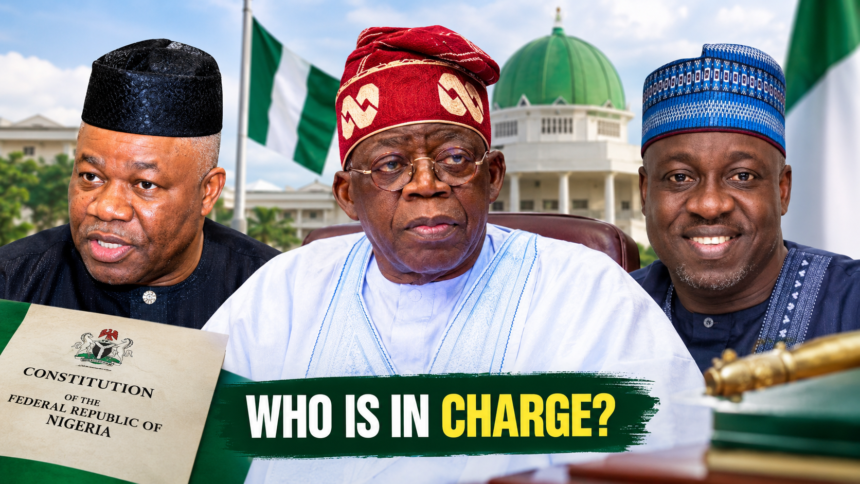
Tinubu absence sparks fresh debate as Senate President Godswill Akpabio insists President Bola Tinubu remains in charge, while the ADC questions compliance with Section 145 on presidential power transfer.
Tinubu absence has triggered a fresh political and constitutional debate as Senate President Godswill Akpabio insists President Bola Tinubu remains in charge, while the African Democratic Congress (ADC) questions whether the constitutional procedure for transferring presidential functions was followed.
The debate intensified after Tinubu extended his stay in Europe beyond the three-week working vacation originally announced by the Presidency. The President left Nigeria on August 30 and is now expected to return at the weekend.
Akpabio says Tinubu remains in charge
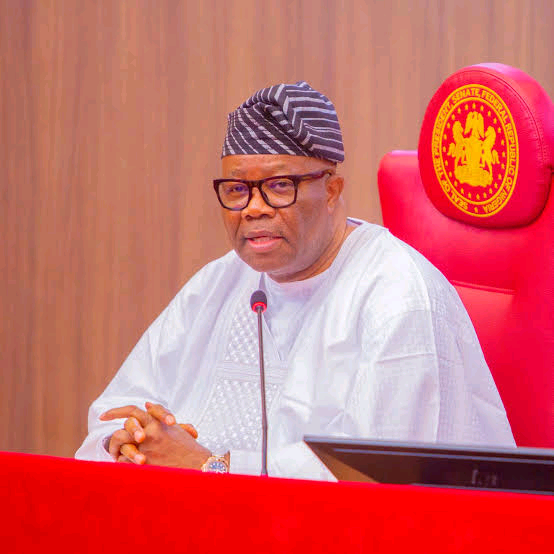
Akpabio addressed the controversy on Tuesday in Akwa Ibom State, where he rejected suggestions that Nigeria currently has a leadership vacuum or that he had assumed the position of Acting President.
The Senate President said Tinubu was still in power and continued to direct the affairs of the country despite being outside Nigeria.
According to Akpabio, modern technology allows the President to remain involved in government business while abroad. He pointed to Tinubu’s recent diplomatic engagements and said the President remained in contact with officials at home.
Akpabio also stressed that he was not acting President and that there was no vacancy in the presidency.
His comments came as questions continued to grow around the simultaneous absence of Tinubu and Vice-President Kashim Shettima.
Shettima left Nigeria on September 20 to represent the President at the 81st United Nations General Assembly in New York.
Tinubu’s extended vacation raises fresh questions
Tinubu initially travelled to London on August 30 for what the Presidency described as a three-week working vacation. He later moved to Paris, where he held meetings, including an engagement with French President Emmanuel Macron and businessman Vincent Bolloré.
On September 21, the Presidency announced that Tinubu had extended his stay by a few days and would return to Nigeria at the weekend.
Special Adviser to the President on Information and Strategy, Bayo Onanuga, said Tinubu had remained in touch with developments in Nigeria and continued directing government affairs while abroad.
The Presidency also said the President had delegated Shettima to represent him at some official functions. With Shettima now in New York, Secretary to the Government of the Federation George Akume has continued to represent Tinubu at some events in Nigeria.
That arrangement has become a central part of the political argument over whether the President’s continued absence requires a formal transfer of presidential functions.
What Section 145 says about presidential absence

At the centre of the controversy is Section 145 of the 1999 Constitution.
The provision states that when a President proceeds on vacation or is otherwise unable to discharge the functions of his office, the President is to transmit a written declaration to the President of the Senate and the Speaker of the House of Representatives.
Until the President transmits a further declaration that he is available to resume his duties, the Vice-President is to perform the functions of the President as Acting President.
The Constitution also provides a further mechanism where the President is unable or fails to transmit the required declaration within 21 days. In that situation, the National Assembly may, by a simple majority vote in each chamber, mandate the Vice-President to perform the functions of the President as Acting President.
The provision therefore makes the written declaration an important part of the constitutional process surrounding a President’s temporary inability or decision to proceed on vacation.
ADC demands clarification over power transfer

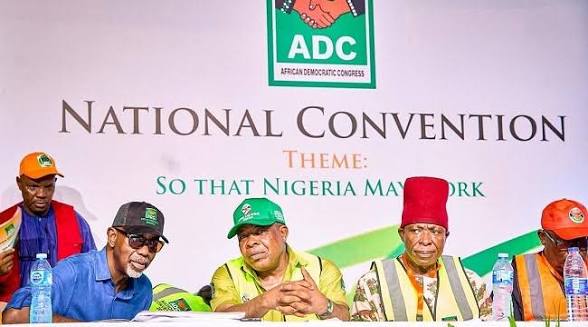
The African Democratic Congress has seized on that provision to demand clarity over the status of presidential authority.
The party’s National Publicity Secretary, Bolaji Abdullahi, questioned whether Tinubu transmitted the required written declaration before or during his absence.
The ADC argued that the issue is not simply whether Tinubu can communicate with officials from another country, but whether the constitutional procedure governing the exercise of presidential functions during an absence has been followed.
The party also questioned the role of the SGF in representing the President at official engagements, arguing that attending ceremonies or delivering messages on behalf of the President is different from constitutionally exercising presidential powers.
Former Vice-President Atiku Abubakar, who is the ADC’s 2027 presidential candidate, has also raised questions about the matter and called for clarification over who is exercising presidential authority while both Tinubu and Shettima are abroad.
Has Tinubu transmitted a written declaration?
This remains one of the central unanswered questions in the current dispute.
A Premium Times investigation published earlier in September contacted officials in the Presidency and National Assembly about whether Tinubu had transmitted the declaration required under Section 145.
The publication reported that the officials contacted did not independently confirm that such a declaration had been transmitted. Onanuga reportedly declined to say whether the President had sent the document, while other officials said they did not have information confirming its existence. Premium Times consequently said it could not independently establish whether Tinubu had formally notified the National Assembly.
That uncertainty has now become a major part of the political argument.
The Presidency’s position remains that Tinubu has continued to direct the affairs of government from abroad, while Akpabio has publicly backed the position that there is no vacancy in the presidency.
The ADC, meanwhile, is asking for clarity on whether the constitutional procedure was followed.
The debate now centres on constitutional procedure
The disagreement is therefore less about whether Tinubu remains the elected President and more about how presidential functions should operate during an extended absence.
Section 145 specifically addresses vacations and situations in which the President is unable to discharge his functions. It also provides a procedure involving the Vice-President and, after 21 days in certain circumstances, the National Assembly.
For now, Tinubu remains abroad and the Presidency says he is expected back in Nigeria at the weekend. Until there is clearer public confirmation of whether the required written declaration was transmitted, the constitutional question raised by the ADC is likely to remain part of the wider debate over the President’s extended absence.
Akpabio’s position is that there is no leadership vacuum and that Tinubu remains firmly in charge. The ADC’s position is that Nigerians deserve clarity on whether the constitutional requirements for presidential absence were followed.
The disagreement now puts Section 145 at the centre of renewed public attention as Nigeria awaits Tinubu’s return.