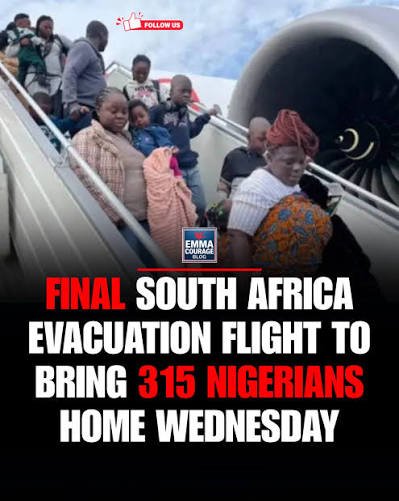
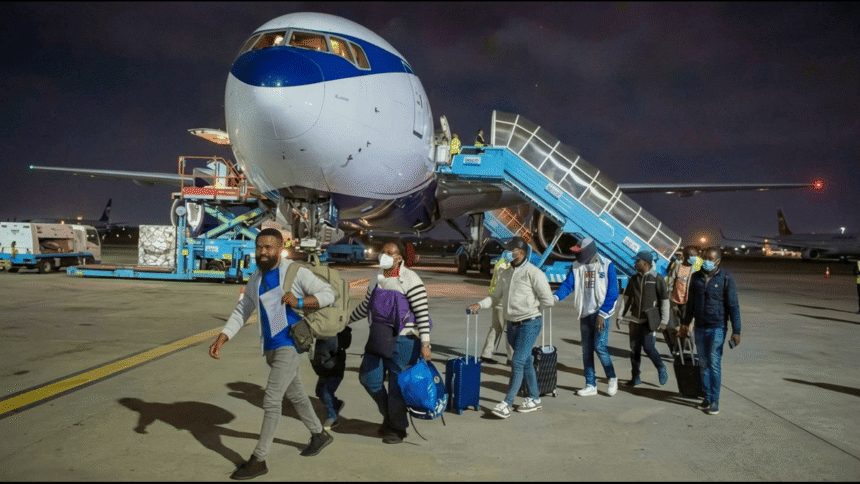
Three hundred and eight Nigerians touched down at Murtala Muhammed International Airport, Lagos, at 11:30 a.m. on Wednesday, bringing Nigeria’s total evacuation count from South Africa to over 1,500 and formally closing one of the federal government’s most urgent humanitarian operations in recent memory.
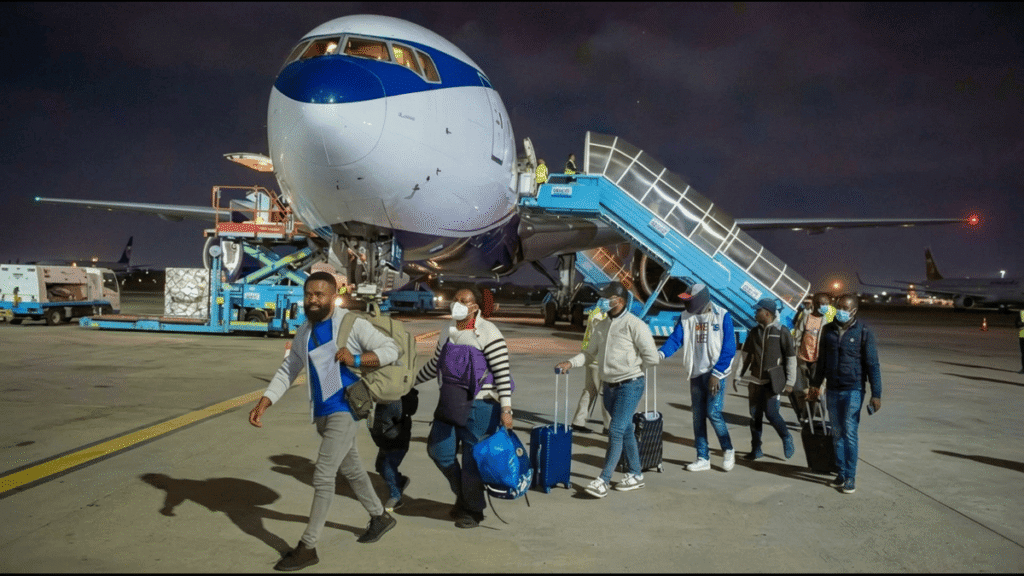
The final Air Peace flight had lifted off from O.R. Tambo International Airport in Johannesburg at 6:30 a.m. South African time. It carried 305 returnees and three Nigerian government officials who had coordinated operations on the ground in Johannesburg throughout the evacuation exercise.
TVC News footage captured the moment the aircraft doors opened. Dozens of passengers, women, children, and whole families gripping luggage, filed down onto the tarmac and into the arms of waiting airport personnel. Many looked drained but composed.
Minister of State for Foreign Affairs, Ambassador Bianca Odumegwu-Ojukwu, broke the news Wednesday morning on her verified X handle. “The last federal government-sponsored flight conveying our nationals home from South Africa as a result of the xenophobic protests and attacks on Black migrants that have engulfed that country departed Oliver Tambo International Airport, Johannesburg, this morning,” she wrote.
She placed the total figure above 1,500. The Ministry of Foreign Affairs, for its part, disclosed a figure of 1,490 Nigerian nationals evacuated across five phases of the voluntary program. But Odumegwu-Ojukwu’s personal statement rounded it higher: “Over 1,500 nationals have been evacuated.”
Other Nigerians were left stranded, their shops looted, their livelihoods erased almost overnight by South African citizens who turned on foreign nationals living in their communities. And many had nowhere to go and no resources left to leave on their own.
Air Peace flew the first batch of 258 Nigerians out on June 10. South African Airways followed on June 24 with 66 returnees. Air Peace then operated consecutive flights: 272 Nigerians on June 30, 268 on July 2, 282 on July 9, and Wednesday’s final 305 on July 15.
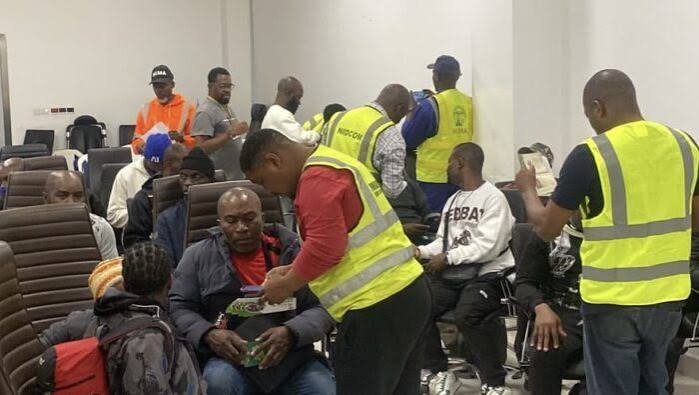
South African Airways also flew 39 Nigerians home on July 11.
All primary Air Peace flights operated on the airline’s Boeing 777-200 wide-body aircraft. Spokesperson Efe Osifo-Whiskey confirmed the carrier “safely repatriated 1,085 Nigerians across four humanitarian evacuation flights, having previously evacuated 262 Nigerians on June 11, 271 on June 30, 268 on July 3, and 284 on July 9.
President Bola Tinubu had approved an extension of the exercise beyond its initial June 30 deadline after anti-migrant groups and vigilantes in South Africa issued an ultimatum of the same date, a deadline the Federal Government effectively ignored, pressing on with flights into July.
Odumegwu-Ojukwu credited him directly.
“His extension of the evacuation exercise even beyond the June 30 deadline issued by anti-migrant groups in South Africa speaks volumes about his unwavering commitment to the welfare of our nationals in crisis situations,” she stated in her Wednesday post.
That extension made Wednesday’s final flight possible.
The Ministry of Foreign Affairs coordinated the operation in collaboration with the Nigerian High Commission in Pretoria, the Nigerians in Diaspora Commission, NEMA, the Nigeria Immigration Service, the Federal Airports Authority of Nigeria, and Port Health Services.
It was a sprawling inter-agency structure that processed each batch from touchdown to transit.
The federal government confirmed plans to seek that compensation for Nigerians forced to leave behind businesses, vehicles, and other valuable assets while fleeing the violence. Yet no timeline for the process was provided.
The human cost registered clearly among those who made it back. A 49-year-old returnee from Edo State who had lived in South Africa for eleven years told of being attacked by gun-wielding South Africans on a prior occasion.
Another returnee, who asked not to be named, described life there as one of constant fear.
Most came home because they had no other choice left.
Wednesday’s closure of the airlift marks the formal end of the emergency response phase. But past crises, deadly riots in 2008, and renewed attacks in 2015 and again in 2019 have repeatedly strained ties between Africa’s two largest economies, and the broader questions of compensation and diplomatic accountability remain very much unresolved.
The Ministry of Foreign Affairs urged Nigerians living abroad to obey the laws of their host countries and to register with Nigerian diplomatic missions in their areas of residence.