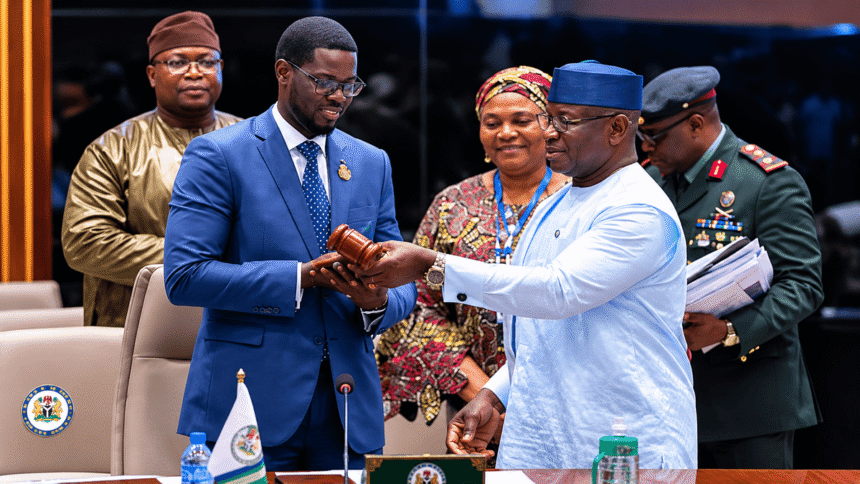
Senegal’s President Bassirou Faye wins the ECOWAS chairmanship at the 69th summit in Sierra Leone, succeeding Julius Maada Bio as the bloc battles a 3-nation withdrawal crisis.
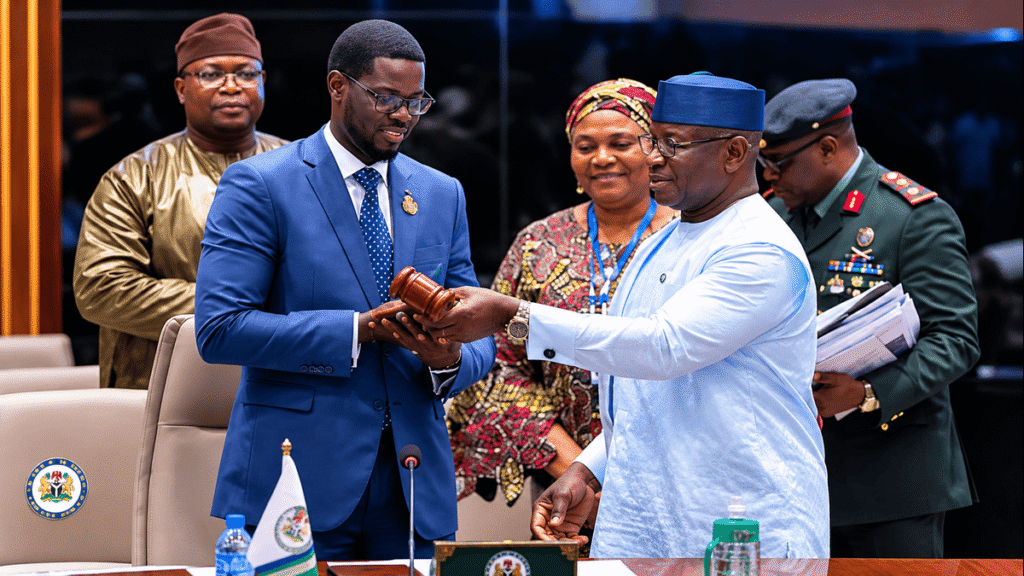
Faye emerged as the new chairman of the ECOWAS Authority of Heads of State and Government during the 69th Ordinary Session of the Authority, held in Sierra Leone on Sunday.
His election places Senegal at the center of the most consequential period in the regional body’s recent history.
Faye succeeds his Sierra Leonean counterpart, Julius Maada Bio, who had assumed the ECOWAS chairmanship when President Bola Tinubu’s two-term leadership of the bloc ended in June 2025. Bio held the position for approximately one year before Sunday’s handover.
Tinubu formally transferred leadership to Bio at the 67th Ordinary Session of the Authority, held in Nigeria’s capital, Abuja. That transition closed a notable chapter in Nigeria’s influence over the West African bloc.
Aged 46, Faye assumes the rotating chairmanship at a period described as critical for the regional body, which is grappling with insecurity, democratic challenges, and strained relations with three member states that recently exited the organization.
The scale of those departures has no recent precedent in ECOWAS history.
One of the most immediate issues expected to define Faye’s tenure is sustained diplomatic engagement with Mali, Burkina Faso, and Niger, which withdrew from ECOWAS following disagreements over sanctions and the bloc’s response to military takeovers in those countries.
Rebuilding those relationships will require consistent pressure and patience from the new chair.
As gathered by Westtrybe, the Punch reported that Faye takes office at a particularly challenging moment, with the regional organization grappling with worsening security challenges, democratic backsliding, and the continued withdrawal of Mali, Burkina Faso, and Niger from the bloc.
At 46, Faye becomes one of the youngest leaders to chair the regional organization, a development that has raised expectations for renewed efforts towards institutional reforms, democratic governance, accountability, youth inclusion, and economic integration across member states.
His election also places Senegal at the center of major diplomatic engagements and strategic policy decisions affecting West Africa. No other West African state holds that dual weight of the chairmanship and a commission appointment simultaneously at this juncture.
Biram Diop was appointed the new president of the ECOWAS Commission at the summit, replacing Dr. Omar Touray. The appointment signals a broader reset of the bloc’s executive leadership at a time when institutional credibility remains under scrutiny.
General Birame Diop, Senegal’s former Minister of the Armed Forces, was elected President of the ECOWAS Commission for the 2026 to 2030 term, marking the first time Senegal has secured the commission’s top executive position since ECOWAS was established in 1975.
Yet the appointments come as the bloc’s membership base remains contracted. Terrorism, violent extremism, military coups, and political instability continue to threaten peace and regional integration across West Africa, according to reporting on the summit. The organization Faye is now chairing is smaller than it was, and the conditions that drove that contraction have not resolved themselves.
Faye will need to navigate all of these simultaneously from his first days in the chair. There is no grace period built into the role. The challenges predate his assumption of the chairmanship and will demand his attention before the transition has fully settled.
With the transition completed, Faye is now expected to steer the affairs of the 15-member regional organization over the coming year while addressing some of the most significant challenges facing the sub-region. Holding a bloc together under those conditions requires more than administrative competence. It requires political persuasion and a willingness to engage member states whose priorities do not always align.
Whether the bloc’s reform agenda advances will depend heavily on how quickly he moves to build consensus among the remaining member states. Consensus in a body this size, facing pressures this varied, is rarely quick and rarely clean. The pace at which Faye pursues it will say as much about his leadership style as any formal policy position he adopts.