


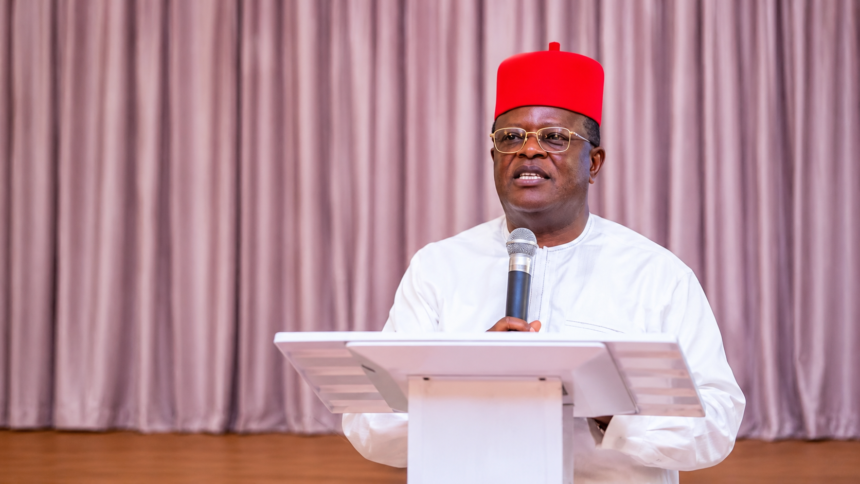
Twenty-one retired staff of the Federal Ministry of Works have petitioned the Minister of Works, Senator David Umahi, over the non-payment of their repatriation allowances, alleging that thousands of former employees who left the ministry between 2023 and 2024 are yet to receive the statutory entitlement despite years of service.
The retirees, who described the prolonged delay as a source of severe hardship, appealed to the minister to urgently intervene and facilitate the payment of the outstanding benefits, insisting that repatriation allowance is a legal entitlement under the Public Service Rules and not a discretionary reward.
Their appeal was contained in a petition dated July 15, 2026, and received at the Office of the Minister on July 26, 2026. A copy of the petition was made available to journalists on Sunday.
The petition was signed by the leader of the group, Engr. Mohammed Katun, a former Assistant Director who retired from the ministry on October 9, 2024.
The retirees stated that although the petition was signed by 21 former employees, their plight reflects that of more than 5,000 workers who have retired from the ministry since 2023.
According to them, only a very small number of retirees, mostly those who served at the ministry’s headquarters, have received their repatriation allowances, leaving the overwhelming majority without the benefits due to them.
Part of the petition read, “We, the undersigned, retired from the Federal Ministry of Works between 2023 and 2024 after years of meritorious service to our fatherland.”
It continued, “We wish to respectfully bring to your attention that for over three years now, no retiree from the Federal Ministry of Works has been paid repatriation allowances as provided under Public Service Rules, PSR 042201, except a few staff at the headquarters.”
The retirees argued that the continued delay had subjected many of them to financial difficulties at a time they were expected to enjoy the rewards of long years of public service.
“This non-payment has caused us severe hardship in our old age despite having served Nigeria diligently. Repatriation allowance is a statutory entitlement, not a privilege,” the petition stated.
They therefore appealed to Umahi to use his office to address the situation without further delay.
“We therefore humbly request your urgent intervention to approve and direct payment of our repatriation allowances with arrears,” they added.
The petitioners further claimed that from 2023 to date, more than 5,000 workers had retired from the ministry, but less than one per cent had reportedly received the allowance.
They expressed confidence that the minister would give the matter urgent attention.
“We trust that you will treat this petition with the urgency it deserves,” the retirees stated.
The petition also indicated that the Director of Human Resource Management, Aliyu Abdullahi, acknowledged and signed the acceptance of notifications of their retirement letters, suggesting that all retirement processes had been duly completed.
Repatriation allowance is provided for under the Public Service Rules to assist retiring public servants with transportation and relocation expenses after leaving service. The retirees argued that withholding the benefit for years defeats its purpose and places unnecessary financial burdens on former workers, many of whom now depend solely on their pensions.
The development comes amid growing concerns by retired public servants over delays in the payment of retirement benefits across several government institutions. Labour advocates have repeatedly argued that timely payment of statutory entitlements is essential to protecting the welfare and dignity of retirees who devoted decades of service to the country.
West Trybe reports that delays in the payment of retirement benefits have remained a recurring challenge in parts of Nigeria’s public service, with pensioners and retirees frequently calling on the Federal Government to ensure prompt settlement of all statutory entitlements as part of broader efforts to strengthen workers’ welfare and restore confidence in the civil service.