


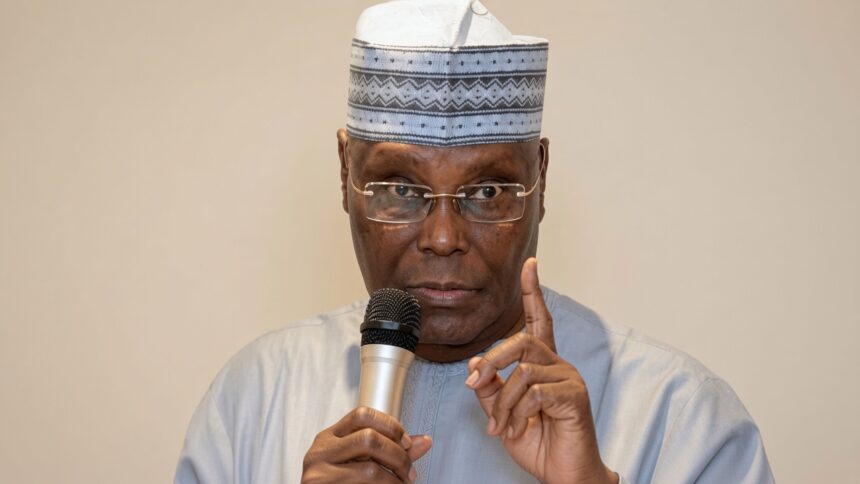
Former Vice-President Atiku Abubakar has insisted that he will reverse the removal of petrol subsidy if elected President in 2027, saying Nigerians should not continue to bear the full burden of rising energy and living costs.
Atiku said his proposed intervention would provide targeted relief to households, farmers and businesses while supporting domestic production and restoring the purchasing power of Nigerians.
The presidential candidate of the African Democratic Congress restated his position on Tuesday in a statement posted on his verified X account, saying his commitment to reversing the subsidy removal remained unchanged.
“On the question of subsidy, my position has not changed and will not change: I will restore it!” Atiku said.
He argued that Nigeria’s natural resources should enable the government to cushion the impact of economic hardship on citizens rather than expose them to increasing costs of transportation, food and other essential commodities.
“A nation as blessed as ours has no business abandoning its citizens to hardship. Nigeria is rich enough to look after her own,” he said.
Atiku said the strength of an economy should be measured by the purchasing power of its citizens rather than by the amount of revenue collected by government.
“I believe the wealth of a nation is not measured by how much government collects, but by how much the money in the pockets of its people can buy,” he said.
According to the former Vice-President, his proposed subsidy policy would be part of a broader economic programme aimed at reducing the cost of living, strengthening domestic production and making wages more valuable.
He said farmers were among those heavily affected by rising fuel prices because the cost of transporting agricultural produce from farms to markets had increased.
“I want wages to have value again. I want farmers to move produce without transport swallowing their profits. I want families to fill their baskets without emptying their pockets,” Atiku said.
He also linked petrol prices to the rising cost of transportation and food, describing the relationship as a major driver of the economic hardship experienced by households.
“When fuel rises, transport rises. When transport rises, food rises. When food rises, families suffer,” he said.
Atiku vowed to break what he described as a cycle of rising costs under the current administration if given the mandate to govern in 2027.
“I will break that wretched chain that has defined our national life in the nearly four years of Tinubu’s presidency,” he said.
However, the former Vice-President said his proposed intervention would not amount to a return to what he described as the abuses and distortions associated with the previous subsidy regime.
“I will not restore the import racket; I will restore relief,” Atiku said.
He said the proposed targeted subsidy would focus on easing pressure on consumers while simultaneously encouraging domestic production and reducing energy costs for businesses.
According to him, businesses would be better positioned to increase production, expand operations and create jobs if energy costs were reduced.
Atiku said his administration would seek to strengthen the purchasing power of Nigerians while ensuring that economic policies translated into tangible improvements in household welfare.
The former Vice-President made the renewed pledge while receiving the Osun State leadership of the ADC in Abuja on Tuesday, as the party continues preparations for the 2027 presidential election.
His comments come amid an increasingly prominent political debate over the future of petrol subsidy, following the Federal Government’s decision to remove the policy after President Bola Ahmed Tinubu assumed office in May 2023.
Tinubu announced the end of petrol subsidy during his inaugural address, arguing that the government could no longer sustain the financial burden associated with the policy.
The decision triggered a sharp increase in petrol prices and contributed to higher transportation and food costs, generating widespread concerns among households and businesses.
The Federal Government has since defended the policy, arguing that subsidy removal was necessary to reduce pressure on public finances and free resources for infrastructure, social investment and other development priorities.
The administration has also introduced various measures aimed at cushioning the effects of the reforms on vulnerable Nigerians.
However, opposition politicians and other critics have continued to question whether the benefits of subsidy removal have sufficiently reached ordinary citizens.
Atiku has positioned the cost of living and declining purchasing power as major issues in his campaign for the 2027 presidency.
He has argued that government policy should focus not only on improving public revenue but also on ensuring that citizens can afford basic necessities and maintain reasonable living standards.
The former Vice-President said his broader economic vision would be anchored on reducing living costs, strengthening production and improving both economic and physical security.
“I will make the naira in your pocket worth more, make daily living affordable again, and secure our people,” he said.
He added that his proposed administration would focus on building an economy based on economic security, physical security and improved living standards.
“Economic security. Physical security. A better life for every Nigerian. That is the Nigeria I intend to build,” Atiku stated.
The subsidy debate is expected to become a major issue ahead of the 2027 presidential election, with political parties likely to present competing proposals on fuel pricing, economic reforms and measures to protect vulnerable citizens.
While the Tinubu administration has maintained that reversing the subsidy removal would undermine fiscal reforms, Atiku has argued that government must intervene to prevent energy costs from continuing to erode household incomes.
Atiku’s latest position also raises questions about how a restored or targeted subsidy would be financed and administered without recreating the fiscal pressures and market distortions that characterised the previous system.
The former Vice-President did not provide detailed figures on the proposed cost of the intervention or specify the precise mechanism through which beneficiaries would be identified in his latest statement.
Such details are likely to attract further attention as the 2027 election approaches and the ADC develops its economic policy platform.
Petrol pricing remains a politically sensitive issue in Nigeria because of its direct impact on transportation, food distribution, agriculture, manufacturing and household expenditure.
Any significant change in petrol prices is therefore capable of producing wider economic consequences, particularly for low-income households and small businesses that depend heavily on road transportation and fuel-powered equipment.
Atiku’s proposal represents a different policy direction from the current administration’s insistence that subsidy removal should be sustained as part of broader economic reforms.
The debate is consequently expected to intensify as presidential candidates seek to convince voters that their respective approaches can reduce hardship while maintaining economic stability.
West Trybe reports that Atiku’s insistence on reversing petrol subsidy removal places the policy at the centre of his emerging 2027 campaign message. While the Tinubu administration maintains that ending the subsidy was necessary to address fiscal pressures and encourage economic reforms, Atiku is promising targeted relief for households, farmers and businesses while arguing that Nigeria’s resources should be used to protect citizens from rising living costs.