


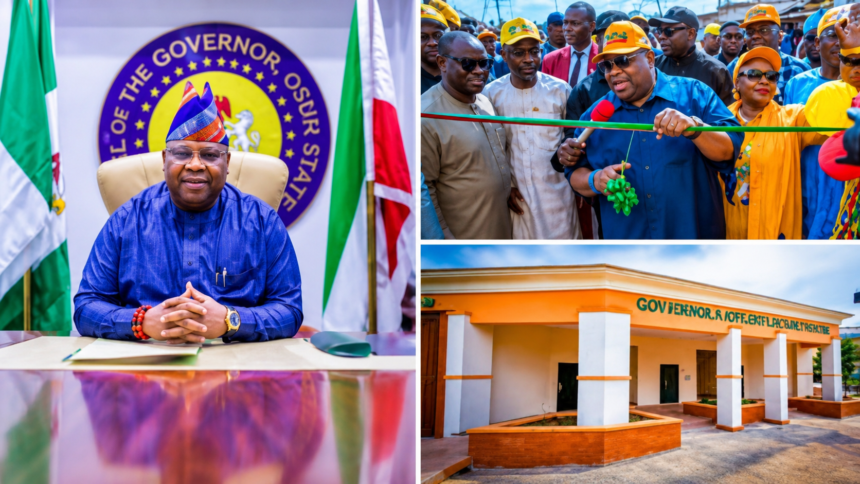
Osun State Governor, Senator Ademola Adeleke, on Monday commissioned a fresh wave of infrastructure projects across Osun State University campuses, a move his administration says cements education as the cornerstone of his governance agenda. Yet as new buildings rose in Osogbo, Okuku and Ifetedo, reactions across the state swung between applause and criticism, exposing the familiar tension between visible projects and lingering public demands.
A Multi-Campus Push
The commissioning tour cut across three of UNIOSUN’s six campuses. In Osogbo, Okuku and Ifetedo, the Governor unveiled facilities designed to ease pressure on classrooms, laboratories and student welfare services. The projects included a FIFA-standard sports complex, modern science laboratories, new lecture halls, a faculty building, and a health services apartment.
University officials said the expansion is part of a deliberate effort to reposition UNIOSUN as a world-class institution amid rising student enrolment. Vice-Chancellor, Professor Clement Adebooye, had earlier disclosed that seven “mega projects” were lined up for commissioning during the university’s convocation period, with funding drawn from TETFund’s High Impact Intervention, Internally Generated Revenue, and support from the state government.
Other signature facilities already completed or nearing completion include an iconic Senate Building with 58 offices, a Senate chamber, Council chamber, conference rooms and executive offices spread across three floors, equipped with elevators and a power plant. There is also a 500-capacity auditorium, a Faculty of Computing and Information Science complex, and a 3-in-1 laboratory complex designed to accommodate 1,500 students at once.
Education as a Governance Signature
For supporters of the Adeleke administration, the UNIOSUN projects are proof that the Governor has kept education at the center of his mandate since assuming office in late 2022. At a recent convocation event, Governor Adeleke reiterated that UNIOSUN “remains a top priority of our government,” commending the Governing Council and management for maintaining a “no-strike, no-aluta” tradition that has kept academic calendars stable.
The administration points to earlier interventions as well. Within his first week in office, Adeleke approved funding to complete a 2-storey 57-office complex at the College of Health Sciences in Isale Osun, a project abandoned since 2011.
He also backed the university’s purchase and completion of a 350-capacity student hostel. The high point came in December 2025 when Adeleke, alongside former Vice President Yemi Osinbajo, former Governor Rauf Aregbesola and Prince Olagunsoye Oyinlola, commissioned the N34 billion Modupe and Folorunso Alakija Medical Research and Training Hospital for UNIOSUN in Osogbo. With a 250-bed capacity, the facility was described by Osinbajo as a “monument to life” and a step toward reducing medical tourism by delivering advanced care closer to home.
Funding Questions and Public Criticism
Not all reactions have been celebratory. Critics argue that many of the newly commissioned projects were funded through university internally generated revenue and TETFund allocations, with little direct financial input from the state government. That argument has fueled broader discontent about infrastructure outside the university gates. Opponents spotlighted dilapidated roads such as the Osogbo-Gbongan route as evidence that the administration’s focus on tertiary institutions has come at the expense of basic road networks and rural development.
The criticism lands at a time when the Governor has announced a N159 billion infrastructure plan covering health, roads and education. Key road projects listed include the dualisation of Odo Ori Junction-Post Office Junction-Adeeke Junction at N10.42 billion, rehabilitation of the Ejigbo-Iwo Road at N11.25 billion, and reconstruction of the Ijebu Jesa-Ere-Ilahun-Ibokun Road with a failed bridge at N8.05 billion. Whether those timelines will calm public frustration remains to be seen.
TETFund and Federal Backing
The Federal Government, through TETFund, has also played a major role in UNIOSUN’s transformation. During the university’s 15th convocation, TETFund commissioned projects worth N3.8 billion. TETFund Board Chairman, Rt. Hon. Aminu Masari, disclosed that since UNIOSUN’s enlistment in 2006, the Fund has allocated N14.1 billion to the institution, with N10.5 billion already accessed.
Masari urged the university management to prioritize maintenance, noting that “these projects are a testimony of government’s resolve to ensure Nigerian universities have the right environment for knowledge creation, learning, and skills development”. The Vice-Chancellor described the new facilities as “game changers” that will enhance academic delivery, research and administration.
What the Projects Mean for Students and Osun
For students, the immediate impact is tangible. More lecture spaces, better labs and improved sports facilities address years of congestion and limited resources across the multi-campus university system. The addition of residential facilities also marks a shift from UNIOSUN’s original non-residential model in 2006 to a more campus-based student experience.
Beyond the campus, the administration frames the investment as part of a larger economic vision. At the 2025 Industrial Investment Roundtable held on the UNIOSUN Osogbo campus, officials said the goal is to move Osun from a raw-materials economy to one driven by manufacturing and value addition. Governor Adeleke has also set a target of creating one million direct and indirect jobs through revitalized trade zone initiatives.
The mixed reactions to the commissioning reflect a larger debate in Osun about priorities and delivery. Supporters see a governor delivering on a promise to rescue public tertiary education from years of neglect. Critics want to see the same urgency applied to roads, healthcare access at the primary level, and job creation outside academic circles.
As the dust settles on the latest commissioning, one thing is clear: UNIOSUN is undergoing its most ambitious infrastructure expansion in years. Whether that translates into improved learning outcomes, research output and graduate employability will determine how history judges this chapter of Osun’s education story.
For now, Governor Adeleke has staked a claim as an education-focused leader. The people of Osun will decide if that claim holds beyond the ribbon-cutting.