Borno State Governor, Babagana Zulum, has invited local and international investors to explore business opportunities in the state, declaring that improved security and its strategic location make it ready for private-sector investment.
The governor identified agriculture, livestock, fisheries, housing, infrastructure and solid minerals as sectors with investment potential, urging businesses to partner with his administration to create jobs and support the state’s economic recovery.
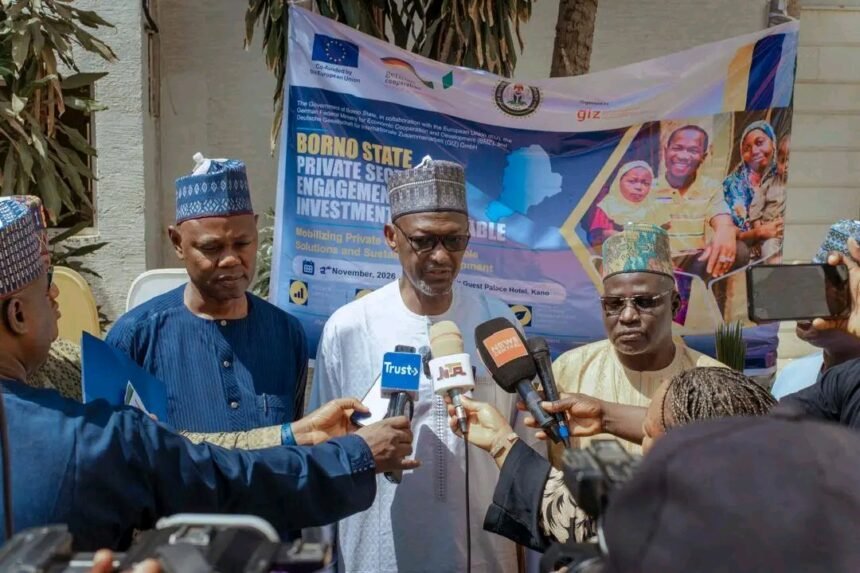
Zulum gave the assurance on Monday at the second private-sector engagement and investment roundtable held at Tahir Guest Palace in Kano, where about 40 prospective investors from different sectors gathered to examine opportunities in the state.
Represented by his Chief of Staff, Dr Babagana Mustapha Mallumbe, the governor said Borno was moving beyond humanitarian relief towards economic recovery and sustainable development through private capital mobilisation.
The roundtable, themed “Mobilising Private Capital for Durable Solutions and Sustainable Development”, was supported by the Deutsche Gesellschaft für Internationale Zusammenarbeit, the European Union and the German Government.
It followed an earlier investment roundtable in Lagos three weeks ago, where the state secured nine investment commitments.
Addressing participants, Zulum said security improvements had created opportunities for businesses to invest in Borno and benefit from its position as a commercial gateway to neighbouring countries.
“Presently, Borno is safe, stable and open for business. Borno sits at the nexus of the Lake Chad Basin, serving as a natural trade corridor linking Nigeria to Cameroon, Chad and Niger Republic,” he said.
The governor credited the armed forces, other security agencies and volunteer groups with contributing to the security gains recorded in the state.
He said Borno’s geographical position offered investors access to an underserved regional market with considerable demand for goods and services.
Zulum also highlighted the state’s agricultural resources, including vast arable land, livestock potential, fisheries and solid mineral deposits, describing them as opportunities for businesses willing to invest in productive sectors.
“Government creates the enabling environment, but the private sector creates wealth, jobs and lasting prosperity,” he said.
He explained that his administration was investing in human capital development under Borno’s 25-year development plan, including vocational and health-sector training.
According to him, vocational training centres established by the state had produced more than 3,000 graduates, while efforts to strengthen skills development in the health sector were also receiving attention.
The governor assured investors that his administration would honour its commitments and provide support for transparent public-private partnerships, particularly in agriculture, housing and other productive areas.
“We are not here to ask for charity. We are here to present bankable, high-yield and direct investment opportunities for you. Borno is ready. Borno is bankable. We invite you to partner with a government that honours its word,” he added.
He identified incentives available to prospective investors as streamlined land acquisition processes, infrastructure support, industrial clusters and a supportive tax framework.
The Chief Adviser to the Governor on Sustainable Development, Partnerships and Humanitarian Response, Dr Mairo Mandara, said Borno was strategically positioned within a regional economic system serving more than 50 million people.
“Borno has moved from emergency to recovery. The task now is to convert recovery into an economy,” Mandara said.
She said the state was seeking to translate humanitarian and reconstruction interventions into sustainable economic activities capable of supporting communities and creating employment.
Participants at the roundtable were also expected to receive presentations on the state’s proposed industrial park, inland dry port and bonded terminal, as well as its ease-of-doing-business framework.
The meeting was attended by the Chairman of the House Committee on Trade, Tourism and Investment, Baba Shehu Gulumba, and the Chairman of the Committee on Rehabilitation, Reconstruction and Resettlement, Baba Mala Sunoma.
Other participants included the commissioners for Information and Internal Security, Prof Usman Tar; Reconstruction, Rehabilitation and Resettlement, Isa Garba Halidu; Works and Housing, Adam Bukar Bababe; Local Government and Emirate Affairs, Sugun Mai Mele; and Planning and Economic Development, Maina Yaumi.
Permanent secretaries, heads of government agencies, special advisers and other officials also attended.
West Trybe reports that the Kano roundtable forms part of Borno’s efforts to attract private capital into its economy as the state pursues a transition from humanitarian dependence to sustainable recovery, with investors expected to assess the opportunities and incentives presented by the government.