


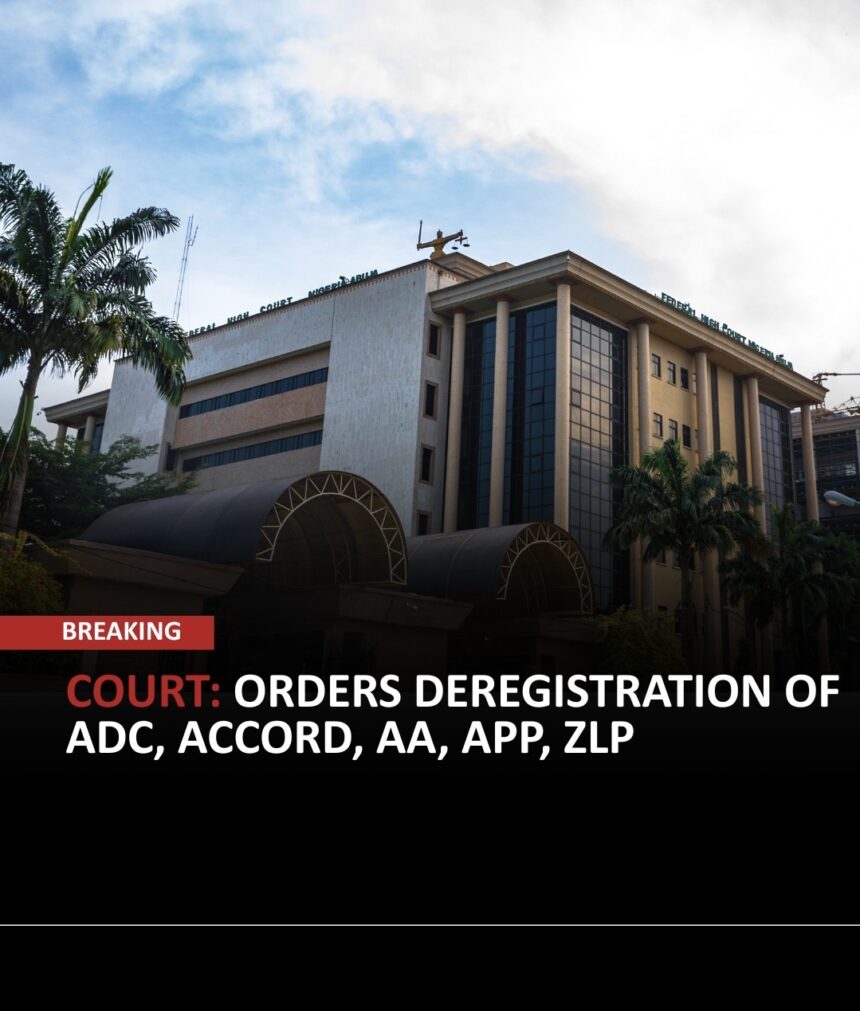
A major political development unfolded on Monday after a Federal High Court in Abuja ordered the Independent National Electoral Commission (INEC) to deregister five political parties for allegedly failing to meet constitutional requirements.
The affected parties are the African Democratic Congress (ADC), Accord Party, Action Alliance (AA), Action Peoples Party (APP), and Zenith Labour Party (ZLP).
The judgment was delivered by Justice Peter Lifu following a suit filed by the Incorporated Trustees of the National Forum of Former Legislators.
Why Did the Court Order Their Deregistration?
According to the court, the affected parties failed to meet the electoral performance requirements outlined in the Constitution and electoral laws.
The plaintiffs argued that political parties are expected to achieve certain electoral benchmarks, including winning elective positions or meeting minimum vote thresholds in elections. They maintained that the continued recognition of parties that fail to meet these requirements goes against the intention of the Constitution.
After considering the arguments, the court directed INEC to deregister the five parties and prevent them from participating in future elections, including the 2027 general elections.
The Long Legal Battle Before the Judgment
The ruling did not come suddenly.
The case has been in court for several months, with multiple hearings, objections, applications, and appeals from the affected political parties. Several attempts were made to stop or delay the proceedings, while the plaintiffs insisted that INEC had a constitutional duty to remove non-performing political parties from the electoral register.
The Attorney-General of the Federation was also joined in the case and supported arguments that constitutional provisions regarding political party registration should be respected.
Why the Decision Is Generating Attention
The judgment has attracted widespread attention because one of the affected parties is the African Democratic Congress (ADC), which has recently gained significant visibility in Nigeria’s opposition politics.
Political observers believe the ruling could reshape conversations around coalition politics ahead of the 2027 elections if eventually upheld by higher courts.
However, legal experts note that the affected parties still have legal options available, including appeals, meaning the final outcome may not yet be settled.
What Happens Next?
The next step is likely to be further legal action.
The affected parties may challenge the judgment at the Court of Appeal, while INEC will also be expected to study the ruling and determine the appropriate legal and administrative response.
Until then, Nigerians will be watching closely to see whether the judgment stands or is overturned on appeal.
What You Should Know at a Glance
A Federal High Court in Abuja ordered the deregistration of ADC, Accord, AA, APP and ZLP.
Justice Peter Lifu delivered the judgment on Monday.
The suit was filed by the National Forum of Former Legislators.
The court held that the parties failed to meet constitutional electoral performance requirements.
INEC was directed to deregister the parties and stop them from participating in future elections.
The ruling could affect preparations for the 2027 general elections.
The affected parties are expected to explore legal options, including appeals.
The case is one of the most significant legal battles involving political party registration in recent years and could have far-reaching implications for Nigeria’s electoral landscape ahead of 2027.