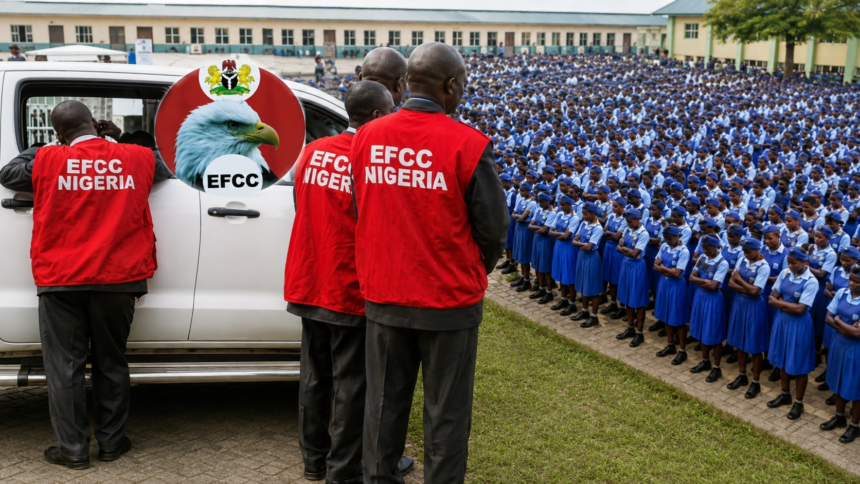
The Economic and Financial Crimes Commission has turned proceeds of crime into classrooms support, handing over 1,452 recovered items to Unity Schools across Nigeria. The gesture is part of a broader shift by the anti-graft agency to deploy recovered assets directly into public services, with education and infrastructure as key priorities.
The Handover To Unity Schools
The EFCC confirmed that the items were released to Federal Government Colleges, commonly called Unity Schools, to support teaching and learning. While the commission did not list every item, the donation aligns with its recent policy of repurposing seized assets for institutions that serve the public.Officials said the goal is to ensure that assets forfeited to the Federal Government are not left idle, but are instead used to address pressing needs in schools that educate students from across the country’s 36 states and FCT.
The move comes as the EFCC under Chairman Ola Olukoyede intensifies efforts to show tangible results from asset recovery beyond court convictions and cash returns.
A Paradigm Shift In Asset Recovery
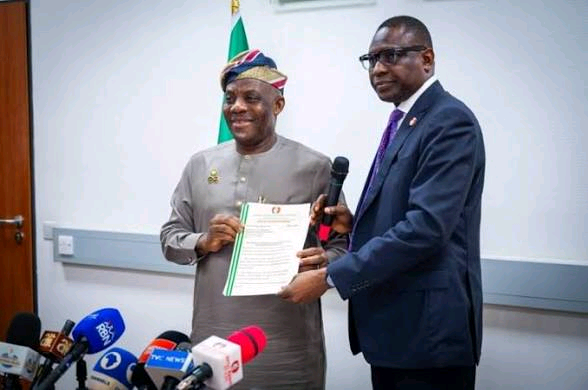
EFCC leadership says the donation reflects a deliberate pivot from simply warehousing recovered property to putting it to work for Nigerians. “The Commission said that unlike in the past when recovered loots from Nigerians and public officials were allegedly re-looted, misappropriated and uncounted for, the current leadership has decided to support the development of the country by deploying the recovered loots to human capital development and infrastructure upgrade,” the agency stated.
This approach has already seen recovered funds channeled into national programs. The EFCC recently announced the release of N50 billion to the Nigerian Education Loan Fund and another N50 billion to the Consumer Credits Corporation, totaling N100 billion invested from recovered proceeds.
The commission described the 2024 figures as its greatest achievements, especially its largest single-year asset recovery since its establishment in 2003.
Other High-Profile Recoveries And Reuse
The Unity Schools donation adds to a growing list of restitutions and asset redeployments by the EFCC.
In Enugu, the commission handed over N1.23 billion recovered from Sujimoto Luxury Construction Limited to the state government over an abandoned smart schools project. Investigations showed the contractor received over N2.28 billion as advance payment but failed to execute the contract.
In Kaduna, a property seized from a former civil servant has been converted into the Federal University of Applied Sciences, Kachia. The EFCC described it as a major milestone in using confiscated assets for public benefit.
Chairman Olukoyede also disclosed that between October 2023 and September 2025, the EFCC recovered over ₦566 billion, several foreign currencies, and more than 1,500 non-monetary assets.
Among these are 753 duplexes forfeited in Lokogoma, Abuja, and Nok University, now the Federal University of Applied Sciences, Kachia.
Some recovered properties have also been allocated to government agencies for use as offices.
Why Education Is Getting Priority
The EFCC says directing recovered assets to education is strategic in the fight against corruption. Chairman Olukoyede has described the student loan programme as a policy issue that will tackle corruption by expanding access to higher education.
By supporting Unity Schools and NELFUND, the commission argues it is addressing one of the root causes of crime: lack of opportunity. Analysts note that reinvesting proceeds of crime into public services aligns with global best practices where such assets are used to improve public services and support vulnerable populations.
The donation to Unity Schools is expected to ease resource gaps in laboratories, libraries, and classrooms, giving students better tools to learn regardless of their state of origin.
Transparency And Public Trust

The EFCC says the shift is also about accountability. In the past, management of recovered loot was often shrouded in secrecy. The current leadership says public handovers and clear allocations are meant to demonstrate that recovered assets are being used for their intended purpose.
Acting Zonal Directors and commission representatives have stressed that restitution is central to the mandate.
“Where there are instances of economic and financial crimes against an individual or an agency of government, the EFCC will ensure that every act that is contrary to law is dealt with and, where possible, restitution is made to the victim,” said Daniel Isei, zonal director, during a handover in Enugu.
For the Unity Schools, school authorities are expected to take custody of the items and integrate them into daily academic activities. The EFCC says it will monitor the use of the donation to ensure it serves students.
With over 1,500 non-monetary assets already recovered in two years, the EFCC indicates more handovers to public institutions are planned. The commission is also pushing for legal reforms to allow anti-graft agencies to retain a percentage of recovered loot to fund operations, a practice it says exists in jurisdictions like the UK.
For now, the message from the commission is clear: crime proceeds should not just be counted, they should be converted. From a university in Kaduna to loan funds for students, and now to desks, equipment and learning materials in Unity Schools, the EFCC is betting that Nigerians will feel the impact of the anti-corruption fight where it matters most — in classrooms