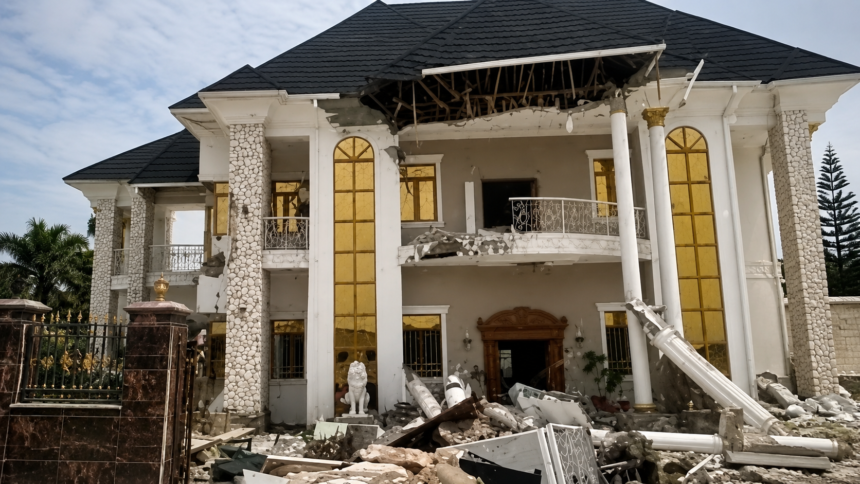
The Federal Capital Territory Administration has ordered the demolition of near-complete buildings erected on land originally allocated to foreign embassies in Abuja, sparking renewed debate over land use compliance, investment protection, and the cost of urban planning violations in the capital city.
The action, confirmed during an inspection by FCT Minister Nyesom Wike, targeted structures in the Katampe Extension diplomatic zone that were built without approval from the Federal Capital Development Authority. Officials say the plots were set aside exclusively for diplomatic residences and any other use constitutes a breach of the Abuja Master Plan.
The Enforcement In Katampe Extension
Speaking to journalists during a project inspection tour, Minister Wike condemned the construction on embassy land, describing the buildings as illegal. He directed that the affected structures be pulled down immediately.
According to the FCT Administration, the plots were originally allocated on March 18, 2008, to various diplomatic missions for residential purposes. However, an illegal developer allegedly seized the land and commenced construction without due approvals.
The Minister said such encroachments would not be tolerated, noting that the integrity of Abuja’s diplomatic district must be preserved for its intended purpose. The demolition adds to a series of recent enforcement actions by the FCTA aimed at reclaiming government and designated lands across the territory.
FHA’s Parallel Crackdown In Gwarinpa
Around the same period, the Federal Housing Authority also carried out demolitions in Gwarinpa II Estate, Abuja, citing violations of land boundaries and development guidelines.
In one case, FHA officials accompanied by police demolished parts of a fence and structures belonging to Tulwu Integrated Ltd along 5th Avenue, 52 Road, Gwarinpa II, Phase I.
The developer alleges the land, initially allocated to Savannah Suites & Restaurant Ltd and later assigned to Tulwu via a consent letter dated March 13, 2013, measures over 22,000 square metres after survey and change-of-use approval in 2023.
FHA, however, maintains the original allocation was 16,000 square metres and accuses the developer of encroaching on an additional 6,000 square metres. FHA spokesman Kenneth Chigelu said the authority acted within its mandate to recover government land and that a previous court injunction had been vacated.
The dispute is now before an FCT High Court in Bwari, with Justice M. A. Madugu having ordered parties to maintain status quo pending hearing. The case was adjourned to May 6, 2026.
Billions At Stake, Housing Concerns Raised
The demolitions have drawn public criticism focused on economic losses at a time Nigeria faces a huge housing deficit. Developers and observers have questioned the destruction of near-complete structures, with some suggesting the buildings could be repurposed for diplomatic use rather than razed.
The tension highlights a recurring conflict between strict enforcement of urban planning rules and the financial risks borne by investors. In Gwarinpa, residents and developers have also accused FHA of delays in approvals and alleged illegal re-allocation of portions of land.
FHA has defended its actions, saying it cannot allow development that compromises the master plan. The agency recently carried out a controlled demolition of one of its own buildings in Gwarinpa after an integrity test revealed structural defects.
Managing Director Hon. Oyetunde Ojo said the decision prioritized safety over cost.
Wider Pattern Of Land Use Violations
The FCTA has expressed concern over what it called “indiscriminate changes in land use within the Gwarinpa District”. Following a building collapse in the area, the Coordinator of the Abuja Metropolitan Management Council, Umar Shuaibu, said the administration observed “flagrant violations of development control guidelines by the FHA”.
The FCTA also ordered the arrest and prosecution of FHA officials and the developer linked to the collapsed building, and announced a review of the mandate ceded to FHA for development control in Gwarinpa.
Officials argue that weak monitoring and disregard for the Abuja Master Plan have led to repeated building failures and encroachments, endangering lives and public assets.
What This Means For Investors And The Diplomatic Zone
For the diplomatic district in Katampe Extension, the government’s position is clear: land allocated for embassies and ambassadorial residences will not be converted to commercial or private estates. The demolition order signals that titles and allocations from as far back as 2008 remain enforceable.
For the broader property market, the episodes underscore the importance of due diligence, proper approvals from FCDA and FHA, and adherence to designated land use. Experts note that while enforcement is necessary to protect city planning, clearer dispute resolution and compensation frameworks could help balance regulation with investor confidence.
As Abuja continues to expand, the FCT Administration says it will sustain efforts to reclaim illegally occupied lands, while agencies like FHA have pledged to ensure that new developments meet safety and planning standards.
For now, the rubble in Katampe and Gwarinpa stands as a reminder: in the FCT, land use designation matters, and building without approval, no matter how far advanced, carries heavy consequences.