


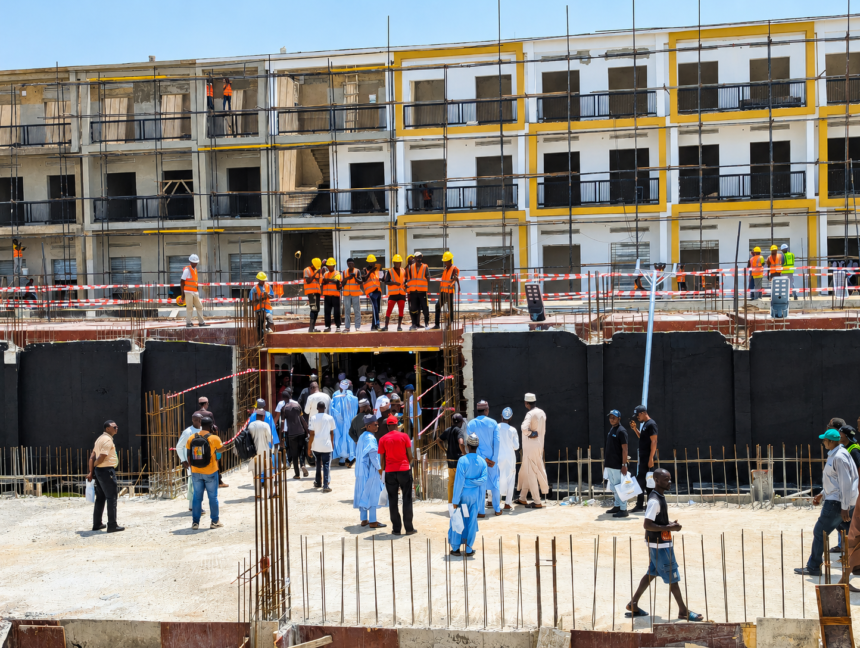
Kano State has unveiled the Hajaj-ZOEC Digital Market, a multi-billion-naira commercial hub expected to generate about ₦50 billion in annual revenue and create more than 100,000 direct and indirect jobs, in what stakeholders described as a major boost to commerce and investment in Northern Nigeria.
The market, commissioned on Saturday at the former Luxurious Bus Park along New Road, Tudun Wada, Sabon Gari, was developed through a Public-Private Partnership between the Kano State Government, Hajaj ZOEC Real Estate Limited and ZOEC Construction.
Speaking at the inauguration, the Chief Executive Officer of Hajaj ZOEC Real Estate Limited, Alhaji Jamilu Abdussalam, described the facility as one of West Africa’s largest dedicated electrical and electronics markets, saying it would strengthen Kano’s position as a major commercial and distribution hub for Nigeria and neighbouring countries.
According to him, the market will accommodate more than 1,500 shops, bringing dealers in electrical and electronic products under one roof while providing modern infrastructure to support trade, investment and regional commerce.
“We believe this market is not only an opportunity for Kano State or Northern Nigeria but for the entire African continent. Instead of travelling all the way to China to purchase goods in bulk, traders will be able to come to Kano and place their orders here,” Abdussalam said.
He disclosed that the project, valued at between ₦25 billion and ₦30 billion, had already attracted international investors, with companies from Egypt and China establishing permanent showrooms within the market.
Abdussalam said between 60 and 65 per cent of the shops had already been sold, adding that the facility features parking space for about 700 vehicles, underground storage capable of accommodating more than 30 forty-foot containers, a central firefighting system and modern sprinkler installations.
“The economic impact will be enormous. During construction alone, over 1,000 people, including labourers, masons and professionals, worked on the site every day. When suppliers and others in the value chain are included, more than 8,000 people have already benefited from the project. Once the market becomes fully operational, we project that more than 100,000 people will benefit directly and indirectly,” he said.
Also speaking, the Minister of State for Housing and Urban Development, Yusuf Abdullahi Ata, represented by his Special Assistant (Technical), Kabir Aminu Dutse, said the Federal Government had removed major bottlenecks associated with Public-Private Partnership arrangements to encourage greater private sector investment in infrastructure.
“As part of our mandate and responsibility, the Federal Ministry of Housing and Urban Development has streamlined the bottlenecks associated with Public-Private Partnership arrangements. We have developed a workable model that is accessible to all our partners across Nigeria and even beyond,” Ata said.
He described the Hajaj-ZOEC Digital Market as a reflection of the growing role of digitalisation in modern commerce, stressing that technology-driven markets would strengthen Nigeria’s economy and improve competitiveness.
“There is no better way to transform the market sector today than through digitalisation. That is the global trend. Across the world, every meaningful improvement in commerce and economic prosperity is driven by digital innovation, and that is exactly what we are witnessing in this project,” he said.
Ata congratulated Summit Bank, Hajaj ZOEC Real Estate Limited, ZOEC Construction and the Kano State Government for delivering the project, describing it as a landmark investment capable of attracting businesses, creating jobs and expanding regional trade.
West Trybe reports that Kano, Nigeria’s most populous state with an estimated population of over 17 million, remains the commercial gateway to Northern Nigeria. The new digital market is expected to strengthen the state’s position as a regional trading hub, attract local and foreign investment, deepen the electronics supply chain and reduce the need for traders to travel abroad to source electrical and electronic products.


