


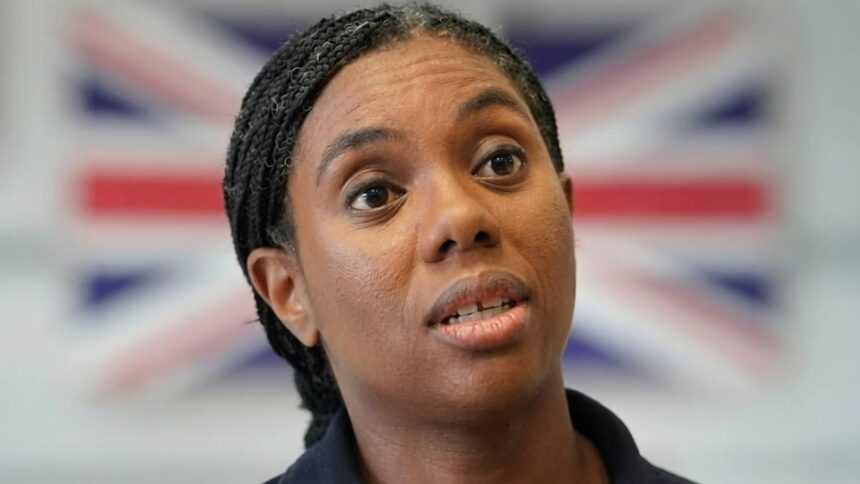
UK Conservative leader Kemi Badenoch congratulated Andy Burnham as Britain’s new prime minister on Monday but warned he is a people pleaser unfit to lead.
Badenoch congratulated Andy Burnham on becoming Britain’s new prime minister but stopped short of endorsing his fitness for office, stating publicly that the country requires a leader capable of making difficult decisions, not one who seeks to please.
She released her position on X on Monday, the same day Burnham assumed office. “I have found Andy to be a nice man,” she disclosed in that statement. “But Britain needs a leader who can take difficult decisions, not a people pleaser.”
She offered to work with Burnham but drew a firm line on the nature of her role. “My job as Leader of the Opposition is to hold the Prime Minister to account, not to be his cheerleader,” she stated.
“When he does the right thing, I will praise him.
Burnham’s assumption of power followed the formal resignation of Sir Keir Starmer, who departed Downing Street on Monday declaring “my work is done” before King Charles III invited Burnham to form a new government, as gathered by West Trybe.
Badenoch welcomed one element of Burnham’s early policy signals. Press reports indicating that Burnham planned to approve licenses for the Jackdaw and Rosebank gas fields in the North Sea drew cautious praise from the Conservative leader, though she urged him to go further.
“He should end Ed Miliband’s destructive ban on new licenses altogether,” she said. “Let’s get Britain drilling so we can bring down the cost of energy.
Yet she did not stop at policy. Badenoch criticized Burnham for what she described as a failure to present a clear governing agenda before taking office, and she raised specific objections to his pre-appointment conduct.
“He has refused calls to come to Parliament to answer questions from MPs, meaning there won’t be a PMQs until September,” she noted. “He has avoided proper media scrutiny, giving an interview instead to Gary Lineker.
Badenoch also turned her criticism toward the wider Labour Party, arguing that changing the party’s leader would not resolve Britain’s structural problems. “The problem wasn’t just Keir Starmer; it was the whole Labour Party,” she disclosed.
She described Starmer’s record in specific economic terms, charging that he leaves office with “a growing welfare bill, higher unemployment, and increased energy costs.” She added that “the tax burden is killing economic growth and making the cost of living worse for families.”
On the path forward, Badenoch called for reduced government spending, with welfare cited as a primary target. She offered to collaborate with Burnham on that objective, framing it as a matter of national priority rather than partisan advantage.
But she reserved her sharpest contrast for the upcoming election cycle, drawing a direct line between her party’s repositioning and what she characterized as Labour’s ideological direction. “Andy Burnham’s Labour offering state control and forced redistribution or my new Conservative Party, offering enterprise, responsibility, and growth,” she told her audience through the statement.
Badenoch argued that the Conservative Party had moved on from its record in government, pointing to changed positions on net-zero commitments and Britain’s relationship with the European Convention on Human Rights as evidence of that shift.
“The Conservatives have changed, and the choice at the next election is becoming clearer,” she confirmed.
Burnham’s entry into Downing Street marks a transition handled entirely within the Labour Party under Britain’s parliamentary system, which permits the ruling party to replace its leader without triggering a general election.
Sir Keir Starmer formally resigned as prime minister Monday, telling the country that “my work is done” before handing power to Burnham, who was subsequently invited by King Charles III to form a new government.