


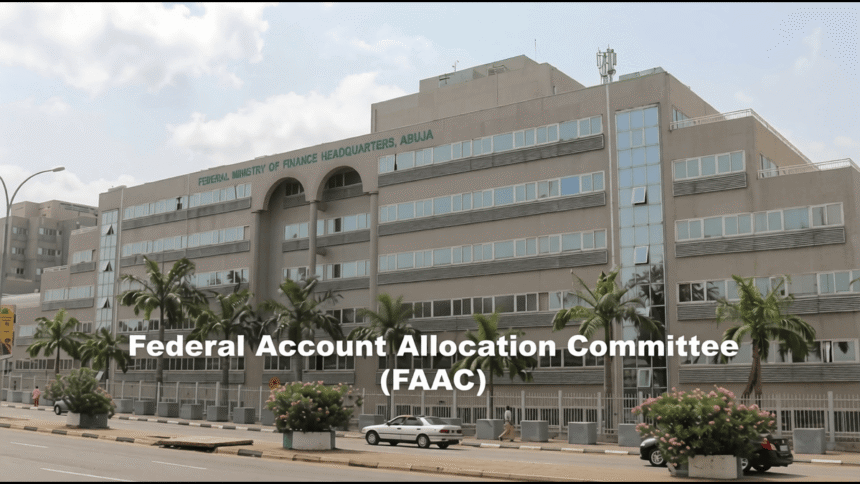
Nigeria shared N2.55 trillion from its June 2026 federation revenue on Thursday, a jump of N250 billion, or 10.9 percent, from the N2.3 trillion distributed the previous month, continuing what has become a steady upward march in allocations since February.
The figure was announced at the Federation Account Allocation Committee meeting held in Abuja, details of which were contained in a communiqué signed by Bawa Mokwa, Director of Press and Public Relations in the Office of the Accountant-General of the Federation.
Finance Minister Taiwo Oyedele chaired the session.
FAAC had shared N2.3 trillion from May revenue. Before that came N2.26 trillion from April, N2.04 trillion from March, and N1.89 trillion from February—five consecutive months of growth that have added N660 billion in cumulative allocations since the year’s first quarter.
Total gross revenue available in June stood at N4.5 trillion, with N160.744 billion deducted as cost of collection and N1.789 trillion recorded as transfers and refunds. What remained for distribution was N1.809 trillion in statutory revenue and N740.7 billion from value-added tax.
“A total sum of N2.55 tn, being June 2026 Federation Account Revenue, has been shared with the Federal Government, States, and the Local Government Councils,” the communiqué stated. But the numbers behind that headline figure tell a more layered story about where the money went.
The federal government took N923.4 billion, state governments received N838.2 billion, and the country’s 774 local government councils shared N591.4 billion among themselves. An additional N197.610 billion, representing 13 percent derivation revenue, went to oil-producing states from the statutory pool.
Breaking down the N1.809 trillion statutory component: the federal government received N849.366 billion, states got N430.810 billion, and local councils collected N332.136 billion. Yet within that same statutory pool, N197.610 billion was carved out as derivation payments before those shares were computed.
From the N740.724 billion VAT pool, the federal government received N74.072 billion, states collected N407.398 billion, and local government councils took N259.253 billion. VAT distribution is always weighted toward the lower tiers under the existing revenue-sharing formula.
Gross statutory revenue climbed sharply, rising from N2.651 trillion in May to N3.700 trillion in June, an increase of N1.049 trillion. And gross VAT revenue moved upward too, from N743.688 billion in May to N799.746 billion in June, a gain of N56.078 billion.
The committee credited the stronger performance to higher receipts from companies’ income tax, capital gains tax, stamp duties, petroleum royalties, gas flaring penalties, rental and miscellaneous oil revenue, VAT, import duties, and CET levies—a broad spread of revenue lines that each contributed to the June surge.
Not every line improved. Receipts from petroleum profit tax, hydrocarbon tax, mineral royalties, and related fees fell during the period, while excise duty recorded only a marginal uptick. The communiqué did not disclose exact contraction figures for those lines.
The meeting was attended by the accountant-general of the federation, state commissioners of finance, and other committee members, according to a statement by Efe Ovuakporie, head of information and public relations at the Federal Ministry of Finance.
June’s N2.55 trillion allocation ranks among the highest recorded so far this year. Higher disbursements are expected to ease liquidity pressure across federal, state, and local administrations, though analysts note that prudent fiscal management remains essential to converting revenue windfalls into meaningful infrastructure and development financing.
The FAAC communiqué issued Wednesday carried no spending targets or directives to accompany the disbursement figures, leaving how the funds will be deployed entirely to each tier of government.