


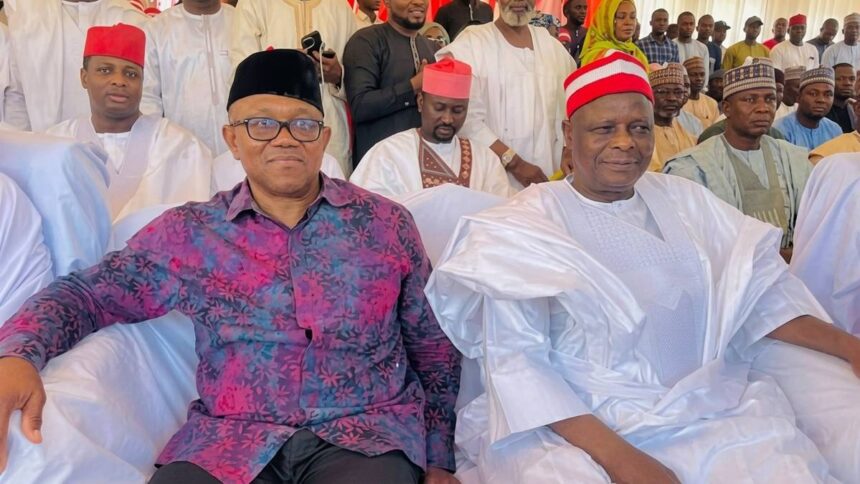
Peter Obi and Rabiu Kwankwaso are leading the NDC’s legal fight after a Federal High Court in Lokoja voided the party’s registration on June 26, 2026.

Peter Obi and Rabiu Musa Kwankwaso are now leading the Nigeria Democratic Congress’s legal counterattack after a Federal High Court in Lokoja voided the party’s registration on Friday, June 26, 2026, throwing the opposition’s 2027 presidential ambitions into sudden jeopardy.
By Sunday evening, NDC leadership had wrapped marathon strategy sessions at the party’s Abuja secretariat, pulling in Obi, national leader Seriake Dickson, and members of the National Working Committee barely 48 hours after the ruling landed.
Justice Isah Dashen delivered the blow. He held that the earlier judgment granting NDC registration had violated the rights of the Peace Movement Party, which claimed ownership of the logo NDC adopted, and that PMP was never joined as a party in the original suit.
INEC had registered NDC on the strength of that same court’s December 15, 2025 order. That single judgment was the party’s entire legal foundation. And now it had been pulled from under them.
National Chairman Senator Moses Cleopas faced reporters at a news conference at the NDC National Secretariat Sunday and argued that the court had become functus officio after delivering its first judgment, stripping it of authority to reverse course on an interlocutory application.
“The court made no order directing the deregistration of the Nigerian Democratic Congress,” Cleopas told reporters flatly. The party was not backing down.
Cleopas pushed further. “As the main opposition party today, we have always anticipated what they could throw at us,” he said, framing Friday’s ruling as anticipated political warfare rather than a legitimate legal intervention requiring any retreat.
National Secretary Ikenna Enekweizu went further still. On Channels Television’s “Politics Today” program Friday evening, he alleged that people unable to tolerate Peter Obi’s candidacy had engineered the ruling against the party.
Obi addressed the crisis publicly from the grounds of Madonna University in Okija, Anambra State, where he had been speaking at a leadership program when news of the ruling’s implications was still reverberating across the country.
He was blunt. “They cannot stop me. They will fail. Let me assure you it is not the end of the road,” Obi told the gathering, dismissing the setback as temporary.
Yet Obi pivoted from defiance to purpose. “My concern is not about who becomes president,” he said. “My concern is that Nigeria works. Our politics must move beyond the quest for power and focus instead on building a united nation founded on justice, strong institutions, the rule of law, and equal opportunity.
Idris Zekeri Jr., spokesperson for the Peter Obi Media Reach, issued a statement urging Obi’s followers and political partners to hold steady while the legal team completed its review of the judgment and prepared a formal appeal to the Court of Appeal.
Senior Advocate of Nigeria Adelola Adedipe offered a critical legal distinction that the party leaned on publicly. He argued the June 26 ruling had not deregistered the NDC outright but had merely reversed the original judicial order that enabled its registration in the first place.
“The ruling of June 26, 2026, set aside the order of registration because a necessary party was not heard in the course of the proceedings. However, the suit remains extant, as the necessary parties are now required to ventilate their positions for an effectual determination of the case,” Adedipe said.
NDC also challenged who exactly had brought the complaint. The party noted publicly that the Peace Movement Party behind the filing is not a registered political party anywhere in Nigeria’s official records.
The party moved quickly regardless. On its official X handle, NDC declared: “We have instructed our team of lawyers to immediately proceed to the Court of Appeal to challenge the jurisdiction and propriety of His Lordship’s order.”
Five hundred kilometres away, the Ondo State chapter rejected the ruling in its own Sunday statement. Chapter chairman Kennedy Peretei expressed direct dissatisfaction with Justice Dashen’s decision and outlined exactly what the party had built since INEC first registered it.
Since registration, Peretei noted, the NDC had operated within the Electoral Act 2026, enrolled members nationwide, conducted ward, local government, and state congresses, held a national convention, ran primary elections, and participated in by-elections in both Nasarawa and Enugu states.
Friday’s ruling sent political temperatures rising. Opposition leaders across the country condemned it as a calculated move to weaken the opposition before the 2027 general election campaign reaches full speed.
The Court of Appeal filing was expected Monday, June 29, 2026. NDC’s legal team was pressing for an expedited hearing, citing the tightening 2027 election calendar and the party’s unresolved primary obligations still waiting to be completed.
The deregistration battle has become the sharpest test yet of whether the Obi-Kwankwaso joint platform survives long enough to contest the presidency. But the party, for now, is not flinching.