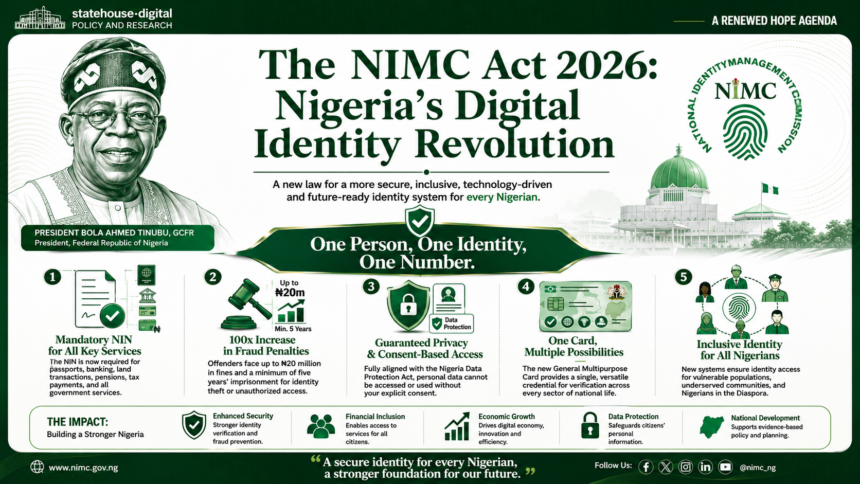
President Bola Ahmed Tinubu has signed the National Identity Management Commission (NIMC) Act 2026 into law, ending nearly two decades of identity governance under legislation written for “a different era”. The move, described by government officials as a landmark reform, replaces the NIMC Act of 2007 and sets the legal foundation for Nigeria’s digital identity, security, and economic ambitions.
“That Era is Over”: What Changed and Why Now

Announcing the assent on X, President Tinubu said: “For nearly twenty years, Nigeria’s identity system operated under a law written for a different era. That era is over”. The 2007 Act had become obsolete in the face of rapid digital growth, e-commerce, cybersecurity threats, and demand for stronger data protection. The new law introduces a “modern legal framework designed to align Nigeria’s identity management system with global best practice, emerging technologies and the demands of a rapidly expanding digital economy”.
The signing took place Friday, June 26, 2025, at the State House, Abuja, with Senate President Godswill Akpabio, Deputy Speaker Benjamin Kalu, Attorney-General Lateef Fagbemi, Interior Minister Olubunmi Tunji-Ojo, World Bank’s Taimur Samad, and NIMC DG Abisoye Coker-Odusote in attendance.

NIMC Becomes Nigeria’s “Root Certification Authority” for Digital Trust
A central provision of the Act designates NIMC as Nigeria’s Root Certification Authority for the National Public Key Infrastructure (PKI) and Digital Public Infrastructure (DPI).
This empowers the Commission to serve as the nation’s trusted authority for secure digital identity, authentication, electronic trust services, digital certificates, and encryption across both public and private sector platforms. The law also authorizes NIMC to facilitate “secure, interoperable and seamless data exchange among government institutions, financial organisations and other authorised entities”, providing the legal backbone for a trusted digital economy.
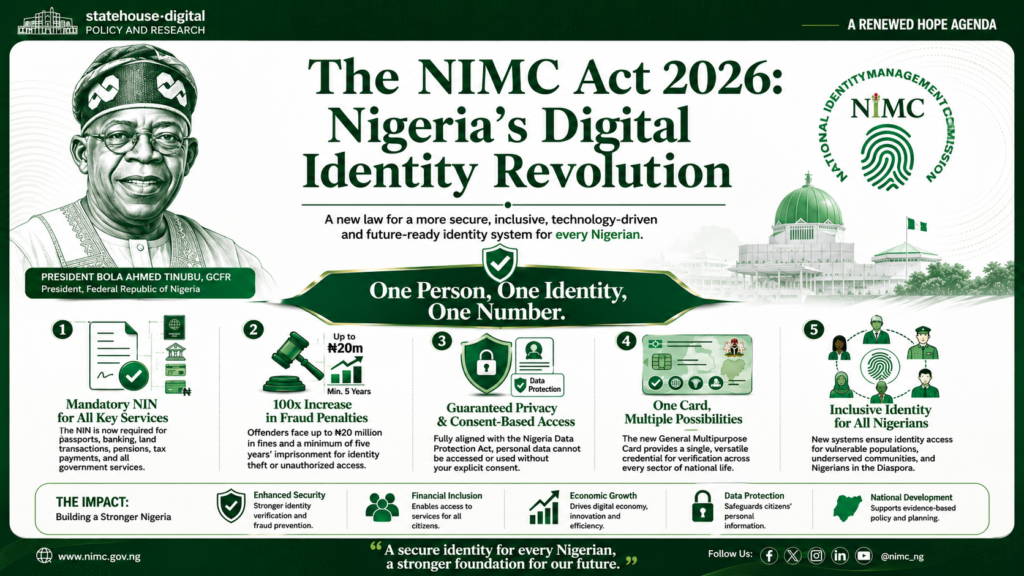
The Act reinforces the National Identification Number (NIN) as Nigeria’s foundational identity credential under the “One Person, One Identity” principle. It also formally recognizes both physical and digital identity credentials, all securely linked to an individual’s NIN.
Security Wins: Database Integration Already Yielding Results
Minister of Interior Dr. Olubunmi Tunji-Ojo said the integration of NIMC databases with other government platforms has already produced security gains. He disclosed that seven suspected commanders of Boko Haram and ISWAP were arrested last week at Katsina Airport while returning from the Hajj pilgrimage in Saudi Arabia.
“We inherited a fractured system. But I’m happy to tell you that even last week, seven known commanders of Boko Haram and ISWAP, at the point of returning from Mecca, were arrested at Katsina Airport and handed over to the Department of State Services (DSS),” Tunji-Ojo stated.
He added that reforms have linked the NIN database with immigration systems and international security platforms, making it harder for criminal suspects to evade detection. “Today, you can’t get a Nigerian passport without pulling data from NIMC,” he noted.
Economic and Governance Goals: From Inclusion to a $1 Trillion Target
The government says the Act directly supports President Tinubu’s Renewed Hope Agenda by accelerating digital transformation, strengthening national security, expanding financial and social inclusion, improving public service delivery, and supporting the vision of a one-trillion-dollar economy.
Senate President Godswill Akpabio described the legislation as a reform that will improve national planning, infrastructure development, border management, and security. “We wanted legislation that would outlive us and serve generations of Nigerians because digital identity is central to national development,” he said.
Deputy Speaker Benjamin Kalu called it a “transformative reform that would improve governance, promote accountability and support national development through a credible identity management system”. “Today marks a historic milestone in Nigeria’s digital transformation,” he added.
Scale and Inclusion: 180 Million Target, Refugees and Inmates Covered
NIMC is now targeting 180 million NIN enrolments by December 2026. As of June 30, 2025, registrations stood at 121 million, leaving a gap of 59 million to be filled in 18 months.
The Commission says it has already enrolled over 206,000 refugees and internally displaced persons, and 32,000 inmates into the national identity database “to ensure that no one is left behind”. The Act also mandates special measures for vulnerable persons without permanent residences.
Abisoye Coker-Odusote said the Commission has moved “from isolated databases and manual processes to an integrated ecosystem that enables interoperability, identity verification, and real-time authentication across sectors”. The database capacity has been expanded from 100 million to 250 million records.
Stronger Data Protection and Anti-Fraud Measures
The 2026 Act introduces innovations to support secure digital identity and seamless service access. It prescribes stringent penalties for multiple registrations and strengthens measures to combat identity theft and impersonation. It also empowers NIMC to establish, manage and maintain PKI and DPI, providing trusted authentication, encryption, digital signatures and verification frameworks that strengthen confidence in digital transactions.
NIMC says it will work with government agencies, development partners, and the private sector to fully implement the law. The Commission is also rolling out tools like the NIN Mobile App, Person Identification Verification Service, and NINAuth for secure digital authentication.
Bottom line
By repealing a 19-year-old law, the NIMC Act 2026 positions Nigeria’s NIN as the bedrock of security, governance, and digital services. With database integration already linked to arrests of terror suspects and a push toward 180 million enrolments, the Act is framed as the legal engine for Nigeria’s digital and economic future.