

Tinubu Independence Day speech 2026 focused on Nigeria’s economy, cost of living, jobs, security and the government’s plan to move from economic reforms to broader prosperity.
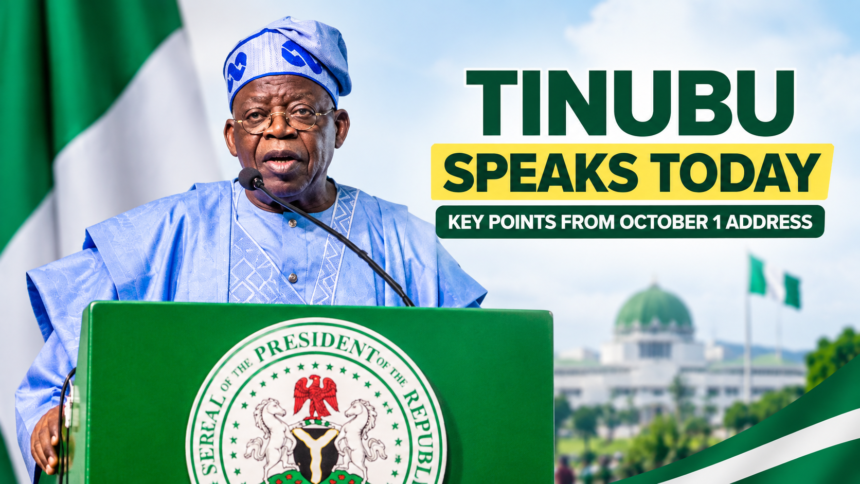
President Bola Tinubu delivered his October 1 Independence Day broadcast today, Thursday, October 1, 2026, as Nigeria marked its 66th Independence Anniversary.
In the address, Tinubu defended his administration’s economic reforms, acknowledged the hardship many Nigerians continue to face and outlined what he described as the next phase of his government’s agenda.
The President’s speech was built around a central message: Nigeria, in his view, has passed through the most difficult phase of economic correction and must now concentrate on turning that foundation into jobs, investment, production and improved living conditions.
Tinubu says Nigeria has moved beyond economic reforms

One of the biggest points in the October 1 broadcast was Tinubu’s declaration that the government’s economic focus is changing.
He said his administration had spent its first three years trying to correct the country’s economic direction. According to the President, the reforms were difficult and came with real side effects, but he argued that they were necessary to address longstanding weaknesses.
“The emergency treatment is over. The foundation has been repaired,” Tinubu said.
He then described the government’s new objective as “shared and widespread prosperity.”
The President’s position was that Nigeria should now move beyond economic stabilisation and concentrate more directly on what growth means for ordinary people.
Cost of living in Tinubu’s 2026 Independence Day speech
Cost of living was another major part of the President’s Independence Day address.
Tinubu acknowledged that Nigerians are still dealing with the pressure of food prices, transportation, school fees, healthcare and other household expenses.
He said lowering the cost of living remains a major priority and linked this to reducing the cost of producing and moving goods around the country.
The President highlighted agricultural production, irrigation, access to farm inputs, mechanisation, storage and transportation as areas where the government intends to increase productivity.
He also pointed to roads, railways and ports as part of the infrastructure needed to move goods more efficiently.
The argument presented in the broadcast was straightforward: increasing production while reducing the cost of getting goods to consumers should help ease pressure on households.
Jobs and young Nigerians feature in Tinubu’s October 1 speech
Tinubu also placed job creation and young Nigerians at the centre of the next phase of his economic plans.
He said Nigeria’s large youth population should be treated as an economic strength, with government policy focused on productive employment, enterprise, industrial development, digital connectivity and skills.
The President mentioned gas-powered industries, factory activity, technology and other productive sectors as areas where opportunities could expand.
His message was that economic growth should create opportunities for Nigerians rather than remain limited to figures showing changes in national output.

That emphasis on jobs is particularly significant in a country where young people make up a large part of the population and where employment opportunities remain an important public concern.
What Tinubu said about Nigeria’s economy
In defending his administration’s record, Tinubu pointed to several economic indicators.
He said Nigeria’s economy had grown by more than four per cent in 2026 and that both the oil and non-oil sectors were contributing to the expansion.
He also pointed to lower inflation from its previous peak, stronger foreign reserves and greater stability in the foreign exchange market.
Tinubu further said Nigeria generated more than $6 billion in non-oil export revenue in 2025, describing it as the highest figure recorded in the country’s history.
These figures were presented by the President as evidence that the reforms had strengthened the foundation of the economy and created room for the next stage of his programme.
Education and support for vulnerable Nigerians

The October 1 broadcast also touched on education and social protection.
Tinubu highlighted the Nigerian Education Loan Fund, saying it is helping students from poorer households access tertiary education.
He also mentioned CREDICORP and its consumer-credit programme, which he said can help working Nigerians acquire assets such as vehicles, solar systems and digital devices.
On social protection, the President said the National Social Register is being updated to improve the targeting of assistance towards vulnerable Nigerians.
These measures formed part of the wider picture he presented: economic reform on one side and programmes designed to support Nigerians through the transition on the other.
Security and national development
Security also featured in Tinubu’s Independence Day message.
The President praised Nigeria’s Armed Forces and security agencies and linked national security with economic development.
He also referred to progress in tackling oil theft and protecting the country’s resources.
For Tinubu, the argument is that economic prosperity cannot be separated from security. Farmers need to be able to work their land, businesses need a stable environment and infrastructure needs to operate without disruption.
What Tinubu’s Independence Day speech means for the next phase

The most important takeaway from the broadcast was not a single new policy announcement but the direction Tinubu set for the next phase of his administration.
After spending much of his address defending the difficult economic decisions taken since 2023, he said the government’s attention must now turn towards making growth more visible in the lives of Nigerians.
That means focusing on production, jobs, lower costs, investment, infrastructure and opportunities for young people.
Tinubu’s Independence Day speech therefore presented a transition from economic correction to what he called an “age of prosperity.”
Whether that change becomes noticeable to households will depend on how the policies translate into prices, employment, business activity and access to essential services.
For now, the President’s October 1 broadcast has clearly set the theme for the next stage of his administration: Nigeria has passed through the reform period, and the government says prosperity is now the priority.