How Nigeria’s Education Loan Fund Is Breaking Financial Barriers — And Fighting Fake News Along the Way
The Nigerian Education Loan Fund, NELFUND, is no longer a pilot project. It’s now one of the Federal Government’s biggest student support programmes, with over N242.4 billion disbursed and 1.38 million students already benefiting across universities, polytechnics, and colleges of education.
Here’s the full picture behind the trending logo.
1. From 1.6M to 7M: The Big Expansion Plan : NELFUND and the National Assembly are pushing to scale the scheme from 1.6 million direct beneficiaries to 7 million. According to NELFUND Managing Director, Akintunde Sawyerr, the fund has so far disbursed about N282 billion and directly supported 1.6 million students. When you include families, the impact jumps to nearly 10 million Nigerians, using an average household size of five.
The goal isn’t just universities. The expansion will also cover vocational and skills acquisition programmes to boost employability.
2. The Numbers So Far: N242.4 Billion and Counting: As of April 15, 2026, NELFUND’s records show: Total applications received: 1,778,854
Students who have benefited: 1,388,592
Total disbursed: N242,400,915,093.25
Breakdown: N157.4 billion paid directly to 288 institutions for tuition and institutional charges
N84.9 billion paid as monthly upkeep allowances to students
That upkeep amount is N20,000 per month — NELFUND has repeatedly debunked claims of a N25,000 increase.
3. What NELFUND Actually Covers: The loan, created under the Student Loan (Access to Higher Education) Act, 2024, signed by President Bola Tinubu, is interest-free.
It covers:1. Full tuition fees paid directly to schools
2. Monthly upkeep of N20,000 for living expenses
Repayment starts two years after NYSC completion.
NELFUND has also extended eligibility to postgraduate students and students in the School of Continuing Education with valid JAMB numbers.
4. Real Impact on Campuses: Institutions are confirming the funds. For example, Kwara State University (KWASU) received N2.14 billion for 11,434 students. NELFUND says the scheme has cost over N1.1 billion so far, with more than 160,000 young people also benefiting from digital skills training under related programmes.
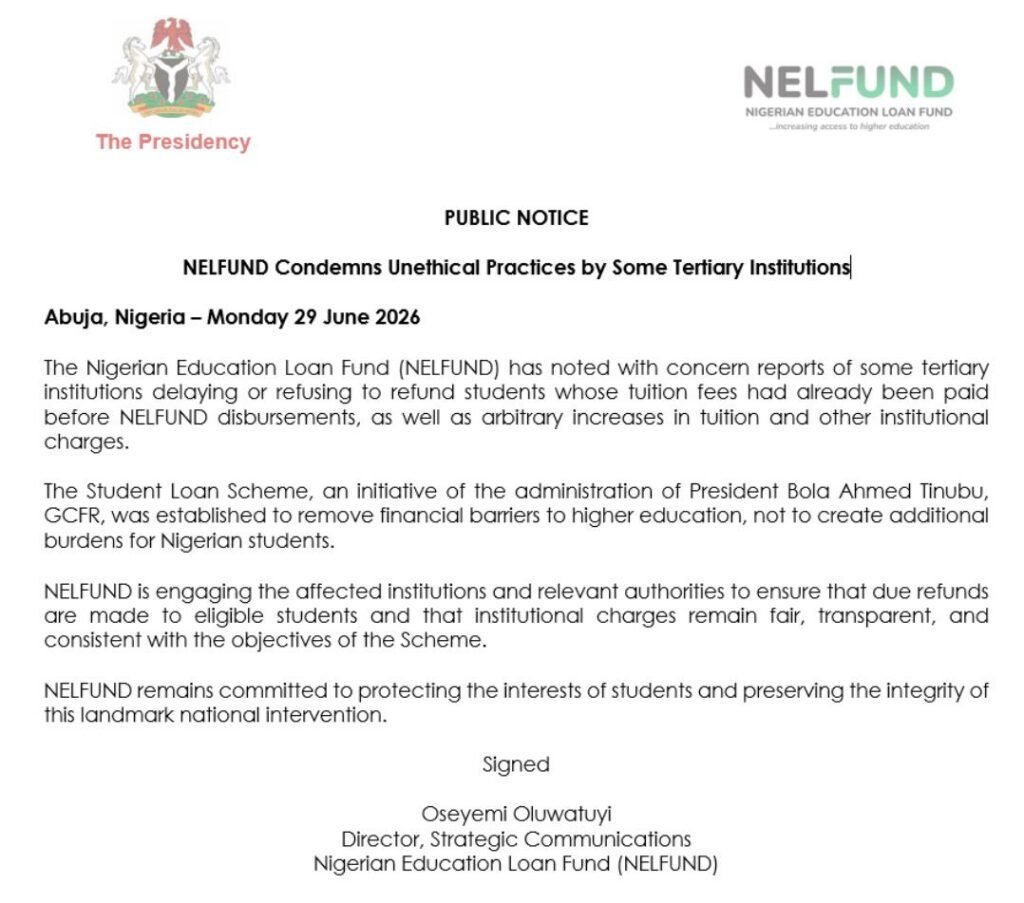
5. Fighting Misinformation: “The Scheme Has Not Been Suspended”: Because the programme is trending, fake notices have gone viral. NELFUND has had to issue multiple clarifications:
April 2026: Debunked a fake letter claiming “temporary pause” of disbursements. “This document is fake. NELFUND has not issued any such directive”
May 2026: Dismissed AI-generated reports alleging suspension of upkeep allowances
June 2026: Reaffirmed that upkeep payments are continuing as scheduled
NELFUND’s advice: “Rely only on official channels for verified updates”.
6. Challenges and Next Steps: NELFUND MD Akintunde Sawyerr notes some delays come from schools’ weak IT systems and varied academic calendars. There have also been protests over delayed refunds at some universities like Gombe Varsity.
Funding-wise, NELFUND is set to receive 25% of proceeds from a new 4% Development Levy on company profits starting January 1, 2026, under the National Taxation Act 2025.
Bottom Line
Launched on May 24, 2024, NELFUND has moved from zero to over 1 million applications and N206 billion+ disbursed in two years. With a push toward 7 million beneficiaries, it’s positioning itself as the Federal Government’s main tool to keep indigent students in school.