


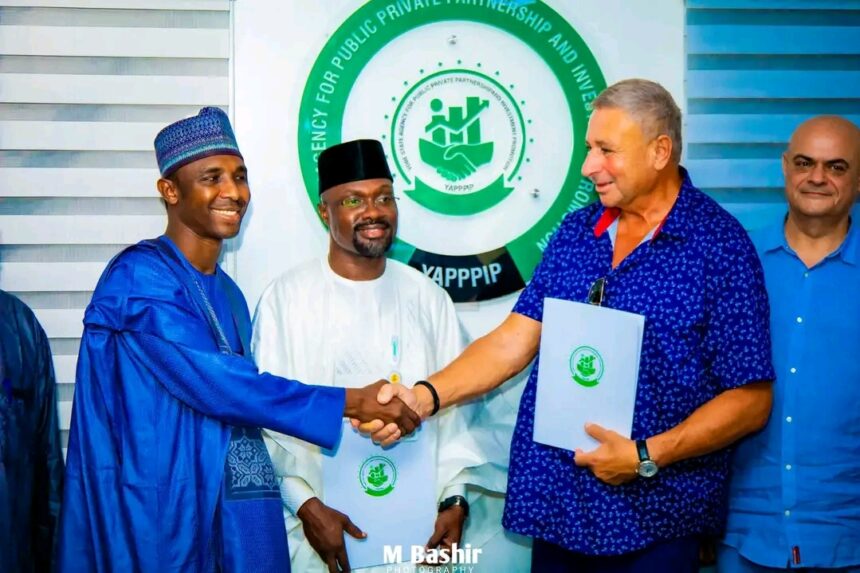
Yobe State Government and Russian investors have signed a Memorandum of Understanding on a proposed gas-powered electricity project for the state’s Special Agro-Industrial Processing Zone.
The agreement followed technical discussions between the state government and a delegation from Legion Investment Moscow, led by Leonid Khasiev, on developing a dedicated power solution for the agro-industrial zone.
The proposed electricity project is expected to provide power for agro-processing, manufacturing, storage, cold-chain facilities, irrigation, logistics and other industrial activities within the SAPZ.
The development followed a courtesy visit by the Russian delegation to Governor Mai Mala Buni, after which the investors held a technical engagement with relevant government officials and experts on the proposed energy solution.
During the technical discussions, the parties examined the power requirements of the SAPZ, investment considerations, infrastructure integration and the long-term sustainability of the proposed gas-powered plant.
As part of the assessment, the delegation visited the Maiduguri Gas Plant and the Yobe Transmission Plant to inspect existing infrastructure and explore possible opportunities for integrating the proposed power project with available facilities.
The proposed plant is expected to provide an energy backbone for the SAPZ, which is being developed as an integrated agro-industrial zone linking agricultural production with aggregation, processing, storage, logistics and market access.
The initiative is also intended to support Yobe’s efforts to move from dependence on the production and sale of raw agricultural commodities towards greater local processing and value addition.
Officials involved in the engagement said reliable electricity would be critical to the operation of processing facilities, cold-chain infrastructure, irrigation systems and other businesses expected to operate within the zone.
The Managing Director and Chief Executive Officer of the Nigeria Food Corporation and Special Adviser to Governor Buni on Food Security described the engagement as significant to the state’s efforts to develop an integrated food and agro-industrial economy.
He said food security should not be viewed solely in terms of agricultural production, stressing that energy, processing facilities, storage, transportation, investment and access to markets were equally important.
According to him, the Nigeria Food Corporation would continue to support strategic partnerships, the revitalisation of agro-processing assets and mobilisation of investment across critical agricultural value chains.
The discussions also focused on how the proposed electricity project could be integrated with existing infrastructure to provide a more dependable energy supply for industries within the agro-industrial zone.
For Yobe, the planned SAPZ is part of a broader strategy to expand the economic role of agriculture by connecting farmers and producers to processing facilities, storage infrastructure, transportation networks and markets.
The state government is also seeking to reduce post-harvest losses by creating facilities where agricultural commodities can be processed and preserved closer to their production areas.
The project is expected to support employment opportunities and investment in agricultural value chains if the proposed infrastructure and associated industrial facilities are successfully developed.
The signing of the MoU marks a further step in the discussions between Yobe State and the Russian investors, although the project will still require the implementation of the agreed technical, investment and infrastructure arrangements before the proposed power solution becomes operational.
With electricity identified as one of the major requirements for the successful operation of the SAPZ, the proposed gas-powered plant could form an important component of the infrastructure required to support industrial-scale agro-processing in the state.
The development also reflects the government’s effort to link agricultural production with energy, processing, storage, logistics and markets rather than treating the sectors as separate components of the state’s economic development programme.
West Trybe reports that Yobe’s push for a dedicated power solution for the SAPZ comes amid efforts by states across Nigeria to increase agricultural value addition, reduce dependence on raw commodity exports and attract private investment into agro-processing. For Yobe, the success of the initiative will depend not only on securing reliable electricity but also on the completion of processing, storage, transport and market infrastructure needed to connect farmers with industrial buyers and consumers.