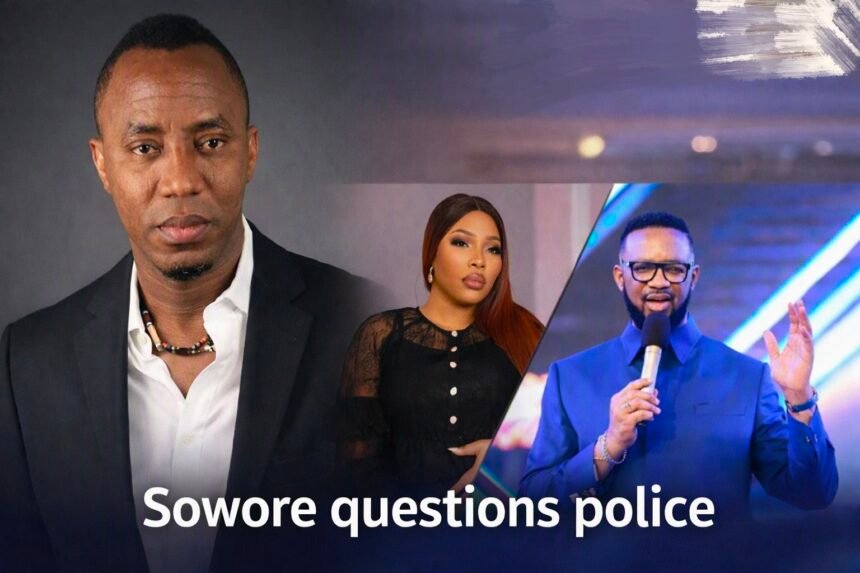
Doris Ogala’s arraignment over allegations involving Pastor Chris Okafor has drawn criticism from human rights activist Omoyele Sowore, who accused the authorities of weaponising the Cybercrimes Act against Nigerians. Sowore questioned why a dispute linked to an alleged relationship with a pastor had escalated into a criminal prosecution, raising concerns about personal disputes, police conduct and the protection of constitutional rights.
In a statement published on his Facebook page, Sowore condemned the Nigeria Police Force over Ogala’s remand at the Kirikiri Correctional Centre in Lagos. He argued that the law should not be used to intimidate individuals or protect influential personalities.
However, the charges against the Nollywood actress go beyond the alleged relationship itself. The prosecution accuses her of offences involving intimate images, electronic communications and alleged threats against the cleric. Ogala has pleaded not guilty.
Sowore Questions Police Over Doris Ogala’s Case

Reacting to the development, Sowore criticised what he described as the weaponisation of cybercrime legislation and questioned the decision to prosecute Ogala.
He wrote: “How could anyone be arraigned simply over allegations of having an affair with a pastor? And how could the police actually take such a matter before a Federal High Court judge?”
Sowore also alleged that law enforcement authorities were acting in the interests of influential figures. He warned against using the police and judiciary to settle personal disputes or shield powerful religious personalities from scrutiny.
“The Nigeria Police Force has no business turning private relationships into criminal prosecutions or deploying the Cybercrimes Act as a weapon of intimidation,” he added.
The activist’s comments have placed renewed attention on the circumstances surrounding Ogala’s prosecution and the distinction between allegations about a private relationship and the specific offences listed in the charge.
His remarks are an expression of his position on the case, rather than a judicial finding that the prosecution is unlawful.
Why Was Doris Ogala Arraigned?

Ogala was arraigned on Wednesday, October 28, 2026, before the Federal High Court in Lagos. The charges were brought by the Office of the Attorney-General of the Federation, and she pleaded not guilty.
During the proceedings, prosecution counsel Tolulope Mokolu alleged that Ogala published intimate photographs of Okafor on her social media accounts without his consent. The prosecution said the alleged conduct occurred between September 2024 and March 2026.
The prosecutor further alleged that she disseminated videos, recordings and electronic messages containing information she allegedly knew to be false, with the intention of bullying, threatening, intimidating or harassing the cleric.
Another allegation concerns threats to publish further intimate or damaging material unless Okafor compensated her or bought her a house.
The prosecution argued that the alleged conduct violated provisions of the Cybercrimes (Prohibition, Prevention, etc.) Amendment Act, 2024, including Sections 24(1)(a), 24(2)(a) and 24(2)(c).
These allegations remain before the court. Ogala’s not-guilty plea means the prosecution must establish its case through the judicial process.
The case therefore involves allegations about electronic communications and the publication of private material, rather than a charge simply accusing the actress of having an affair with a pastor.
Court Remands Doris Ogala Pending Bail Hearing
Following Ogala’s plea, the prosecution asked the court to remand her and schedule further proceedings. Mokolu told the court that he had received the actress’s bail application that day and needed time to study it and file a response.
Ogala’s defence counsel, N. C. Atulomah, opposed her continued detention and urged the court to exercise its discretion in favour of bail. He also undertook to produce her for subsequent proceedings.
Justice Akintayo Aluko held that the defence had not presented sufficient grounds to justify her immediate release at that stage. The judge ordered an accelerated hearing of the bail application and directed that Ogala remain at the Kirikiri Correctional Centre pending its determination.
The matter was adjourned until Friday, October 30, 2026, for the hearing of the bail application.
The remand order does not amount to a finding that Ogala is guilty of the offences alleged against her. The court is yet to determine the criminal case.
Sowore Raises Concerns About Fair Hearing

Beyond the charges, Sowore questioned the handling of the case and expressed concern about what he described as possible judicial partiality in matters involving pastors.
He argued that Ogala, who is the African Action Congress governorship candidate in Abia State, should receive the full protection of her constitutional rights, including due process and a fair hearing.
“The police must stop criminalising private disputes, and the judiciary must never become an instrument of religious influence or personal vendettas. This abuse must end!” he wrote.
His statement places the case within a wider debate about the application of cybercrime laws, freedom of expression and the boundaries between personal disputes and criminal conduct.
Those concerns, however, must be distinguished from the legal questions the court has to decide: whether the prosecution can prove the allegations against Ogala and whether the applicable law supports the charges.
What Happens Next in Doris Ogala’s Case?

The immediate next step is the hearing of Ogala’s bail application, scheduled for October 30, 2026. The court’s decision will determine whether she can be released on bail while the case continues.
The substantive allegations remain unresolved. Ogala has pleaded not guilty, and the prosecution must establish its claims through the court process.
Meanwhile, Sowore’s intervention has brought additional public attention to the case, particularly his argument that the authorities should not use cybercrime legislation to pursue private disputes or intimidate individuals.
As proceedings continue, the key issues will be the evidence presented by both sides, the court’s interpretation of the relevant legal provisions and the protection of the defendant’s right to a fair hearing.