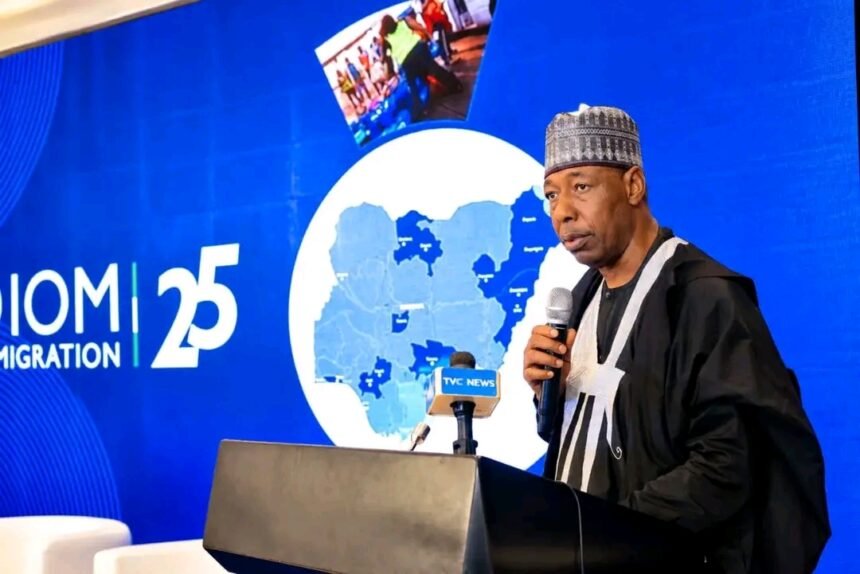
Borno State Governor, Babagana Umara Zulum, has urged humanitarian organisations and international development partners to prioritise permanent housing, employment opportunities and infrastructure in their interventions for people displaced by insurgency in the North-East.
He said emergency food supplies and other forms of humanitarian assistance should be complemented by long-term recovery programmes that would enable displaced families to rebuild their communities, restore their livelihoods and become economically independent.
Zulum made the appeal on Saturday at the 25th anniversary celebration of the International Organization for Migration in Nigeria, held at the Abuja Continental Hotel.
The event brought together government officials, diplomats, development partners and other stakeholders to review the organisation’s humanitarian interventions in Nigeria and discuss its priorities for the next 25 years.
The governor said the prolonged insurgency in the North-East had left thousands of families without homes, farmlands and other sources of livelihood, forcing many to depend on humanitarian assistance in internally displaced persons’ camps.
He noted that the consequences of the conflict were not limited to Nigeria, as neighbouring Cameroon, Chad and Niger had also experienced the effects of insecurity and population displacement.
According to him, addressing the humanitarian crisis requires sustained cooperation among affected countries, international organisations and development partners.
Zulum commended the IOM for its contributions to humanitarian operations and efforts to improve the living conditions of displaced persons in Borno State and other parts of the North-East.
However, he maintained that the next phase of intervention should focus more on addressing the conditions that prevent displaced people from returning to normal life.
He called for increased investment in permanent and semi-permanent shelters, describing adequate housing as a critical requirement for families seeking to rebuild their lives after years of displacement.
The governor also identified livelihood support as an important component of recovery, arguing that affected households needed sustainable economic opportunities rather than prolonged dependence on relief materials.
He urged development partners to support programmes that would enable displaced persons to engage in farming, trading and other productive activities.
Zulum further stressed the importance of infrastructure development in communities affected by insurgency, saying access to basic facilities would be necessary to support the return and reintegration of displaced families.
He also called for environmental restoration as part of broader recovery efforts, noting that communities recovering from conflict require interventions capable of restoring their economic and social activities.
The governor reaffirmed his administration’s commitment to working with the IOM and other international partners to strengthen recovery programmes, improve livelihoods and promote stability across conflict-affected communities in the North-East.
Borno has been among the states most affected by the Boko Haram insurgency, which has resulted in widespread destruction of homes, public infrastructure, schools, health facilities and agricultural livelihoods.
The conflict has also forced large numbers of residents to flee their communities, creating prolonged humanitarian needs and placing pressure on host communities and public services.
Although emergency assistance has remained central to the response, the transition towards durable solutions has become an important issue for governments and humanitarian organisations working in the region.
Such solutions generally involve creating conditions for displaced people to return voluntarily and safely to their communities, integrate into host communities or rebuild their lives elsewhere.
The IOM’s anniversary celebration provided an opportunity for stakeholders to examine its work in Nigeria and discuss future cooperation in migration management, humanitarian assistance, community recovery and development.
The organisation has worked with government institutions and other partners on interventions addressing displacement, migration-related challenges and the needs of vulnerable populations.
Zulum’s appeal comes as authorities and development partners continue to confront the challenge of moving communities affected by years of insurgency from emergency dependence towards sustainable recovery.
West Trybe reports that the governor’s position underscores the need for a stronger connection between humanitarian relief and long-term development in the North-East, particularly through housing, livelihood opportunities and infrastructure that can support the safe return and reintegration of displaced families.