


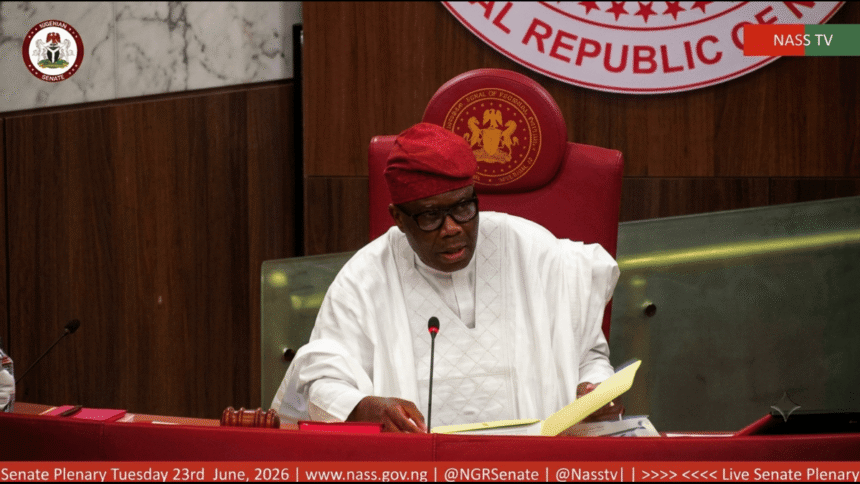
Nigeria’s Senate votes Wednesday, June 24, 2026, on the State Police Bill, a constitutional amendment that would allow each of Nigeria’s 36 states to establish its own police force.
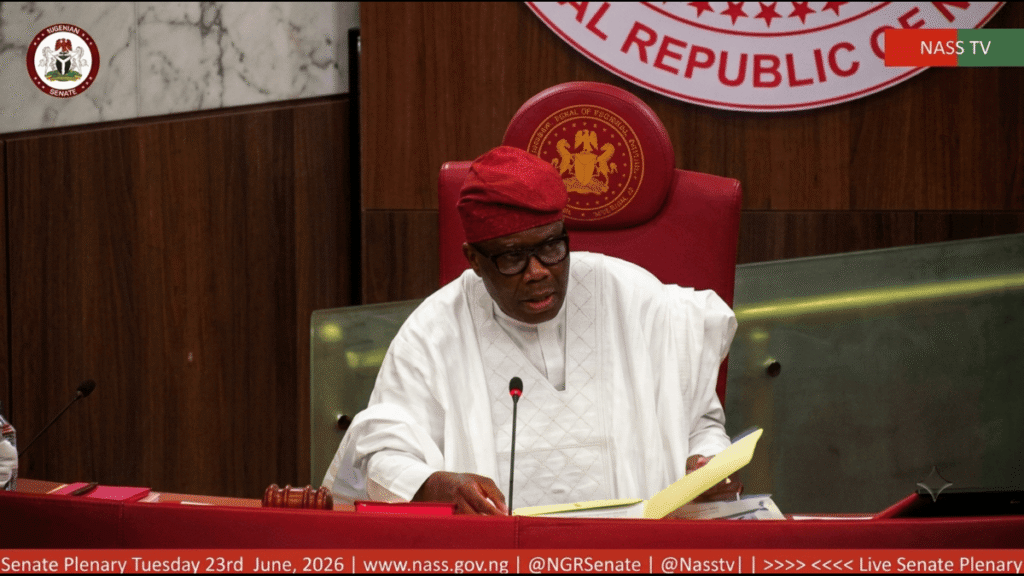
Nigeria’s Senate votes Wednesday, June 24, 2026, on the State Police Bill, a constitutional amendment that would allow each of Nigeria’s 36 states to establish its own police force.
Nigeria’s Senate convened Wednesday morning at the National Assembly Complex in Abuja to vote on the State Police Bill, a constitutional amendment that would allow each of Nigeria’s 36 states to establish its own police force. The bill sat at the top of the agenda.
Passage requires a two-thirds majority. That threshold already defeated the chamber once this session, forcing Senate President Godswill Akpabio to cut short the recess and recall lawmakers to Abuja three weeks early for a special sitting that began at 11:00 a.m.
The recall came through a memo dated June 15 from Senate Clerk Emmanuel Odo, formally convened at Akpabio’s instance to consider matters of urgent national importance, with national security identified as the primary driver. But the political urgency was unmistakable long before the memo went out.
On Tuesday, June 23, Akpabio read to the chamber a presidential letter dated June 15, in which President Bola Tinubu formally transmitted an executive version of the bill for consideration. The Senate had already pledged to conclude the bill that same day.
Formally titled the Constitution of the Federal Republic of Nigeria (Alteration) State Police Bill, 2026, the legislation seeks to amend the 1999 Constitution to shift policing from the Exclusive Legislative List to the Concurrent Legislative List, enabling state governments to establish police formations alongside the federal force.
Akpabio addressed the chamber in terms that reached back to independence. “Since 1960, Nigeria has not had the courage to decentralize policing,” he told senators. “This is the first time we are taking that step.” He credited the Constitution Review Committee with two years of sustained work on what he called an epoch-making bill.
Senate Leader Opeyemi Bamidele, who sponsored the legislation, warned colleagues that every seat needed to be filled. “We need a minimum of two-thirds of distinguished senators to be able to vote on constitutional alteration,” he told the chamber, framing the measure as one that transcended party lines and regional interests.
Bamidele catalogued the security failures driving the bill: terrorism, banditry, mass abductions, farmer-herder clashes, armed robbery, cultism, communal violence, pipeline vandalism, and cyber-enabled crimes. Yet he did not sidestep the abuse question, pointing to State Police Service Commissions, federal oversight through the Federal Police Service Commission, and legislative confirmation of senior appointments as built-in safeguards.
Across the street at the House of Representatives, the bill had already passed by a margin that left little doubt, with 289 lawmakers voting in favor, one against, and none abstaining. And should the Senate clear the two-thirds bar, both chambers will form a joint conference committee to reconcile their respective versions.
After reconciliation, the harmonized bill heads to all 36 State Houses of Assembly for ratification, as the constitution requires for any alteration. That process will take its own time.
One security commentator drew the sharpest line on the risks, telling this newspaper, “Governors must be told to be decisive in the use of these powers, not to turn state security into a system of negotiation with terrorists and bandits. ” State police, he added, “can strengthen Nigeria, but only if power is clearly defined, properly supervised, and never allowed to become a tool for political misuse.”
Wednesday’s vote will determine whether Nigeria’s 66-year experiment with centralized federal policing finally gives way to a dual-force structure. Akpabio pledged to push proceedings through a Committee of the Whole sitting and wrap up before the chamber rises for recess.