
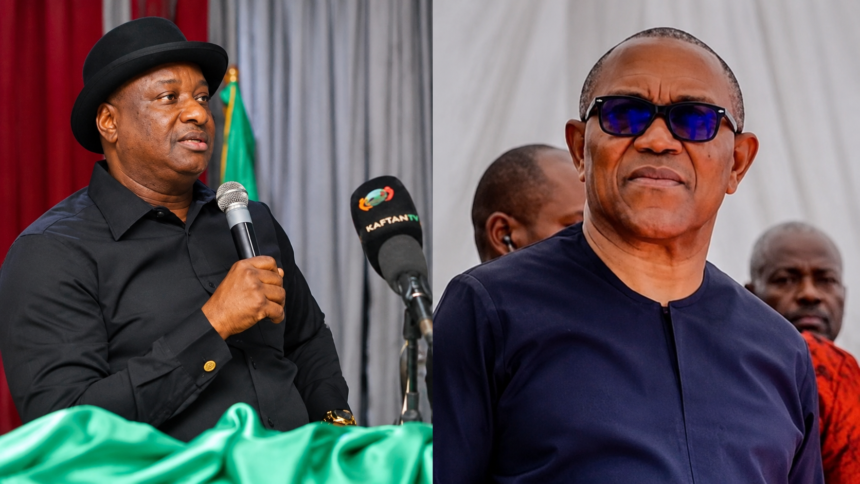
A routine airport parking enforcement has exploded into a public face-off between Nigeria’s Minister of Aviation and Aerospace Development, Festus Keyamo, and former Labour Party presidential candidate, Peter Obi.
What began with a clamped vehicle at Nnamdi Azikiwe International Airport has now drawn in questions of law, privilege, and how rules are applied at Nigeria’s busiest airports.
What Happened At Abuja Airport On July 4
According to footage released by the Minister, Obi’s vehicle was clamped on July 4 at the Nnamdi Azikiwe International Airport, Abuja. The violation occurred after the driver allegedly parked unattended in a designated drop-off zone for about 30 minutes.
Airport drop-off zones are designated for quick passenger offloading and are monitored to prevent gridlock and security breaches.
Obi later described the incident as “targeted harassment” during an interview. He argued that the treatment was selective and politically motivated.
Minister Keyamo rejected that claim. He insisted the action was standard enforcement and not personal. In a public statement, Keyamo accused Obi of breaking airport regulations and then “crying foul” when consequences followed.
Keyamo’s Demand: Apology, Fine, Or Further Action

The Minister has given Obi one week to take two steps or face additional sanctions from the Federal Airports Authority of Nigeria, FAAN.
First, a public apology to airport staff. Second, payment of a N25,000 fine for the parking infraction. Keyamo framed the demand as a matter of principle: no one is above airport rules, regardless of status. “We will deal with it according to the law,” he has maintained in other aviation disputes, stressing that essential services like aviation must not be disrupted.
FAAN officials have not released a separate statement, but the Minister’s directive signals that enforcement will proceed if the deadline passes.
A History Of Airport Confrontations
This is not the first time Nigeria’s aviation sector has been in the spotlight over conduct at airports. In recent months, the ministry has had to manage several high-profile incidents. These include a clash between Senator Adams Oshiomhole and Air Peace staff at Lagos’ Murtala Muhammed Airport after the senator allegedly arrived late for a flight, and the case of an Ibom Air passenger who was charged to court and remanded after an altercation with cabin crew.
Obi himself has commented on those cases, accusing the Ministry of “double standards” and demanding that “justice must be served to all, and it must be served fairly”. He argued that while some individuals face swift action, others with influence appear to escape similar scrutiny.
Keyamo has responded to past incidents by ordering probes and directing agencies to “exercise restraint in jumping to conclusions” until all sides are heard. He has also warned that aviation is an essential service and disruptions will not be tolerated.
Rules vs VIP Culture
Industry observers say the Obi incident highlights a deeper issue at Nigerian airports: the tension between enforcement and what many call a “VIP culture.”
Under Part 17 of the Nigerian Civil Aviation Regulations, airport aprons and operational zones are Security Restricted Areas with access limited to authorized personnel. Yet experts note that high-profile individuals are sometimes allowed to bypass checkpoints, while ordinary travelers face strict screening.
Keyamo has previously moved to crack down on such practices. He has ordered investigations into security breaches and repeatedly emphasized that rules must apply uniformly.

For his part, Obi has positioned himself as an advocate for fairness and for supporting Nigerian institutions. After a separate incident involving Air Peace, he urged political leaders to “give strong and deliberate support to indigenous businesses” instead of harassment. He has also praised Air Peace for its professionalism on international routes.
The one-week ultimatum now puts the ball in Obi’s court. If he complies, the matter ends with an apology and the N25,000 penalty. If not, FAAN is expected to take further enforcement action.
Beyond the fine, the episode has reignited debate about how Nigeria balances security, order, and equity at its airports. With passenger traffic rising and the government pushing a cashless policy at airport toll gates, authorities say strict adherence to rules is non-negotiable.
For Keyamo, the message is clear: airport regulations exist to protect all users. For Obi and his supporters, the issue is whether those rules are applied without bias.
As both sides stand firm, Nigerians will be watching to see if this parking clash ends with compliance, or becomes the latest test case for accountability in public spaces.