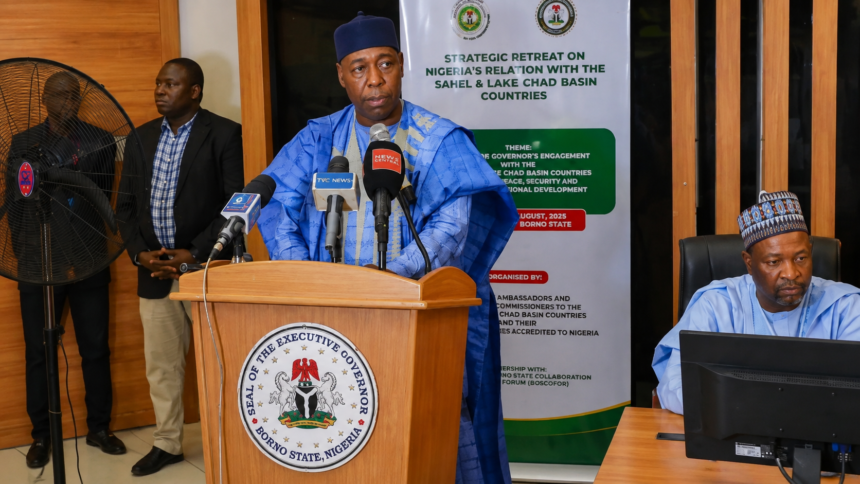
Borno State Governor, Babagana Umara Zulum, has called for stronger regional cooperation among Sahel countries to confront terrorism, insurgency and the wider security crisis threatening communities across the region.
Zulum made the call on Saturday during a high-level retreat with representatives of Sahel countries and ambassadors in Maiduguri, where participants deliberated on coordinated strategies to counter terrorist groups and strengthen regional security.
The retreat, held at the conference hall of the Musa Usman Secretariat, brought together government officials, diplomats and representatives of countries affected by the growing security challenges across the Sahel.
The meeting also reinforced Maiduguri’s emerging role as a centre for discussions on counter-terrorism, stabilisation and post-conflict recovery, given the city’s experience at the centre of Nigeria’s prolonged battle against Boko Haram and the Islamic State West Africa Province.
Addressing participants, Zulum said the scale and cross-border nature of terrorism required countries in the region to work together rather than pursue isolated security responses.
He maintained that military operations remained essential in confronting terrorist groups but argued that armed force alone could not permanently resolve the insecurity, displacement and socioeconomic problems created by years of insurgency.
“While our armed forces continue their brave operations, we must enhance intelligence sharing, community-based border management, and joint stabilisation initiatives alongside the Multinational Joint Task Force,” Zulum said.
The governor called for stronger intelligence-sharing mechanisms among neighbouring countries, saying terrorist groups could exploit gaps between national security systems and porous borders to move personnel, weapons and resources.
He also advocated greater attention to border management, rehabilitation and reintegration of affected populations, humanitarian assistance and development programmes as part of a broader strategy for achieving lasting peace.
According to him, communities affected by prolonged violence require more than military protection, stressing that rebuilding livelihoods and restoring basic services are critical to preventing renewed instability.
The governor’s position was shaped by Borno’s experience with the Boko Haram insurgency, which has resulted in widespread displacement, destruction of public infrastructure, loss of livelihoods and disruption of education and healthcare across many communities.
He urged participating countries to strengthen cooperation through existing regional security mechanisms, including the Multinational Joint Task Force, while developing complementary initiatives capable of addressing emerging threats.
Also speaking at the retreat, the Minister of State for Foreign Affairs, Sola Enikanolaiye, called for deeper regional collaboration to tackle terrorism and other security threats confronting countries across the Sahel.
Enikanolaiye said governments must look beyond military responses and address the underlying factors that create conditions for violent extremism and instability.
He urged countries in the region to intensify collective efforts to tackle the root causes of insecurity while strengthening cooperation between security agencies and diplomatic institutions.
The minister stressed that sustainable security would require coordinated action involving political authorities, security institutions, communities and development partners.
The Permanent Secretary of the Ministry of Foreign Affairs, Dunoma Umara, also underscored the importance of regional stability to Nigeria’s national security and economic interests.
He noted that Nigeria’s historical, cultural and economic links with neighbouring Sahel countries meant that instability in one country could have consequences for others.
According to him, insecurity across national borders could facilitate the movement of arms and terrorists while contributing to displacement and disrupting legitimate trade and economic activities.
He therefore called for stronger regional mechanisms capable of addressing threats before they spill across national boundaries.
The Ambassador of Chad to Nigeria, Brah Mahamat, urged countries in the region to maintain a united front against terrorism despite their membership of different regional political and economic blocs.
Mahamat warned that differences between regional organisations should not prevent countries from cooperating on matters of common security.
“Although we belong to different institutional groupings, this should in no way impede our common security,” the ambassador said.
He said terrorist organisations were not constrained by the boundaries separating regional blocs and would continue to exploit weaknesses in cooperation between neighbouring countries.
“Let us be clear: the enemy cares little whether we belong to CEMAC, ECOWAS or the AES. Its aim is to continue slipping across our borders, exploiting the operational limitations we have imposed upon ourselves,” Mahamat added.
His remarks highlighted the complex regional environment in which terrorist organisations operate, with armed groups taking advantage of vast territories, difficult terrain, porous borders and limited state presence in some communities.
The retreat also examined the importance of combining security operations with stabilisation and development programmes in communities affected by terrorism.
Participants emphasised the need for better intelligence exchange, coordinated border operations and joint initiatives aimed at rebuilding communities that have suffered years of conflict.
For Borno, such cooperation remains particularly important because the state has been at the forefront of Nigeria’s counter-insurgency campaign for more than a decade.
The Boko Haram insurgency has affected communities across the Lake Chad Basin, with the conflict extending beyond Nigeria into neighbouring Chad, Cameroon and Niger.
The activities of terrorist factions in the region have consequently made cross-border security cooperation a central component of efforts to prevent further attacks and restrict the movement of insurgents.
Beyond military operations, the participants recognised that long-term stability would require investment in education, employment, livelihoods, infrastructure and humanitarian assistance for communities affected by terrorism.
West Trybe reports that the Maiduguri retreat underscores the increasingly regional nature of the Sahel’s security crisis, where terrorism, porous borders and socioeconomic vulnerabilities transcend national boundaries. For Borno, which has remained at the frontline of Nigeria’s battle against Boko Haram and ISWAP, the gathering provides an opportunity to push for stronger intelligence cooperation, coordinated border management and joint stabilisation efforts capable of complementing military operations and supporting lasting peace across the region.