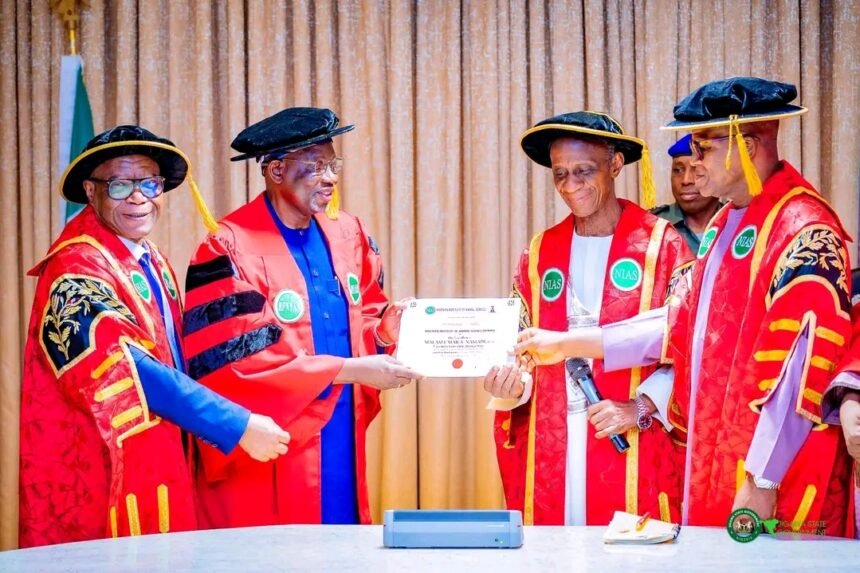
The Nigerian Institute of Animal Science has conferred an honorary fellowship on Jigawa State Governor, Malam Umar Namadi, in recognition of his administration’s reforms and investments in the livestock sector.
The award was presented on Wednesday during a courtesy visit by a delegation of the institute, led by its President, Prof. Suleiman Elias Bogoro, to the Government House, Dutse.
In a statement issued on Thursday by the Chief Press Secretary to the Governor, Hamisu Mohammed Gumel, the institute said Jigawa had emerged as a national reference point in livestock development because of the administration’s efforts to build a modern and commercially viable industry.
Presenting the fellowship, Bogoro said the institute recognised leaders who had translated policy commitments into measurable improvements in the livestock subsector.
“When the Governing Council and the Board of Fellows of NIAS surveyed the national landscape to identify leaders who have translated policy rhetoric into tangible and verifiable impact on the livestock sub-sector, Jigawa State emerged as an undisputed national pace-setter,” he said.
He described the state as a benchmark for modern animal husbandry in sub-Saharan Africa under Namadi’s 12-Point Agenda.
Bogoro highlighted the establishment of a separate Ministry of Livestock Development and the appointment of a professional animal scientist as its pioneer commissioner among the administration’s major initiatives.
He also cited the establishment of a Faculty of Agriculture with a Department of Animal Science at Sule Lamido University, Kafin Hausa, as part of efforts to strengthen research and professional training in the sector.
The NIAS president commended the state government’s sponsorship of 16 technical officers for specialised training at the National Dairy Development Board in India, where they received training in artificial insemination, advanced breeding technologies, disease control, and feed and fodder development.
Other initiatives he identified included a $10m partnership with Srinivasa Farms for poultry development, the empowerment of 2,350 widows through the Goat Breeding Micro-Credit Scheme, the development of integrated cattle ranches and the 100,000-hectare Jigawa Alfalfa Value Chain Project.
He also acknowledged investments in livestock extension services across the state’s 287 political wards, the demarcation and gazetting of grazing reserves and stock routes, and the modernisation of the Maigatari International Livestock Market.
Bogoro said the institute was ready to deploy the expertise of its registered animal scientists to support Jigawa in feed quality control, standardisation, hatchery and breeder farm certification, and capacity development for livestock workers.
Responding, Namadi expressed appreciation to the institute, describing the recognition as encouragement for his administration to sustain and strengthen its livestock development programme.
The governor said the creation of the Ministry of Livestock Development followed deliberate planning, including baseline assessments, feasibility studies and visits to countries with advanced livestock industries.
He explained that the government’s strategy was designed to expand economic opportunities, improve food security, create jobs and promote peace and stability by integrating pastoralist communities into the wider economy.
Namadi commended the pioneer commissioner and other personnel of the ministry for their commitment, while assuring the institute of his administration’s readiness to deepen collaboration.
He also pledged to provide land for the establishment of a proposed NIAS office in Jigawa State.
The governor further disclosed that the state government’s 2027 budget would make substantial provision for the livestock sector, assuring stakeholders of continued investment in the industry.
The statement was signed by Gumel on November 19, 2026.
West Trybe reports that the recognition places fresh attention on Jigawa’s livestock development agenda, with the proposed partnership offering an opportunity to strengthen professional standards, technical capacity and commercial investment in the sector.