


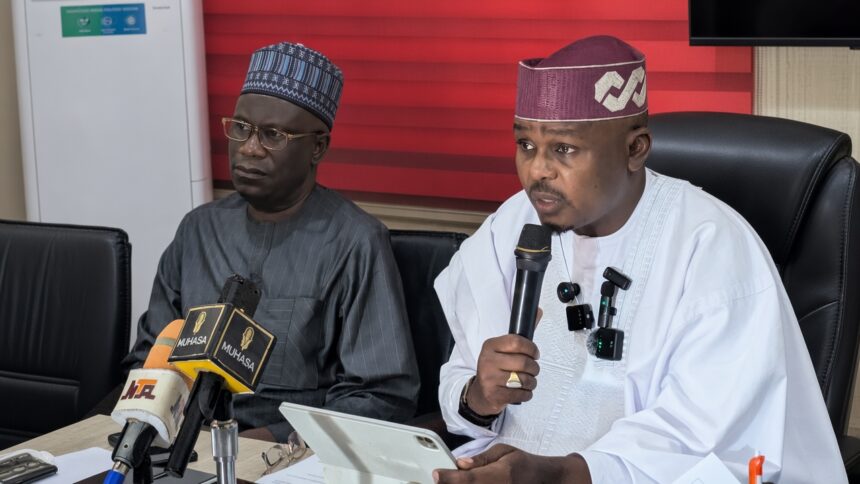
The Kano State Government says it has committed N996.29bn to 1,557 development projects across the state in nearly three years, with 867 projects already completed.
The Commissioner for Public Procurement, Projects Monitoring and Evaluation, Nura Maaji Sumaila, disclosed this on Sunday at an international press briefing on the administration’s project implementation, geographical distribution, procurement compliance and financial performance.
Sumaila said the projects were spread across the state’s 44 local government areas, with 654 projects currently ongoing, while 26 projects were at the award stage and 10 others had been prepared for award.
“The data before us shows that Kano State has committed N996.29bn to 1,557 projects across the 44 local government areas, with 867 projects, representing 55.68 per cent, already completed,” the commissioner said.
He explained that the 867 completed projects represented 55.68 per cent of the total number of projects captured in the government’s records, while the 654 ongoing projects accounted for about 42 per cent.
According to him, the figures reflected the government’s investment in infrastructure and other development initiatives since the administration of Governor Abba Kabir Yusuf assumed office.
Sumaila said the ministry had also strengthened its oversight of procurement and government spending through the issuance of Certificates of No Objection and the vetting of payment certificates for projects executed by the administration.
He disclosed that N695.20bn of the cumulative contract value had received Certificates of No Objection approvals, while payment certificates worth N444.75bn had been vetted by the ministry.
“Of the N996.29bn cumulative contract value, N695.20bn has received Certificates of No Objection approvals, while N444.75bn in payment certificates has been vetted by the ministry,” he said.
The commissioner said the Certificates of No Objection approvals represented 69.78 per cent of the cumulative contract value, while the vetted payment certificates accounted for 44.64 per cent.
He added that the ministry would continue to monitor projects from procurement through implementation and payment certification to ensure that public funds were used for their intended purposes.
“Our responsibility is to ensure that every naira committed to public development is subjected to appropriate procurement procedures, monitoring and accountability, and that these investments ultimately deliver tangible value to the good people of Kano State,” Sumaila said.
Giving a geographical breakdown of the projects, the commissioner said 598 projects valued at N299.36bn were located across the eight metropolitan local government areas.
He said another 653 projects, valued at N287.90bn, were being implemented across the 36 rural local government areas.
“Rural development remains a major component of this administration’s investment programme, with N287.90bn committed to 653 projects across the 36 rural LGAs,” Sumaila said.
The commissioner explained that the distribution demonstrated the government’s effort to spread development investments beyond the metropolitan areas and ensure that rural communities also benefited from major infrastructure projects.
He disclosed that 37 cross-cutting projects with a combined value of N159.50bn were designed to cover multiple local government areas.
Another 269 projects classified as statewide and other projects accounted for N249.54bn, he said.
According to him, the projects under the different categories included road construction and expansion, bridges, solar-powered street lighting, traffic management systems and inter-local government road projects.
Sumaila said the administration had prioritised major infrastructure projects capable of improving transportation, housing, urban development and economic activities across the state.
Among the major investments, he listed the N113.19bn mass housing project at Rijiyar Gwangwan in Dawakin Kudu Local Government Area.
He also identified the N24.77bn Katsina Road expansion project covering parts of Fagge and Dala local government areas as one of the major infrastructure investments.
Another major project, according to him, is the N21.90bn Modern Cities infrastructure project covering Dawakin Kudu, Dawakin Tofa and Kumbotso local government areas.
The commissioner further listed the N27.74bn Madobi-Yako-Kafin Maiyaki/Kiru Road project and the N22bn Rural Model City housing project covering the 36 rural local government areas.
He said the scale and financial value of some of the projects meant that simply counting the number of projects located in each local government area would not provide a complete picture of the government’s investment.
“The scale of these investments shows why government performance cannot be assessed simply by counting projects in each local government. Some single strategic projects are worth billions of naira and serve communities beyond one LGA,” Sumaila said.
He, however, acknowledged that some high-value projects were yet to commence because they remained at the award stage.
Among them, he mentioned the Dawakin Kudu mass housing scheme and the Rural Model City project, saying both were awaiting the completion of relevant due-process procedures.
Sumaila said the ministry would not compromise procurement requirements in its effort to ensure that government contracts were awarded transparently and executed in accordance with approved standards.
He assured citizens, development partners and other stakeholders that the ministry would continue to strengthen its monitoring and evaluation mechanisms.
He said the government remained committed to ensuring that projects were properly implemented, payments were subjected to necessary scrutiny and contractors delivered value for money.
The briefing also provided an opportunity for the government to present details of its project distribution and procurement processes to stakeholders and the international community.
The commissioner said the administration’s project monitoring framework was designed to improve transparency and enable government to identify challenges affecting project implementation and address them promptly.
He added that continuous monitoring would help prevent delays, ensure compliance with contractual obligations and protect public resources.
West Trybe reports that the N996.29bn investment comes amid increased emphasis by state governments on infrastructure development, procurement transparency and project monitoring. With 867 projects reportedly completed and 654 still ongoing, the figures presented by the Kano Government indicate a broad infrastructure programme covering urban and rural communities, although several major projects remain subject to procurement and award processes.