

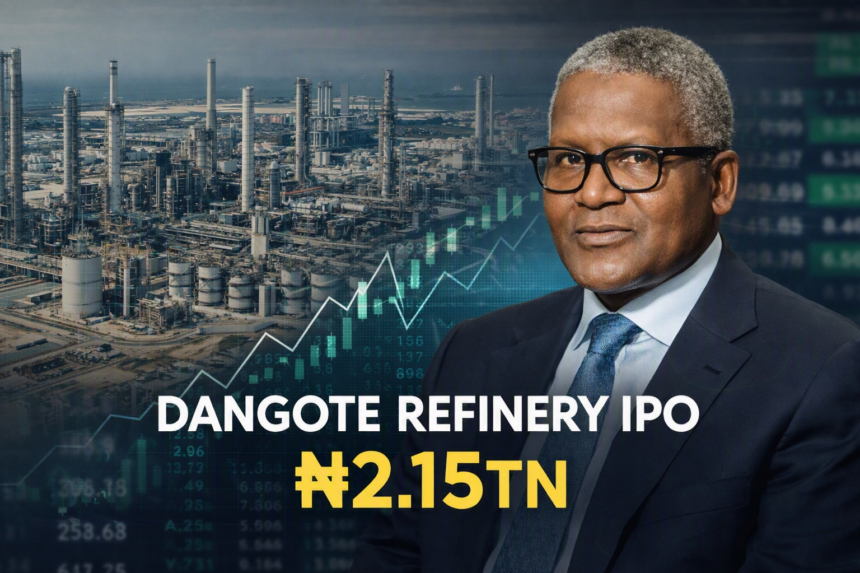
Dangote Refinery IPO has secured SEC approval for a ₦2.15 trillion share sale, with 4.1 billion shares priced at ₦525 as the refinery moves closer to a major Nigerian market listing.
Dangote Refinery IPO has taken a major step forward after Nigeria’s Securities and Exchange Commission (SEC) approved the proposed public offering of shares in the Dangote Petroleum Refinery and Petrochemicals FZE.
The approval clears the way for the refinery to offer 4.1 billion ordinary shares at ₦525 each, potentially raising about ₦2.15 trillion if the offer is fully subscribed. The transaction is shaping up to be one of the biggest capital-market deals in Nigeria and, according to Reuters, Africa’s largest-ever share sale.
The development comes just days after Aliko Dangote said the long-awaited IPO would open within 10 to 12 days, giving investors a clearer indication that the refinery’s transition into the public market is finally moving from preparation to execution.

SEC approval moves Dangote Refinery IPO forward
The SEC’s approval was communicated in a letter to Vetiva Advisory Services Limited, the lead issuing house for the transaction. The commission also registered the refinery’s existing 120.13 billion ordinary shares, providing the regulatory foundation for the proposed public offering.
The approval also allows the company to proceed with the next stages of the transaction, including its Completion Board Meeting and signing ceremony.
That distinction matters because the IPO is no longer simply a plan being discussed by the company. Regulatory approval has now been obtained for the proposed offer, bringing the refinery significantly closer to becoming a publicly traded business.
Earlier in June, the SEC had warned investors about unofficial promotions linked to a purported Dangote Refinery share sale.
At the time, the regulator said no IPO application had been submitted or approved and directed operators to stop soliciting funds or commitments from members of the public. The latest approval marks a significant change in that position.
₦525 share price sets the terms

Under the approved structure, investors will be offered 4.1 billion shares at ₦525 per share.
If all the shares are taken up, the offering could generate approximately ₦2.15 trillion, equivalent to roughly $1.6 billion based on the exchange-rate conversion cited by Reuters.
The size of the transaction makes it particularly significant for Nigeria’s capital market. Reuters described it as Africa’s largest-ever share sale, while the Dangote Group said it could rank among the biggest transactions in Nigerian capital-market history.
The company’s existing shares have also been registered by the SEC. Reuters calculated that the registration implies a total refinery valuation of about $47 billion, although the final market value will ultimately depend on investor demand and how the shares perform once trading begins.
Why the refinery is seeking fresh capital
The IPO is closely tied to Dangote’s plans to expand the refinery beyond its current scale. The facility, located near Lagos, has a designed refining capacity of 650,000 barrels per day. It reached its full nameplate capacity in February 2026 and has subsequently recorded a performance test of up to 700,000 barrels per day, according to Reuters.
Dangote has said the broader ambition is to double the refinery’s capacity to about 1.4 million barrels per day.

That expansion would transform an already massive facility into one of the largest refining operations anywhere in the world. Reuters reported that the funds raised through the public offering are intended to support the planned capacity increase.
The refinery currently produces petrol, diesel and aviation fuel for Nigeria and export markets. Its growing role has also changed the flow of refined petroleum products in the region, with the plant supplying customers across Africa and beyond.
Investors are watching the valuation closely
Despite the excitement around the IPO, the size of the valuation is likely to attract close attention from investors.
The refinery is an unusually large and strategically important industrial asset, but its valuation is considerably higher than some publicly traded refining companies used as international comparisons. Reuters noted that analysts have questioned the valuation relative to companies such as Turkey’s Tupras and U.S.-based HF Sinclair.
That means the success of the IPO will not depend only on the refinery’s size or importance to Nigeria. Investors will also be looking at profitability, crude supply, operating costs, export opportunities and the company’s ability to sustain strong production.
Crude supply is particularly important. Reuters previously reported that the refinery has faced challenges sourcing enough Nigerian crude at competitive prices and has increasingly relied on imported crude, including U.S. oil. Those costs could affect margins and remain an important issue for potential investors.

When will the Dangote Refinery IPO open?
The company is moving quickly toward the public offer.
Aliko Dangote said on September 3 that the IPO would open within 10 to 12 days. Reuters subsequently reported that the order book is expected to open on September 14, although investors should rely on the formal offer documents and official announcements for the confirmed timetable.
The offering is therefore entering a crucial phase. Once the offer opens, investor demand will provide the first major market test of how Nigerians and international investors view the refinery at its approved price.
For Dangote, the IPO is about more than raising money. It is also an opportunity to bring outside investors into one of the biggest industrial projects ever built in Nigeria while securing capital for the next stage of its expansion.

With SEC approval now secured, attention will shift from whether the Dangote Refinery will go public to how investors respond when the shares finally become available.
The ₦2.15 trillion target, ₦525 offer price and planned expansion to 1.4 million barrels per day have set the stage for a landmark transaction that could reshape Nigeria’s capital market and further strengthen the refinery’s position in Africa’s energy industry.