


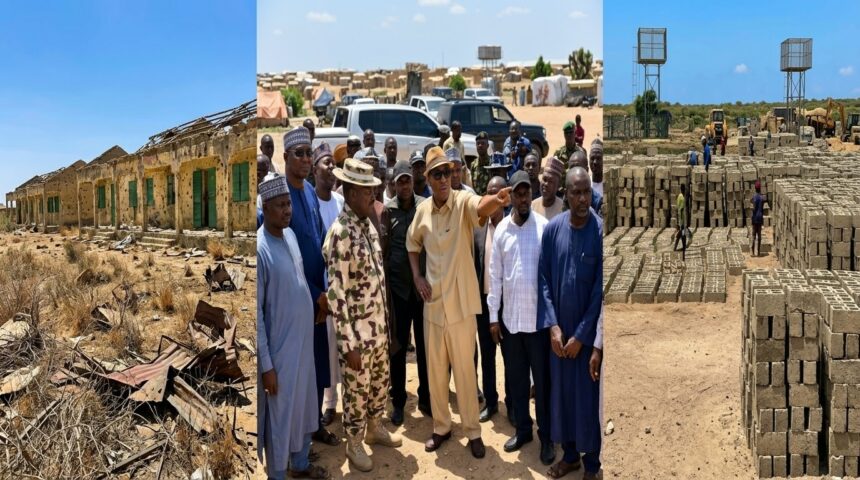
Borno State Governor, Babagana Umara Zulum, has ordered the immediate reconstruction of key public facilities in Malam-Fatori, Abadam Local Government Area, while directing the suspension of village and ward heads over their absence during his visit to the war-ravaged border community.
The governor announced the measures on Tuesday during a working visit to Malam-Fatori, where he inspected public infrastructure damaged by years of Boko Haram insurgency and engaged residents on the challenges confronting the community as displaced residents gradually return to their ancestral homes.
Malam-Fatori, located along Nigeria’s border with Niger Republic, has suffered extensive destruction and prolonged abandonment as a result of insurgency, leaving schools, government buildings, health facilities and residential structures in various states of disrepair.
Zulum’s latest intervention is aimed at restoring basic services and creating the conditions required for residents returning to the community to rebuild their lives and livelihoods.
During the inspection tour, the governor assessed several damaged facilities, including schools, government buildings and housing infrastructure, and directed the immediate construction of an Islamiyya school, primary and secondary schools as well as a hospital.
He said restoring basic public services was essential to ensuring that the return of residents translated into sustainable recovery rather than merely physical resettlement.
“Provision of basic amenities is critical to enabling returnees to rebuild their lives, restore livelihoods, and give their children a stronger foundation for the future,” Zulum said.
The governor’s directive came as residents highlighted some of the difficulties they face in returning to a community where years of conflict had disrupted education, healthcare, economic activities and other essential services.
Zulum, who interacted directly with residents during the visit, said government interventions must respond to the realities confronting communities emerging from prolonged conflict.
He stressed that rebuilding Malam-Fatori would require more than the rehabilitation of physical structures, noting that the restoration of education, healthcare, governance and security would be critical to achieving a durable return of civilian life.
The governor also visited the headquarters of the 68 Battalion of the Nigerian Army in Malam-Fatori, where he met the Commanding Officer, Lieutenant Colonel D. Y. Chuwar, alongside other senior officers and troops deployed to the area.
He commended the troops for their courage and commitment to maintaining security in the border community and supporting efforts to facilitate the return of civilians.
Zulum assured the military personnel that his administration would continue to provide necessary support, particularly essential supplies aimed at improving their welfare and operational effectiveness.
The visit to the military formation underscored the continuing importance of security in the government’s reconstruction efforts, especially given Malam-Fatori’s location in an area that has experienced prolonged insurgent activity.
For the governor, the rebuilding of the town must therefore proceed alongside efforts to maintain the security conditions necessary for residents to remain and resume normal economic and social activities.
However, Zulum’s visit also exposed what he considered a serious governance gap in the community.
The governor ordered the immediate suspension of all village and ward heads in Malam-Fatori after none of them was present during his visit.
He further directed that the process of appointing new traditional representatives should commence without delay to provide leadership for the returning population.
Zulum described the absence of the traditional leaders as unacceptable, particularly at a time when residents were returning and the government was intensifying efforts to rebuild the community.
“Traditional leaders have a critical role to play in stabilising communities emerging from conflict. Their presence is essential not only for maintaining communication between government and residents but also for strengthening community resilience and providing leadership as returnees settle into their ancestral homes,” the governor said.
He directed the Commissioner for Local Government and Emirate Affairs, Sugun Mai Mele, to work with the Shehu of Borno to begin the process of selecting new village and ward heads for Malam-Fatori.
According to the governor, the new traditional representatives must be people capable of responding to the peculiar challenges of a community emerging from years of displacement and destruction.
He specifically directed that those selected should demonstrate integrity, competence, commitment and ingenuity, while maintaining effective collaboration with government authorities, residents and security agencies.
The emphasis on traditional leadership reflects the government’s broader approach to rebuilding communities affected by insurgency, where local leaders often serve as the first point of contact between residents, government institutions and security agencies.
Malam-Fatori is the headquarters of Abadam LGA and one of the communities in Borno that suffered heavily during the height of the Boko Haram insurgency.
The prolonged conflict forced many residents to flee their homes, while public infrastructure deteriorated as government presence and economic activity were disrupted.
The gradual return of residents has consequently created pressure for the restoration of schools, healthcare facilities, administrative structures, roads, housing and other basic amenities required for sustainable reintegration.
The latest directives by the governor indicate that the state government intends to combine physical reconstruction with the restoration of local governance and public services.
The approach is also significant because the success of reconstruction in conflict-affected communities depends not only on rebuilding structures but also on restoring institutions and community leadership capable of sustaining stability.
Zulum was accompanied on the visit by the Chief Whip of the Senate, Senator Mohammed Tahir Monguno; the member representing Abadam Constituency in the Borno State House of Assembly, Jamna Bong; the Commissioner for Information and Internal Security, Professor Usman Tar; the Commissioner for Local Government and Emirate Affairs, Sugun Mai Mele; and the Commissioner for Education, Science, Technology and Innovation, Lawan Abba Wakilbe, among other government officials.
The presence of senior political and government officials during the inspection further highlighted the importance attached to the reconstruction of Malam-Fatori and the wider effort to restore government services to communities affected by insurgency.
West Trybe reports that Borno has in recent years intensified reconstruction and resettlement efforts in several communities affected by insurgency, with the restoration of public infrastructure and security remaining central to the state’s strategy for encouraging displaced residents to return home.