

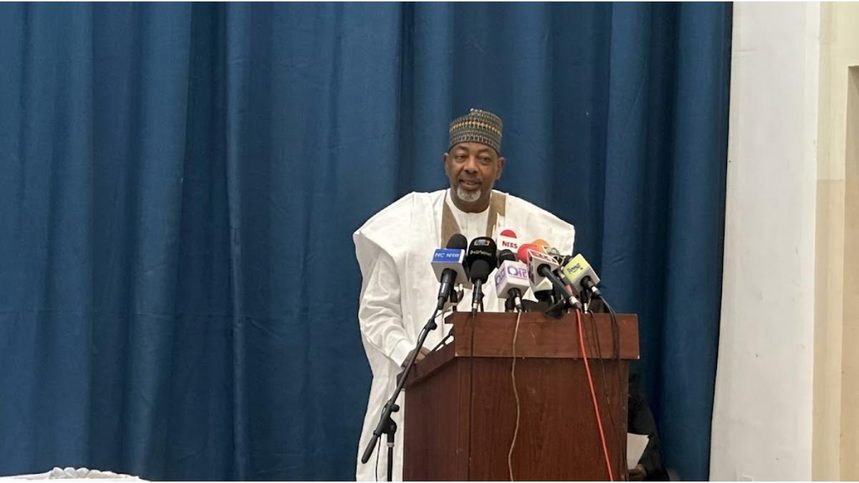
Agriculture and Food Security Minister Abubakar Kyari announced that prices of essential food commodities have dropped by up to 50 per cent across the country compared to their pre-2023 levels. No independent price data accompanied the claim. No commodity-specific figures were provided at the session.
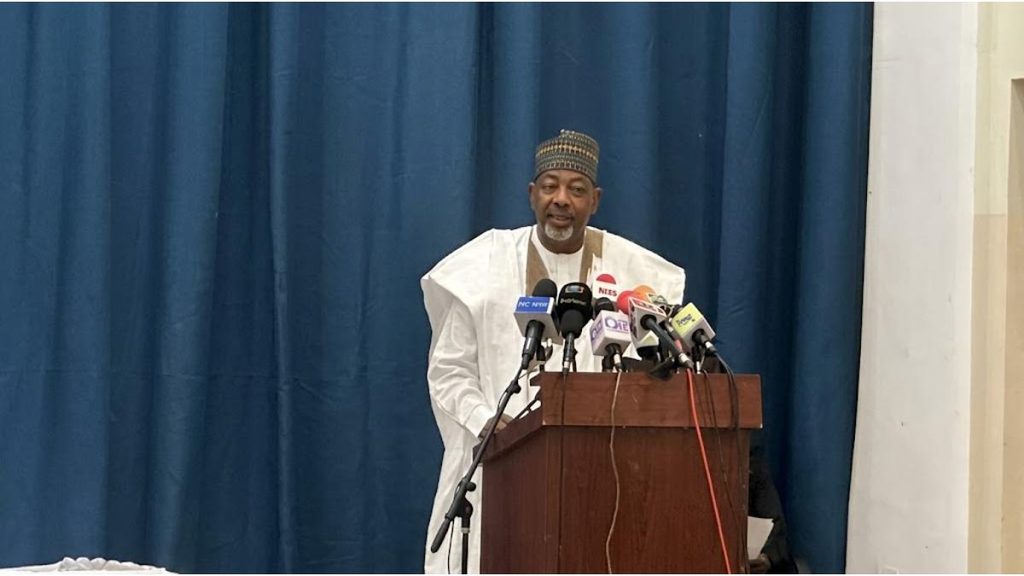
Kyari made the disclosure on Monday in Maiduguri while delivering the opening address at the Community of Practice Meeting of Commissioners for Agriculture, Health, Environment, and Rural Development from across the federation. State commissioners were the audience, not the public.
The meeting was organized by the Federal Ministry of Agriculture and Food Security in collaboration with the Borno State Government and supported by Germany under the theme “Stronger Partnerships for a Food Secure Nigeria.” Berlin’s role was represented by the head of development cooperation at the German Embassy.
“We have seen the reduction of up to 50 percent in prices of some essential food commodities, alongside expanded input delivery, investment in rural infrastructure, and support to smallholder farmers,” Kyari said while addressing participants at the Maiduguri summit.
Kyari noted that President Bola Ahmed Tinubu’s administration has placed food security at the core of its national agenda, challenging critics to look at the empirical evidence and not to politicize the cost of living. He did not define what empirical evidence he was referencing.
The minister framed the comparison in blunt terms. Kyari said prices of items had significantly dropped when compared to what they were in 2023, telling the gathering, “Let’s be honest, how much was a bag of rice and maize in 2023, and how much is it now? Let us not play politics with these things.”
The minister said early procurement under the Presidential Fertilizer Initiative had generated N61.58 billion in savings, with Nigeria on course for a 1.1 million metric-tonne fertilizer program in 2026. That figure was the only specific monetary claim he attached to a policy outcome.
The minister explained that the Maiduguri summit would critically evaluate the Kampala Comprehensive Africa Agriculture Development Programme Declaration and its Strategy and Action Plan for 2026–2035. That 10-year continental framework sets targets across food production, nutrition, and rural investment.
“The Kampala framework takes a broader agrifood systems approach, with priorities spanning sustainable production, investment and finance, food and nutrition security, trade, inclusion, resilience, and stronger governance,” Kyari said, adding that for a country of Nigeria’s scale, choices made in agriculture have consequences beyond its borders, for regional markets and Africa’s wider agrifood transformation.
Kyari added that CAADP Biennial Review indicators had been integrated into national planning, budgeting, and reporting systems to help align federal and state budgets, reduce duplication, and channel investments towards agreed priorities. He directed states to leave Maiduguri with clearer action plans.
Kyari said alignment between the federal and state governments must translate into compatible policies, reliable data, complementary investments, and clear responsibilities for implementation, telling commissioners, “We need one coherent agri-food system in which national direction and state-level execution reinforce one another.”
Germany, through its development cooperation arm, gave its own account of what the partnership was meant to achieve. The German government supported the summit under the theme “Stronger Partnerships for a Food Secure Nigeria,” with its embassy representative assuring continued backing for agricultural policy reform at the state level.
The German Embassy’s head of development cooperation, Dr. Karin Jansen, confirmed that support would continue through the Sustainable Agricultural Systems and Policies project. “Our aim is simple,” she told the gathering: “to strengthen existing structures and help turn national commitments into action where it matters most.”
The federal government, state governments, non-state actors, and development partners renewed their commitment to implementing the Comprehensive Africa Agriculture Development Programme Kampala Declaration 2026–2035 to accelerate Nigeria’s agricultural transformation and strengthen food security. What remains unanswered is whether the food prices Nigerians encounter in markets reflect the 50 per cent reduction Kyari confirmed on Monday in Maiduguri.