



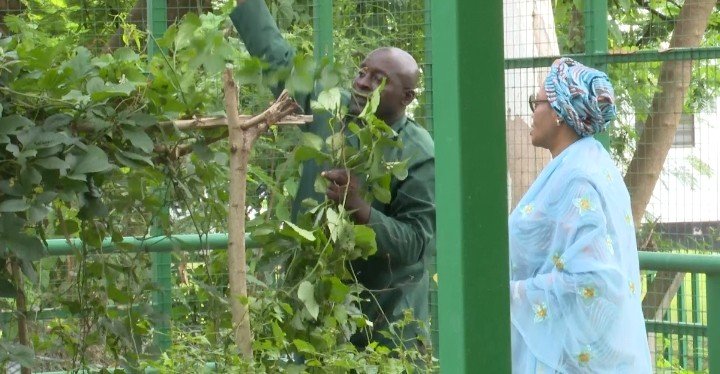
Nigeria’s First Lady, Senator Oluremi Tinubu, rolled up her sleeves on Monday and harvested fresh vegetables from the State House garden in Abuja, nearly two years after launching the plot as a model for household food production. The harvest is the latest push under her Renewed Hope Initiative to get Nigerians growing their own food as the country grapples with soaring inflation and food insecurity.
The Harvest At The Presidential Villa
The garden, unveiled in July 2024, has continued to yield common Nigerian greens including spinach, waterleaf, fluted pumpkin, bitter leaf, scent leaf, ewedu, okra and lemongrass.
According to NTA, the First Lady carried out the harvest on Monday at the Presidential Villa and shared part of the fresh produce with members of her staff.
She described the garden as a demonstration project meant to show that even within limited residential spaces, households can grow nutritious food and reduce feeding costs.
“This little garden will be able to provide healthy vegetables enough for my household and I would definitely be able to let some of my staff have as well,” she said during the initial launch, adding that “as a leader I must show example and plant my own garden”.

#EveryHomeAGarden
The Villa plot is tied to the #EveryHomeAGarden competition, a flagship sub-initiative of the Renewed Hope Initiative, RHI. The program encourages women and families to cultivate vegetables in available spaces around their homes to supplement household food supplies.
At launch, the First Lady said the competition “aims to inculcate the habit of farming and food production into society right from the family unit and promote eating healthy foods”.The campaign has been rolled out nationwide. In Edo State, the RHI distributed poultry chicks, improved seeds, farm tools, fertilizers and cash grants to women under the Women in Agriculture Empowerment Programme, with participants in #EveryHomeAGarden competing for cash prizes of ₦1 million, ₦500,000, and ₦300,000.
In Lagos, winners like Mrs Aadaeze Glory from Epe Division received ₦2.5m for her home garden.The Bank of Agriculture has also pledged support, with its MD Mr. Ayo Sotinrin saying the bank is working on financing for female civil servants through the initiative and partnering on a National Community Food Bank Programme to tackle child malnutrition.
Food Security, Health And Climate Goals

The First Lady has consistently framed home gardening as a simple strategy for boosting nutrition, lowering food expenditure and strengthening food resilience, especially as many Nigerians grapple with high food prices.
She emphasized the medicinal value of the vegetables grown and the role of smart gardening in promoting healthy diets and environmental sustainability.The message to women has been direct: lead the food security campaign. “I would like to encourage all Nigerian women to join the #EveryHomeAGarden competition and get involved in farming and food production,” she posted on X.
Praise And Pushback
Supporters have applauded the initiative as practical and symbolic. At a time when market prices for tomatoes, pepper and leafy greens have surged, a home garden offers immediate relief for households. The culture of sharing produce with staff and neighbors has also been highlighted as a way to build community resilience.
However, critics argue the messaging risks appearing out of touch. The advocacy comes amid widespread insecurity in farming communities, displacement of farmers, and inflation that has pushed food costs beyond the reach of many families. Some commentators question whether home plots can meaningfully address structural challenges in Nigeria’s agriculture sector.
The First Lady’s team has countered that the goal is not to replace commercial farming, but to complement it. “The solution to any problem lies in everyone contributing their own quota,” she said, stressing that individual effort can collectively drive the federal government’s food security campaign.
With the Villa garden now producing for nearly two years, the RHI says it will continue expanding #EveryHomeAGarden through state coordinators, partnerships with BoA, and competitions that reward innovation in urban and rural gardening.
For millions of Nigerian households, the question is whether small-scale gardening can scale into a national buffer against food price shocks. For the First Lady, the garden at Aso Villa is meant to be both proof of concept and a call to action: that food security can start at the backyard.

As she put it while tending to her seven vegetables: “Every small contribution can collectively drive the food security campaign forward”.