

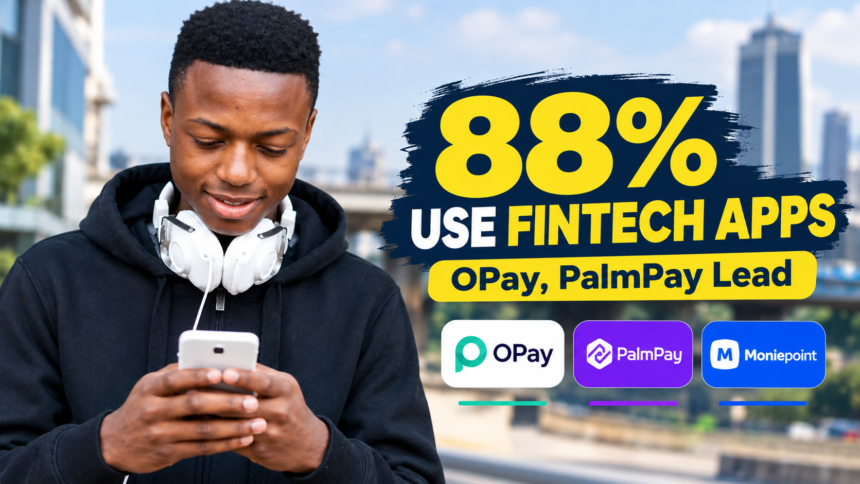
OPay, PalmPay and Moniepoint feature prominently as banking and fintech apps reach 88% adoption among respondents in a KPMG and Orange Group Nigeria smartphone study.
OPay, PalmPay and Moniepoint are among Nigeria’s most prominent financial apps as banking and fintech applications reach adoption levels as high as 88% among respondents in a new KPMG and Orange Group study.
The Nigeria Smartphone Study 2025, released in September 2026, surveyed 13,251 respondents across 12 major Nigerian cities to examine smartphone ownership, app usage and changing digital habits.
The findings offer a closer look at how Nigerians are using smartphones not just for communication and entertainment, but increasingly for payments, transfers and other everyday financial activities.
OPay and PalmPay Stand Out in Fintech Usage

Among the individual banking and fintech applications examined, OPay recorded the highest smartphone presence at 69%, while PalmPay followed at 29%. Moniepoint was also identified among the three leading banking and fintech apps found on respondents’ smartphones.
The figures do not represent market share and should not be added together.
A smartphone user can have several financial applications installed or use more than one provider. Someone, for example, may have OPay, PalmPay, a Moniepoint app and one or more traditional banking applications on the same device.
The study therefore measures the presence or penetration of individual applications within the surveyed group rather than suggesting that the companies collectively account for a particular percentage of Nigeria’s banking customers.
That distinction is important when interpreting the numbers.
Fintech Apps Reach 88% Adoption
The broader banking and fintech category recorded adoption levels of as high as 88% among respondents, making it the second-most popular application category in the study.
Social media and communication applications ranked ahead with 98% adoption. Banking and fintech apps were followed by productivity applications at 85%, streaming and music platforms at 82%, and web browsers and utilities at 81%.
KPMG and Orange Group said the high level of financial-app adoption reflects the growing reliance on smartphones for payments, transfers and financial management.
The finding also shows how quickly mobile applications have become part of ordinary financial activity, particularly as consumers look for ways to carry out transactions without depending entirely on physical banking channels.
OPay Leads Individual Banking Apps

OPay’s 69% presence was notably higher than the figures recorded for the individual traditional banking applications covered by the study.
Access Bank recorded 16%, while UBA and GTBank each recorded 11%. FirstBank stood at 10%, Zenith Bank at 9% and Stanbic IBTC at 6%.
Moniepoint was reported at 14%, placing it behind OPay but ahead of several traditional bank applications. Other apps identified in coverage of the study included Kuda and PayPal.
The figures highlight the increasingly crowded mobile financial-services space, where fintech companies and established banks are competing for consumers through smartphone applications.
They also show why app experience has become an important part of financial services. Transfers, bill payments, airtime purchases and other transactions can now be handled through mobile platforms rather than requiring customers to visit a branch.
Smartphone Ownership Rose to 75%

The fintech growth comes against a broader increase in smartphone ownership.
According to the study, smartphone ownership among respondents rose from 64% in 2023 to 75% in 2025. Over the same period, feature-phone usage fell from 36% to 28%.
These are figures for the respective device categories reported by the study and should not be treated as percentages that must add up to 100% in the same way as mutually exclusive categories in a single survey question.
The shift nonetheless points to a continuing move from basic mobile phones towards internet-enabled devices capable of running financial, social, commercial and productivity applications.
KPMG attributed the broader digital transformation to factors including Nigeria’s youthful population, improving connectivity and greater smartphone affordability.
Nigeria’s Digital Economy Keeps Expanding

The study also places the growth of smartphone applications within a wider expansion of digital activity.
KPMG cited Nigerian Communications Commission data showing 157 million internet subscribers as of May 2026, while data consumption had exceeded 1.5 million terabytes.
The report said smartphones have moved beyond their traditional role as communication devices and are increasingly being used for economic participation, business activity and access to digital services.
The Information and Communication sector accounted for 11.31% of Nigeria’s real GDP in the first quarter of 2026, according to the KPMG study.
For financial-service providers, the expanding smartphone ecosystem creates a larger environment in which mobile applications can become the main point of contact between companies and customers.
Digital Access Still Has Gaps
Despite the rapid growth, KPMG’s report does not present Nigeria’s digital transition as complete.
More than a third of mobile subscribers were still using 2G as of May 2026, according to the study. It also identified infrastructure limitations, affordability, gaps in digital literacy and cybersecurity concerns as factors that could influence how widely and effectively Nigerians participate in the digital economy.
That means rising smartphone ownership and strong fintech-app adoption do not necessarily translate into equal digital access for everyone.
The quality of network coverage, cost of devices and data, knowledge of digital services and confidence in online transactions can all affect how consumers use financial applications.
What the KPMG Study Shows
The most significant takeaway from the study is the growing role of the smartphone in everyday financial activity.
With banking and fintech applications reaching 88% adoption among the respondents, financial services now sit close to the centre of Nigeria’s mobile-app ecosystem.
OPay’s 69% smartphone presence and PalmPay’s 29% figure further show the strong position of fintech platforms alongside traditional banking applications.
The numbers do not mean that 88% of all Nigerians use fintech apps, nor that 69% of Nigerians use OPay. They describe findings from the 13,251 respondents covered by the KPMG and Orange Group study.
Still, the pattern is clear: as smartphone ownership expands, more Nigerians are using their phones as gateways to financial services.
The competition between fintech companies and traditional banks is therefore increasingly taking place on the smartphone screen, where convenience, accessibility and the ability to complete everyday transactions can shape how consumers interact with financial providers.