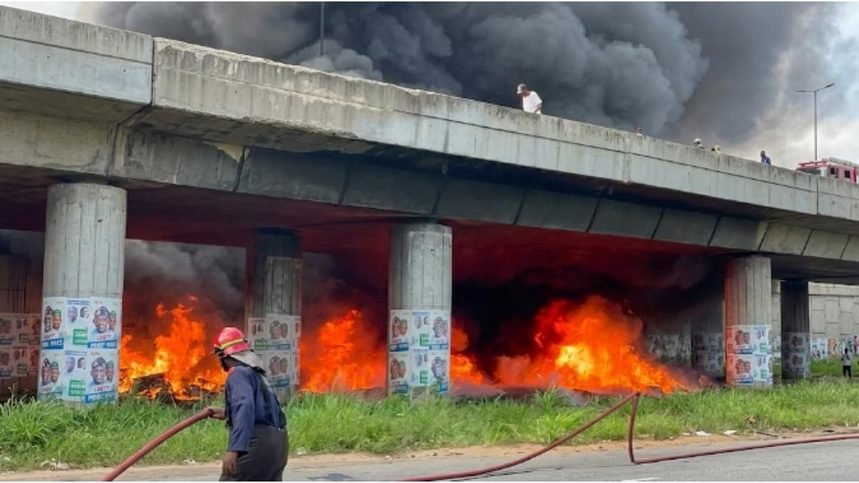
A tanker burst into flames under the Otedola Bridge along the Lagos-Ibadan Expressway on Monday afternoon, sending residents and motorists into panic along one of Lagos’ most dangerous road corridors.
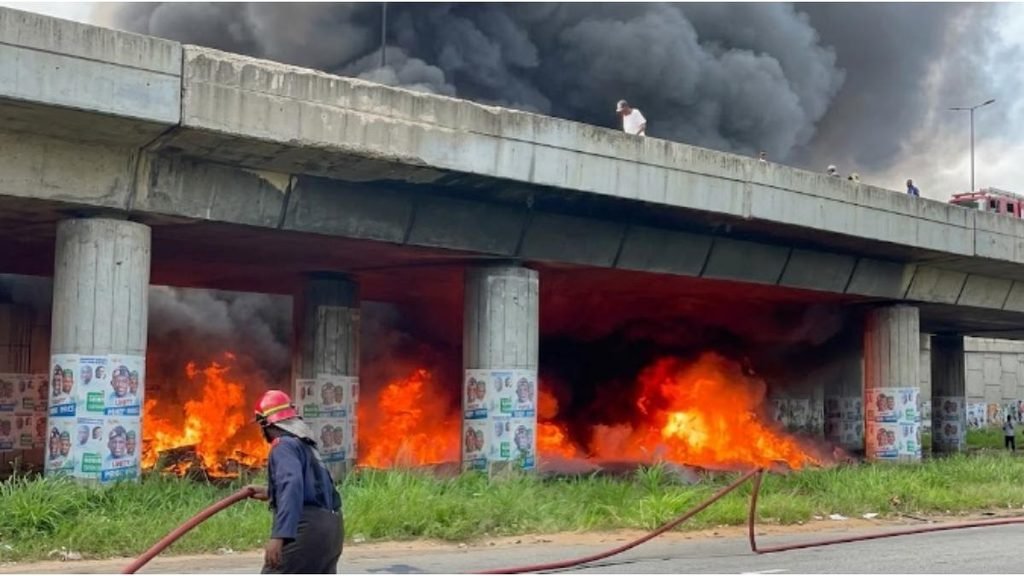
The Lagos State Emergency Management Agency (LASEMA) confirmed the tanker fire and said it received a distress report at approximately 4:24 pm. The agency’s spokesperson, Olawale Afolabi, immediately alerted journalists in a terse message: “Tiger team en route to Otedola. Tanker on fire.”
LASEMA Tiger Team Deployed to Otedola Bridge Fire Scene
Afolabi confirmed that LASEMA dispatched its Tiger response team to the scene without delay after receiving the distress call. The rapid deployment signals the agency treated the incident as a high-priority emergency from the outset.
The Tiger team is LASEMA’s specialist rapid-response unit trained to handle fire suppression, hazardous materials containment, and structural rescue operations. The unit operates with dedicated fire-fighting equipment and is designed to arrive at emergency scenes faster than conventional response units across Lagos State.
As of the time of filing this report, the cause of the tanker fire had not been established. Whether anyone sustained injuries and the full extent of property damage were not immediately available. Details of the tanker’s contents, registration, and make were also not known at the time of reporting. LASEMA had not yet issued a full situation report confirming whether the vehicle was carrying petroleum products, liquefied gas, or other flammable cargo.
The Lagos-Ibadan Expressway corridor where the Otedola Bridge sits has a documented history of tanker-related disasters. The bridge has been widely regarded as one of Lagos’ most dangerous traffic blackspots, particularly for accidents involving heavy-duty vehicles. The narrow underbelly of the bridge, combined with the gradient of the approach road, creates conditions that have repeatedly proven hazardous for laden tankers.
Otedola Bridge’s Deadly Record of Tanker Accidents
The stretch has seen repeated fire emergencies driven by the heavy volume of fuel haulage traffic that passes through the area daily. Tankers moving petroleum products from depots in the Apapa axis frequently use the Lagos-Ibadan Expressway as a major artery, making this corridor one of the most heavily trafficked by hazardous cargo vehicles in Southwest Nigeria.
In June 2018, the bridge witnessed a catastrophic tanker explosion that killed at least 12 people and destroyed dozens of vehicles, marking one of the deadliest road accidents in Lagos’ recent history. That incident triggered widespread calls for tighter regulation of tanker operations in the city.
More recently, in March 2025, a gas tanker overturned and exploded at the same Otedola Under Bridge axis near CMD Road, killing two people, injuring three others, and destroying 12 vehicles, eight tricycles, and one building. A church, a residential building, and a mechanics’ park were among the structures consumed in that blaze.
Following that March 2025 incident, the Lagos State Government revealed that the gas tanker had ignored a road sign barring trucks from using that section of the road. The Lagos Commissioner for Transportation, Oluwaseun Osiyemi, confirmed during an assessment visit that structural cracks on the bridge and surrounding facilities had to be inspected to determine the integrity of the infrastructure.
Monday’s fire is the latest in a long series of incidents on the bridge. In January 2025, a multiple-vehicle accident involving trucks left at least one person dead and three others injured at the same location. A January 2026 incident saw a tomato-laden truck ram into vehicles on the bridge, further underlining the persistent danger at that spot.
LASEMA has not yet issued a full situation report on Monday’s tanker fire. The agency routinely publishes post-incident reports that include casualty counts, property loss estimates, and a summary of response operations. That report was pending as of the time this story was filed.
The Otedola Bridge sits at a known chokepoint where trucks navigating the link road ascending to the Lagos-Ibadan Expressway face sharp gradients and tight turns. Emergency management officials and the Lagos State Ministry of Transportation have repeatedly warned heavy-duty vehicle operators against using the restricted corridor, though compliance has remained inconsistent.
Lagos State has also flagged the broader issue of aging tanker fleets operating on its roads. Many tankers in active service across Nigeria are overdue for mechanical inspection, a factor that emergency and transport officials have cited in previous incident reviews as a contributing element in tanker fires and explosions.
Traffic conditions on the expressway in the aftermath of Monday’s fire were not immediately confirmed by the Lagos State Traffic Management Authority (LASTMA). Motorists using the Lagos-Ibadan Expressway were advised to monitor official updates from LASEMA and LASTMA and use alternative routes where possible pending a full situation assessment.
This is a developing story. Further updates, including casualty figures and damage assessments, will be published as LASEMA issues additional statements.