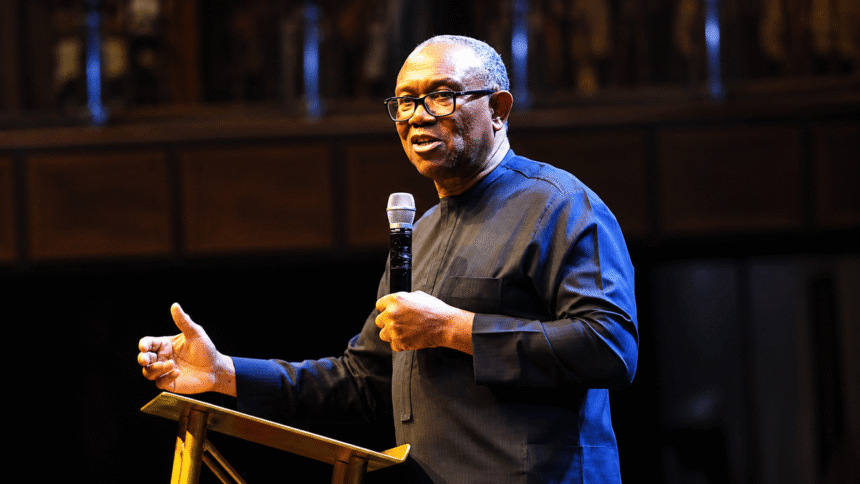
Obi addressed diaspora Nigerians at a town hall meeting in Manchester, United Kingdom, on Sunday, October 18, at an event attended by his supporters in the UK.
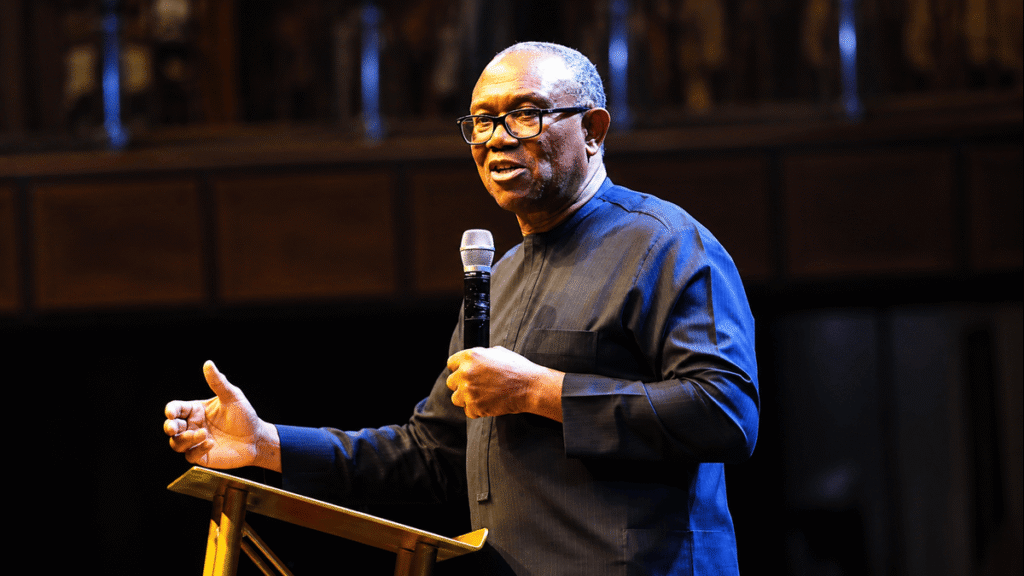
The former Anambra State governor attributed Nigeria’s economic difficulties to poor leadership, arguing that continued financial assistance from Nigerians abroad could ease the immediate burden on struggling families without addressing structural problems responsible for their hardship.
“You have people at home in Nigeria today who are begging you for money. Tell them no!” he said.
Addressing the gathering, he encouraged Nigerians in the diaspora to convince their relatives to prioritize political change rather than continually requesting money from abroad.
Obi maintained that Nigerians at home must feel the full weight of bad governance so they are motivated to demand better leadership and make wiser choices at the ballot box.
He urged Nigerians in the UK to use their interactions with family members and friends at home to promote political accountability and encourage support for leaders who would prioritize productivity and prudent management of public resources.
“Countries change by people saying, ‘Hey, wait a minute, enough of this,'” he said.
He also linked money allegedly diverted through corruption to the country’s inadequate public services, including schools and hospitals.
The reaction was not uniformly sympathetic. Critics, including commentator JJ Omojuwa, described the position as weaponizing poverty. Social media commentator Daniel Regha also criticized Obi over the comments, accusing him of placing his political ambition above the welfare of Nigerians grappling with economic hardship.
Regha wrote on X: “Peter Obi went to the UK to urge UK-based Nigerians not to render financial assistance to their loved ones so they can vote him in.”
He argued that similar comments from President Bola Tinubu, former Vice-President Atiku Abubakar, Omoyele Sowore, or another opposition figure would have attracted widespread condemnation.
Supporters, however, framed the call as a necessary long-term position, arguing that remittances insulate bad governance from consequences. Obi, the NDC presidential candidate, has urged Nigerians in the UK to stop giving money to people in Nigeria who ask them for financial help, saying continued assistance may ease the effects of hardship without addressing its underlying causes.
The remarks carry particular weight given the scale of Nigeria’s diaspora economy. Diaspora remittances into Nigeria stabilized at $21.8 billion in 2025 despite mounting global economic pressures, tighter immigration policies in major economies, and rising transfer costs.
Nigeria remains the second-highest recipient of diaspora remittances in Africa, trailing only Egypt.
Inflows through licensed International Money Transfer Operators reached a record $1.29 billion in the first quarter of 2026, up 45 percent from $888.47 million in the same period in 2025.
Remittances have become not only a household lifeline but also a countercyclical buffer for the macroeconomy, especially during inflationary cycles or foreign exchange pressures.
The Manchester remarks also land against a backdrop of unsettled opposition negotiations. A coalition of concerned Nigerians known as the G100 concluded a first round of consultations with leaders of six opposition political parties, including Atiku Abubakar of the African Democratic Congress, Peter Obi, and Rabiu Kwankwaso of the Nigeria Democratic Congress.
Obi denied reports that he rejected a vice-presidential offer from Atiku Abubakar’s camp ahead of the 2027 elections and said any coalition must be driven by the parties themselves, not individual candidates negotiating behind closed doors.
The G100 urged Atiku Abubakar and Obi, alongside their running mates Rotimi Amaechi and Rabiu Kwankwaso, to set aside individual ambitions and agree on a common candidate.
An earlier opposition summit convened to forge a common front ahead of the 2027 general elections suffered a setback when several prominent opposition leaders failed to attend the gathering in Abuja.
The absence of Atiku Abubakar, Peter Obi, Rabiu Musa Kwankwaso, and Rotimi Amaechi was noticeable at the event.
No official clarification has been issued by Obi’s campaign on whether the Manchester call applies strictly to the period before the 2027 vote or constitutes a broader position on diaspora remittances as a tool of political pressure. What is clear is that a statement aimed at galvanizing supporters in the UK has put the NDC candidate on the defensive at home, where millions of families remain dependent on exactly the funds he is asking Nigerians abroad to withhold. The question of Peter Obi’s approach to remittances will not leave the conversation easily.