

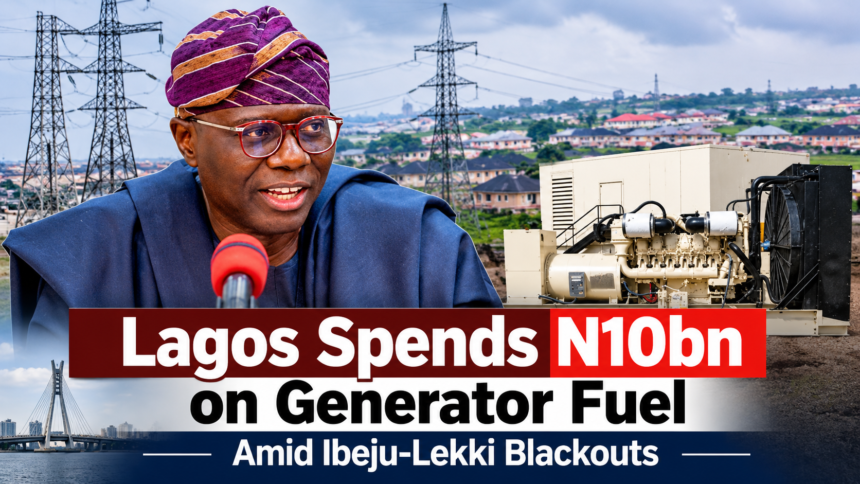
Lagos State Government‘s generator fuel spending reached N10.04bn between January and September 2026, while more than 40 communities in Ibeju-Lekki continue to face persistent electricity challenges. The expenditure, alongside N382.81m spent on magazines, periodicals, newspapers and telephone charges, has brought renewed attention to the state’s spending priorities and the electricity difficulties confronting some residents.
The figures are contained in the Lagos State Government‘s Third Quarter 2026 Budget Implementation Report, which provides details of expenditure recorded across government during the first nine months of the year.
The figures raise questions about electricity access, infrastructure development and the cost of keeping government operations running in a state where some communities still struggle with unreliable power supply.
Lagos Spends N10.04bn on Generator Fuel

According to the official budget report, Lagos spent N10,038,965,459.63 on plant and generator fuel between January and September 2026.
The expenditure represents 48 per cent of the N20.93bn allocated to the item in the state’s original 2026 budget.
A breakdown shows that N1.78bn was spent on generator fuel during the third quarter alone, covering July to September.
The report also recorded N339m for magazines and periodicals, N43.43m for telephone charges and N380,000 for newspapers during the same nine-month period.
Combined, these three expenditure items amounted to approximately N382.81m.
Magazines and periodicals accounted for the largest share, representing 66 per cent of their N513.36m annual allocation. Telephone charges consumed 33.2 per cent of the N130.73m budget, while newspaper expenditure stood at 1.5 per cent of its N24.76m allocation.
Together, generator fuel and the three other expenditure categories amounted to approximately N10.42bn.
However, the budget report presents these figures under statewide expenditure classifications. They should not be interpreted as spending exclusively by the Ministry of Energy or as evidence that the generator fuel was used to supply electricity to the affected communities.
Ibeju-Lekki Communities Still Face Electricity Challenges
The expenditure comes against the background of longstanding electricity problems in parts of Ibeju-Lekki Local Government Area and Lekki Local Council Development Area.
Residents of more than 40 communities have previously raised concerns about prolonged blackouts, inadequate electricity infrastructure and the difficulties associated with living and conducting business without reliable power.
The situation is not entirely new.
In October 2021, the Lagos State Government announced a partnership with the African Development Bank and Eko Electricity Distribution Company to address electricity challenges affecting more than 40 communities in the Lekki and Ibeju-Lekki areas.
The proposed arrangement included an electricity cooperative model through which beneficiaries would contribute towards infrastructure costs and repay the investment through electricity sales.
The concerns have continued to feature in government engagements.
In its 2024 Off-Grid Electrification Strategy and Action Plan, the Lagos State Ministry of Energy and Mineral Resources identified Ibeju-Lekki, Epe and Badagry as some of the worst-served local government areas in terms of grid electricity.
The document also acknowledged that several communities in Ibeju-Lekki had remained unelectrified for between six and 16 years.
This highlights the scale of the electricity access challenge facing parts of the state.
Lagos Government Announces Fresh Electricity Plans
There have also been renewed efforts to address the situation.
On September 30, 2026, Ibeju-Lekki Local Government Chairman, Abdullahi Sesan Olowa, announced an electricity stakeholders’ dialogue involving residents, community leaders, youths and the Lagos State Commissioner for Energy and Mineral Resources, Biodun Ogunleye.
The meeting provided an opportunity to discuss electricity challenges, particularly right-of-way issues, grid infrastructure and other obstacles affecting power supply.
In a statement shared on his LinkedIn page, Olowa said the engagement was intended to bring relevant government officials and residents together to address the problems.
He stated that the administration was committed to working with relevant authorities and communities to remove the identified bottlenecks.
“Together, we move from conversation to action,” he added.
The discussions form part of broader efforts to improve electricity infrastructure across the Ibeju-Lekki corridor.
Among the proposed interventions is a 132kV transmission line project linking the Ajah Power Substation to Eleko Junction, which is expected to strengthen transmission capacity in the area.
The success of these interventions will depend on implementation and whether the affected communities eventually experience a meaningful improvement in electricity supply.
What the Spending Figures Mean for Lagos Residents

Lagos’ generator fuel expenditure also reflects a wider electricity challenge.
The state government’s own 2024 off-grid electrification strategy acknowledged that Lagos receives less than 25 per cent of the grid-connected electricity it requires.
The document estimated that the state had approximately 15,000MW of backup generator capacity, highlighting the extent of its dependence on alternative electricity sources.
This dependence comes with significant financial and environmental costs, particularly for households and businesses that must rely on generators when public electricity supply is inadequate.
For communities in Ibeju-Lekki, the concern goes beyond government expenditure. Unreliable electricity affects businesses, household activities, education and access to essential services.
Although the N10.04bn expenditure does not establish how much individual communities receive in electricity infrastructure investment, it provides an important financial context for discussions about energy access in Lagos.
The central question remains whether ongoing government commitments and planned infrastructure projects will translate into reliable electricity for communities that have experienced prolonged supply challenges.
As Lagos moves towards the final quarter of 2026, residents will be watching to see whether the promises made during recent engagements produce measurable improvements.