
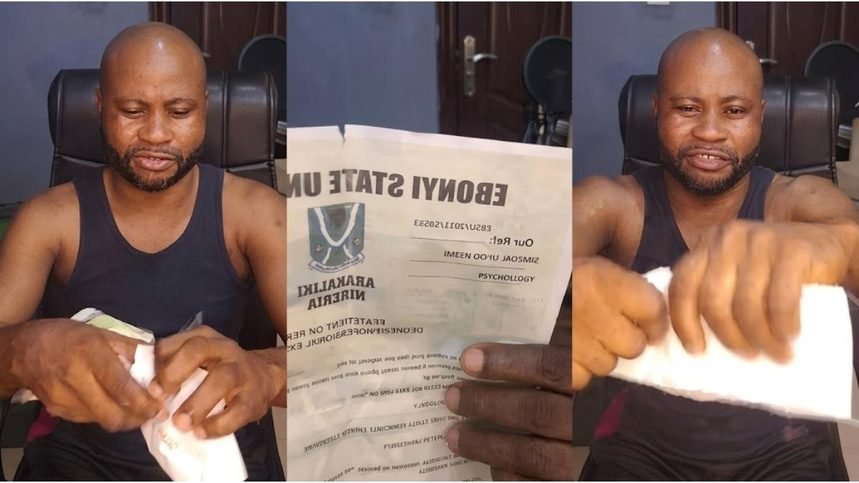
A Nigerian man tore his university degree certificate, his NYSC discharge certificate, and his WAEC result on Friday, saying years of formal education produced nothing for him. The video spread rapidly across social media, shared by accounts including YabaLeftOnline on October 10.
The man, a psychology graduate who earned a second-class upper degree, did not stop at one document. He destroyed all three credentials in full view of the camera, then told anyone watching that he wished he had never enrolled in university at all.
“I regret going to university; it didn’t help me,” he said in the video. “I graduated with a second-class upper degree in psychology.” His decision to destroy the certificates drew immediate and divided reactions from viewers across the country, with the clip accumulating thousands of shares within hours of being posted.
Some users who commented on the clip said they recognized his situation in their own lives. Many shared accounts of unemployment or jobs that paid far below what their qualifications suggested they should earn, according to reactions visible under the video. Several commenters noted they had been searching for work for more than two years after graduation.
Others questioned whether the documents he tore were genuine originals or photocopies. That debate ran alongside the broader conversation about what a university degree is actually worth in Nigeria’s current job market, where the National Bureau of Statistics has previously reported youth unemployment rates among the highest on the continent.
Psychology as a discipline does allow graduates to work in counselling, human resources, education, and research. Several of those roles, however, require additional qualifications or specialized training beyond a first degree, a fact that complicates the path from graduation to stable employment.
“I don’t want to be a graduate again,” the man said in the clip. “It didn’t favor me.” That sentence, short and plain, became one of the most quoted lines in the comment sections that followed.
The video is not the first of its kind. Past incidents of Nigerian graduates destroying their academic certificates have circulated online, each one triggering fresh rounds of debate about what tertiary education promises and what it actually delivers in a market stretched thin.
Viewers who commented on this latest clip called for reforms to both the education system and the broader employment landscape. No government body had responded publicly to the video as of Friday.
The clip surfaced on the same day social media accounts were already discussing graduate unemployment, with users drawing connections between individual stories of frustration and the structural conditions that produce them.
Whether the man’s documents were originals or copies, the act itself landed. Thousands of Nigerians have watched someone reduce years of formal education to torn paper, and a significant number of them, based on the responses, said they understood why.
Psychology graduates do have career options open to them, but the man’s video did not describe a theoretical employment market. It described his own experience, and his own experience, as he told it, produced nothing worth keeping intact.
The incident has renewed calls online for a serious national conversation about the gap between the number of graduates Nigerian universities produce each year and the number of jobs the economy generates to receive them. Nigeria’s universities collectively produce hundreds of thousands of graduates annually, a figure that has grown steadily while formal sector job creation has not kept pace.
No detail in the video or in the social media responses identified the man by name. His face and voice are in the clip. His credentials, or what he presented as his credentials, are now in pieces.
The torn degree, the torn NYSC certificate, and the torn WAEC result are, as of Friday, among the most discussed images on Nigerian social media, carrying a question that nobody in the video answered: what comes next for a graduate who no longer wants to be one?