


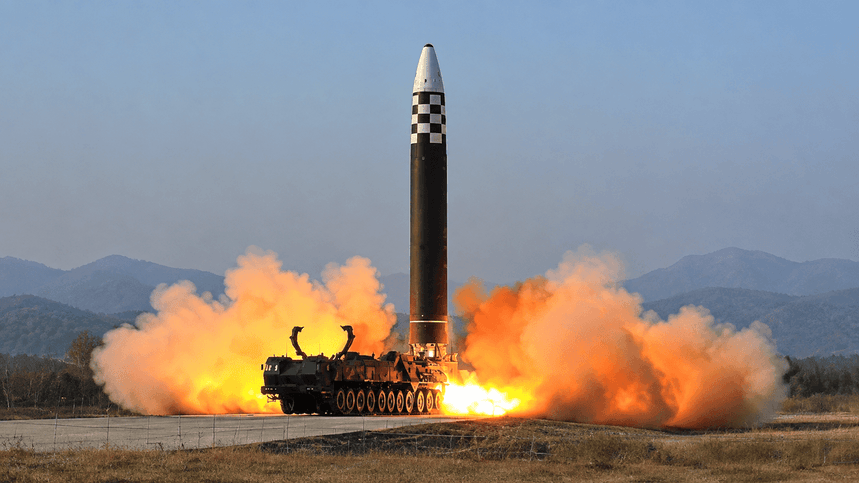
Both launches, about three hours apart, originated from North Korea‘s eastern coastal Wonsan area.
The first missile flew approximately 280 miles, while the second covered more than 370 miles, both directed toward the North’s eastern waters. Neither missile struck land.
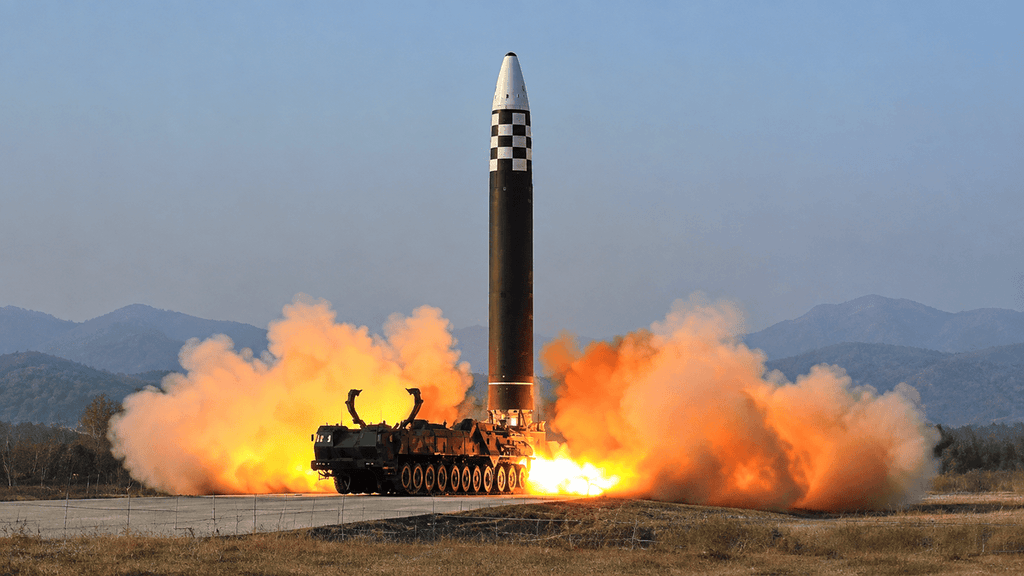
South Korea’s presidential office urged North Korea to immediately halt ballistic missile launches that are banned by U.N. Security Council resolutions.
South Korea’s military confirmed it maintains readiness to repel any provocations by the North under its alliance with the U.S. Seoul made those remarks through its Joint Chiefs of Staff.
The launches came just days after Pyongyang reasserted its status as a nuclear-armed state and rejected a U.N. resolution demanding it halt its nuclear activities. That rejection now frames Sunday’s missile tests not as impulsive provocation but as a deliberate signal.
The launches were the latest in a series of weapons demonstrations even after President Trump scaled back a joint military exercise with South Korea last month in an apparent effort to revive diplomacy with Kim Jong Un. That concession, it turns out, bought nothing.
Kim Yo Jong, the North Korean leader’s sister and senior official, shrugged off Trump’s overture, saying that shortening the drill would not change its “provocative, aggressive nature.” She holds one of the most influential positions in Pyongyang’s inner circle.
North Korea’s military also launched about 10 short-range ballistic missiles toward the sea in a separate action, apparently following through with a prior threat to respond to the U.S.-South Korean drill. That volley preceded Sunday’s two-missile test.
On Friday, Kim Yo Jong escalated the language further. She described a recent U.S.-led multilateral maritime exercise in the region as a “frantic military move” designed to extend American influence across the Asia-Pacific. The exercise, called Pacific Vanguard, involved the United States, South Korea, Japan, Australia, New Zealand, and Canada.
She also claimed, according to the CBS/AP report, that “regular U.S.-led war rehearsals” are the primary driver of rising tensions on the Korean Peninsula. Pyongyang has used that same framing consistently to justify expanding its weapons programs.
“Our will to defend our sovereignty will be expressed in clearer action,” Kim Yo Jong said, “and there will never ever be change in the course of intensifying the nuclear war deterrence.” That statement came Friday, two days before Sunday’s launches.
Japan’s Defense Ministry said it detected a suspected North Korean missile on Sunday but confirmed the weapon did not land in its territorial waters. Tokyo’s detection added a third military to those tracking the launches in real time.
Earlier this month, North Korea conducted what it called a joint live-fire drill combining missiles, artillery, and drones. That exercise came one day after the United States, South Korea, and Japan wrapped a five-day trilateral military drill that Pyongyang described as a provocation.
North Korea said its own drill involved firing multiple types of weapons simultaneously. The goal, analysts read from the pattern, was to develop the ability to overwhelm South Korean and U.S. air defense systems at once, applying pressure across multiple interception layers.
South Korea’s presidential office called on Pyongyang to immediately stop all ballistic missile launches, which violate U.N. Security Council resolutions. Those resolutions have been on the books for years, and Pyongyang has not complied with a single one.
South Korea’s Joint Chiefs of Staff disclosed that authorities from both Seoul and Washington are conducting a detailed analysis to determine the exact type and specifications of the second missile fired Sunday. No final classification had been released by the time of this report.
The sequence—a U.N. rejection, a diplomatic concession from Washington, a public rebuff from Kim’s sister, and now two more ballistic missile launches—points to a North Korea that sees no incentive in restraint while nuclear deterrence remains its stated policy.