


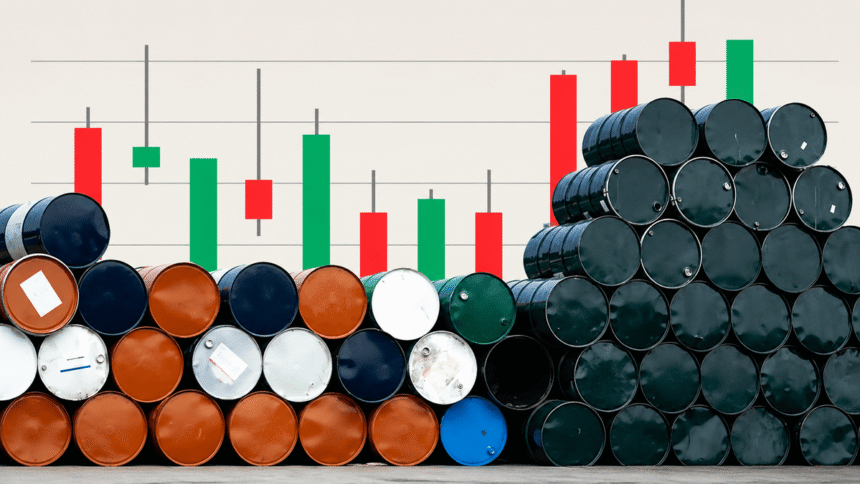
Oil prices swung sharply on Sunday as fresh diplomatic signals from US-Iran nuclear talks rattled global energy markets, sending shockwaves through crude benchmarks that Nigeria watches closely for its budget projections.
Brent crude, the international benchmark against which Nigerian crude is priced, dipped after reports emerged that Washington and Tehran had resumed high-level negotiations over Iran’s nuclear program. A potential deal could unlock Iranian oil exports, flooding a market already wrestling with demand uncertainty.
The timing is uncomfortable for Abuja. Nigeria’s 2025 budget was benchmarked against a specific crude price assumption, and any sustained drop in oil prices puts the fiscal framework under immediate pressure. The federal government has not issued a public statement on the latest market movements, but sources within the Ministry of Finance told this newspaper that officials are monitoring the situation closely.
Iran currently sits under heavy US sanctions that restrict its oil exports. If a deal gets done and those restrictions are lifted, Tehran could push additional barrels into a market that is already fragile. Analysts say the sheer prospect of that supply hitting the market is enough to weigh on prices, even before any agreement is signed.
Now, Nigeria is not a passive observer here. Africa’s largest oil producer depends on crude revenue to fund the bulk of its federal budget. When oil prices fall, the naira feels it. When the naira feels it, ordinary Nigerians feel it at the petrol station, in the market, and in their pockets.
The Nigerian National Petroleum Company Limited has not yet commented on the market volatility. But industry watchers say the NNPC will be watching the trajectory of these talks with the same intensity as the negotiators themselves.
Brent crude prices moved within a notable range during early trading, according to commodity market data, though figures were fluctuating too rapidly for a fixed number to be confirmed at press time. West Texas Intermediate, the American benchmark, tracked a similar pattern.
The US side, represented by senior State Department officials, has maintained that any agreement must include strict verification mechanisms. Iran, for its part, has signaled willingness to engage but has not formally accepted the terms being discussed. Neither side has announced a breakthrough, and diplomats caution that the gap between the two positions remains wide.
But markets do not always wait for facts. Traders priced in the possibility of a deal the moment credible reports of talks surfaced, and that anticipatory selling pushed oil prices lower through the morning session.
For Nigeria, this creates a familiar headache. The country has in previous years adjusted its budget benchmark when oil prices deviated sharply from projections. Whether the National Assembly would sanction another revision depends entirely on how long the current pressure lasts and how far prices fall.
OPEC Plus, of which Nigeria is a member, will also be watching. The cartel has previously responded to price weakness by tightening output quotas. If oil prices remain soft on the back of these diplomatic developments, another round of production cuts cannot be ruled out. That would directly affect Nigeria’s production quota and, by extension, its export earnings.
And the ordinary Nigerian, who has endured subsidy removal and persistent pump price adjustments, will be asking a simple question: does any of this bring relief, or does it make things worse?
The honest answer, for now, is that nobody is certain. The talks are ongoing, the market is reactive, and Nigeria sits squarely in the middle of whatever comes next.