

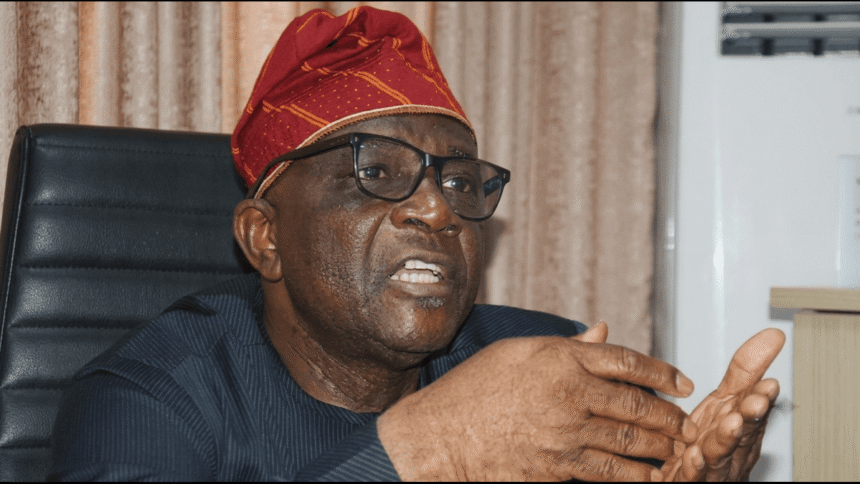
Bayo Onanuga, Special Adviser to President Tinubu on Information and Strategy, says he does not see Nigeria’s hunger levels Nigerians describe in public.

Bayo Onanuga does not believe Nigerians are as hungry as they say they are. The special adviser to President Tinubu on information and strategy made that position plain Tuesday evening on Arise Television’s Prime Time program, and by Wednesday morning the country had opinions.
“I don’t see the level of hunger people are talking about because I see them, and I keep asking them questions: How are things? How are they adjusting? What are the problems?” Onanuga told the Arise anchor. But his source material raised immediate questions: the presidential spokesman said conversations with domestic staff and informal workers, not statistical reports, shaped his view.
Roads, he insisted, tell a truer story. Onanuga recalled a drive from Ibadan to Lagos during which he detoured through Sagamu and Ijebu-Ode after checking Google Maps for traffic and discovered a newly constructed concrete road he had not known existed. “Before, it was two hours, 30 minutes,” he told the program.
He also pointed to the Lagos-Calabar coastal highway project, which he credited with cutting his personal commute from Ajah into central Lagos from more than two hours to roughly one. And he framed those gains as the kind of visible, concrete progress that critics deliberately ignore when measuring this administration against public complaints.
Onanuga confirmed on Tuesday that the Tinubu administration raised the national minimum wage by more than 100 per cent. He also flagged the federal government’s student loan scheme and a credit facility giving civil servants access to loans at single-digit interest rates as direct relief measures aimed at ordinary workers.
He traced the hunger narrative back to a single viral video from the early days of the administration, in which a voice-over on footage of President Tinubu leaving a mosque in Lagos said, in Yoruba, “Ebi n pawa o,” meaning “we are hungry.” “Since then, people have been saying that,” Onanuga noted. “We have been pigeonholed into certain assumptions, certain conclusions.”
Yet official numbers from the National Bureau of Statistics pull the conversation in a different direction that the presidency has not directly addressed. Nigeria’s annual inflation rate climbed for a third consecutive month to 15.93 percent in May 2026, the highest reading since last November, according to the NBS Consumer Price Index report released June 15.
Food inflation, the heaviest component in that basket, accelerated for a fourth straight month, reaching 17.8 per cent in May from 16.6 per cent in April. Enugu recorded the steepest year-on-year food price increase at 32.7 percent. Kwara followed at 30.8 per cent, then Adamawa at 30.1 per cent.
Rivers, Delta, Bauchi, Edo, Zamfara, Gombe, Anambra, and Benue all logged food inflation above 20 per cent on a year-on-year basis. Eleven states, counted plainly, saw food prices rise by at least a fifth in twelve months. Not one of those figures came from an opposition party.
In 2025, the Global Hunger Index placed Nigeria 115th out of 123 countries for which scores could be calculated, rating the country at a “serious hunger level.” Separately, the Famine Early Warning Systems Network projected that between 16 million and 16.99 million Nigerians would require urgent humanitarian food assistance. Both assessments originated with international monitoring bodies.
Trade Union Congress President Festus Osifo, speaking on Channels Television on May 1, 2026, put the wage debate in stark terms. Even a minimum wage of N1 million would mean little without fixing the naira’s underlying value, he warned, adding: “If you don’t fix the fundamentals and you are just talking about minimum wage alone, it may not necessarily have the right purchasing power.” Labor unions are currently pushing for N154,000 as the new minimum wage floor ahead of the 2027 statutory review, a figure economists already consider insufficient for workers in Lagos or Abuja.
As of Wednesday morning, neither the Nigeria Labour Congress nor any formal opposition formation had issued a response to Onanuga’s Tuesday remarks. The presidency released no follow-up statement addressing the NBS inflation figures by press time.