
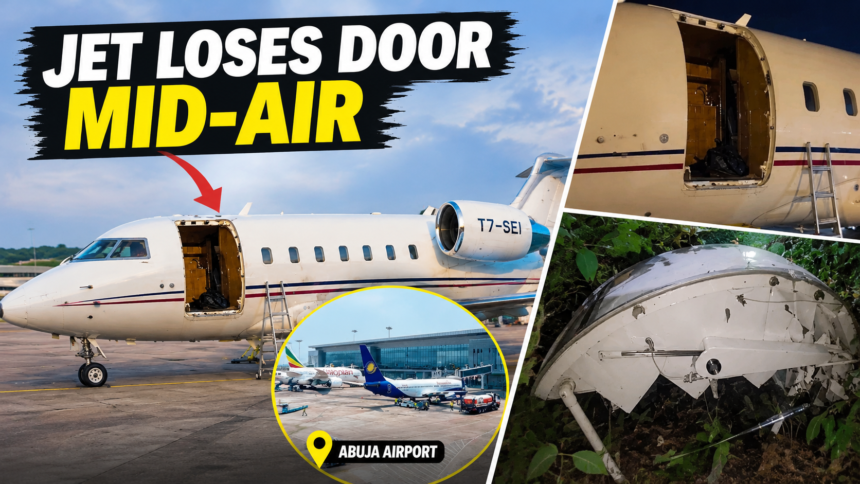
A private jet lost a door mid-air shortly after take-off from Abuja on Thursday, October 15, 2026, forcing the crew to declare an emergency and return to Nnamdi Azikiwe International Airport. The aircraft, operated by Triton Aviation, was heading to Lagos when the incident occurred, triggering an urgent response from air traffic controllers and airport emergency teams.
The aircraft, identified by its registration number T7-SEI and flight identification DWC052, had departed Abuja for Murtala Muhammed International Airport, Lagos. What began as a routine journey quickly turned into an emergency after the crew reported a door-related problem while climbing away from the airport.
The jet eventually landed safely in Abuja, while a separate development emerged after a video circulated showing what appeared to be the missing aircraft door recovered from farmland in the area.
How the Abuja Private Jet Lost Its Door Mid-Air
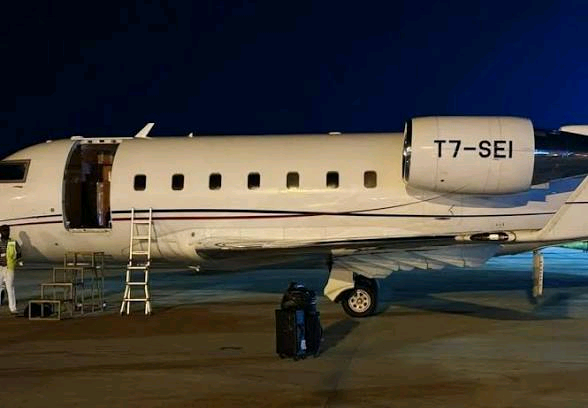
Details contained in an air traffic control incident report indicate that the aircraft departed Runway 22 at Nnamdi Azikiwe International Airport at approximately 4:17 p.m. Coordinated Universal Time (UTC), equivalent to 5:17 p.m. in Nigeria.
About three minutes later, at approximately 4:20 p.m. UTC, the aircraft was around three nautical miles from the airport and climbing through 3,000 feet when the crew contacted air traffic control to report the problem.
The crew issued a distress call, transmitting, “Mayday, Mayday, Mayday.”
The internationally recognised distress call signals that an aircraft is facing a serious and immediate emergency requiring urgent assistance. In this case, the crew reported that a door had opened during flight, prompting air traffic controllers to arrange the aircraft’s return to Abuja.
The incident report identifies the aircraft as a CL60, a designation associated with the Bombardier Challenger 600 series.
Although the precise circumstances surrounding the door’s detachment remain unclear, the crew’s report prompted an immediate change to the flight’s planned journey to Lagos.
Emergency Landing at Abuja Airport
Following the distress call, air traffic controllers directed the aircraft back to Nnamdi Azikiwe International Airport for an emergency landing.
Airport emergency personnel, including fire and rescue teams and medical responders, were reportedly placed on standby as preparations were made for the jet’s return.
The aircraft remained in communication with the control tower while arrangements were made for its landing.
At approximately 4:29 p.m. UTC, the crew asked whether controllers could determine the condition of the door from the ground.
The duty controller reportedly attempted to inspect the aircraft using binoculars but could not establish the door’s condition because of the aircraft’s position.
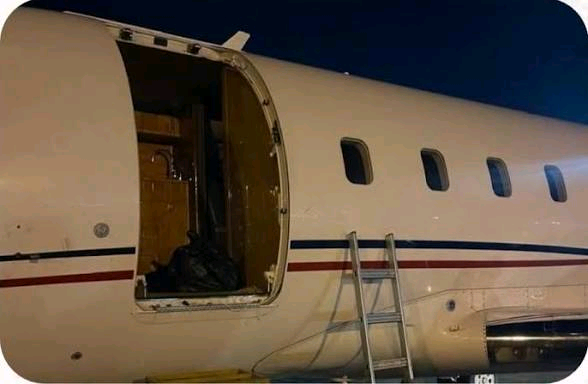
The jet subsequently landed on Runway 22 at approximately 4:34 p.m. UTC, about 14 minutes after the distress call.
After the landing, the control tower observed that the door was missing from the aircraft’s fuselage.
The jet was then taxied to the international apron extension and parked with assistance from a marshaller.
While the aircraft’s safe return was a significant development, it did not establish what caused the door to open or become detached. Those questions remain central to determining the circumstances of the incident.
Missing Aircraft Door Found on Abuja Farmland
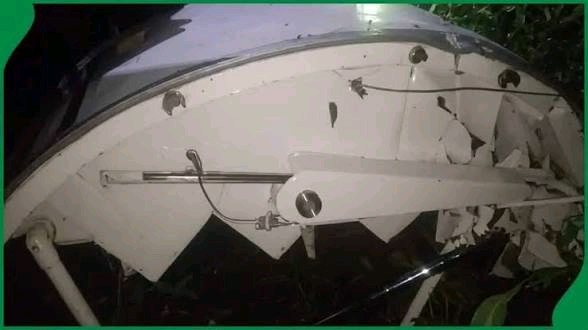
The incident attracted further attention after a video circulated showing a large aircraft door reportedly recovered from farmland in the Abuja area.
In the footage, a man says the object was discovered by farmers returning from their farm.
“This is what we found as we were returning from our farm. It fell from a plane, but we don’t know much about its identity,” the man says in the video.
He also appeals for assistance in identifying the object and establishing where it came from.
The footage has drawn attention to the unusual circumstances of the incident, particularly the possibility that an aircraft component fell onto farmland while the jet was airborne.
However, the video’s claims do not independently establish the precise location where the door detached, its flight path or the circumstances that caused it to separate from the aircraft.
Those details would need to be verified by investigators using the aircraft, relevant records and any available physical evidence.
The number of passengers and crew members aboard the jet has also not been independently confirmed in the information available at the time of writing.
Aviation Authorities Expected to Establish Cause
The Nigeria Civil Aviation Authority (NCAA) reportedly confirmed the incident, with its Director of Public Affairs and Consumer Protection, Michael Achimugu, directing further enquiries to the Nigerian Safety Investigation Bureau (NSIB).
The NSIB is responsible for investigating aviation accidents and incidents to establish what happened and identify measures that could improve transport safety.
The investigation will need to establish the sequence of events leading to the door opening or detaching, alongside any relevant technical and operational factors.
These could include the condition of the door and its locking mechanisms, maintenance records, inspection history and any available evidence from the flight. Such matters are lines of inquiry, not established explanations for this particular incident.
As of the time of writing, no verified public finding had established the cause of the door’s detachment. It would therefore be premature to attribute the incident to a specific mechanical defect, maintenance failure or individual action.
Triton Aviation’s detailed account of the incident was also not available in the material reviewed for this report.
Questions Remain After the Jet’s Safe Return
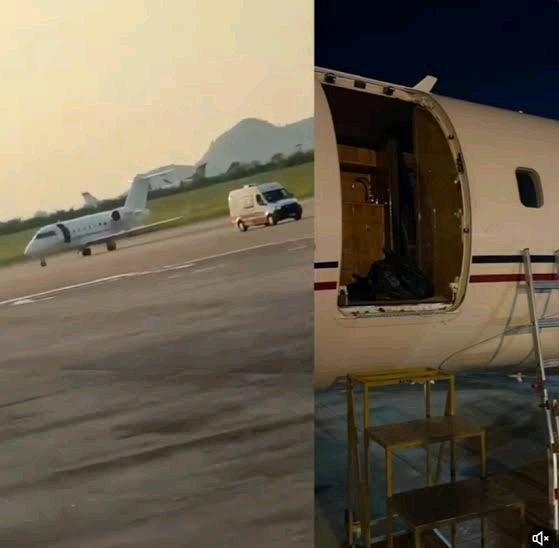
The safe landing brought the immediate airborne emergency to an end, but important questions remain unanswered.
Investigators will need to determine how the door came to open or detach, whether any other part of the aircraft was affected, and whether the recovered object can be conclusively linked to the jet.
The circumstances also raise questions about the inspection and maintenance history of the aircraft, although the incident alone does not establish that any maintenance or regulatory requirements were breached.
For now, the established sequence is clear: the Triton Aviation-operated CL60 departed Abuja for Lagos, reported a door-related emergency while climbing through approximately 3,000 feet, declared Mayday and returned safely to the airport.
The cause of the incident, the number of people aboard and the full findings of any safety investigation remain unconfirmed.
Further information from the relevant aviation authorities and the aircraft’s operator will be important in establishing exactly what happened and whether any additional safety measures are required.