


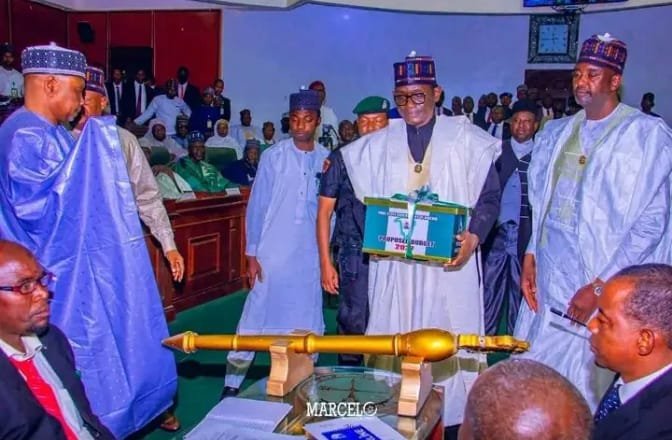
Yobe State Governor, Mai Mala Buni, has presented a proposed N532.27bn budget for the 2027 fiscal year to the State House of Assembly, with education and healthcare among the major beneficiaries of the estimates.
The proposal, christened the Budget of Consolidation, Sustainability and Inclusive Growth, allocates N288.426bn, representing 54.2 per cent, to recurrent expenditure, while N243.845bn, or 45.8 per cent, is earmarked for capital projects.
Buni presented the 2027 Appropriation and Finance Bills before lawmakers in Damaturu on Tuesday, describing the proposal as the eighth and final budget of his administration.
The proposed estimates represent an increase of N16.739bn, or 3.2 per cent, over the N515.532bn approved for the 2026 fiscal year.
Presenting the budget, the governor said it was designed to consolidate his administration’s achievements, complete ongoing projects and sustain existing investments.
“Today, with a sense of humility and fulfilment, and in accordance with Section 121(1) of the 1999 Constitution of the Federal Republic of Nigeria (as amended), I once again stand before this Honourable House of Assembly to present the Eighth and last Finance and Appropriation Bills by this administration for your kind consideration and approval for the 2027 fiscal year,” he said.
Buni said the government would prioritise project completion, improved service delivery and prudent management of public resources.
“The 2027 budget is therefore designed to balance immediate service delivery with the long-term development interest of the state,” he added.
A breakdown of the proposal shows that education received N99.792bn, while N80.543bn was allocated to healthcare.
The governor said the education allocation would support the completion of ongoing school construction and rehabilitation projects, the provision of teaching materials, assistance to tertiary institutions and scholarship programmes.
On healthcare, he said the government would sustain investments in hospital upgrades, maternity and emergency services, medical equipment and healthcare training institutions.
He identified the establishment of a modern kidney centre in Gashua as one of the administration’s priority projects.
“We are equally committed to advancing the ongoing establishment of a modern Kidney Centre in Gashua, with emphasis on a safe, accessible, patient-centred treatment environment, appropriate dialysis equipment and the clinical and operational arrangements required for sustainable service delivery,” Buni said.
Infrastructure development will also remain a major priority, with emphasis on completing ongoing road, drainage, electricity and commercial projects.
The governor specifically mentioned the Gashua-Masaba, Balanguwa-Kumagannam and Dumbulwa-Lailai roads among the projects requiring attention.
Other priority areas include agriculture, livestock production, water supply, environmental protection, peacebuilding and the rehabilitation of communities affected by insurgency.
Reviewing the performance of the 2026 budget as of September 30, Buni said the state recorded revenue receipts of N347.078bn, representing 67.3 per cent of the annual projection.
He said the approved 2026 budget comprised N291.904bn for capital expenditure and N223.628bn for recurrent expenditure.
According to him, recurrent expenditure during the first nine months amounted to N139.346bn, while capital expenditure stood at N94.280bn.
The governor said his administration remained committed to paying salaries, pensions and gratuities despite prevailing economic challenges and the demands of post-insurgency recovery.
Highlighting the achievements recorded in the past seven years, Buni said his administration had established 148 primary healthcare centres out of the planned 178, upgraded four general hospitals to specialist hospitals and converted eight primary healthcare centres to general hospitals.
He added that more than 15,000 healthcare workers had been employed and that the government had established what he described as Nigeria’s biggest maternal and childcare hospital in Damaturu.
In education, the governor said the administration had reconstructed more than 300 schools, built 929 classrooms, rehabilitated 748 others and established 15 mega and model schools.
He further disclosed that more than 9,000 teachers had been recruited, while over 12,000 others had received training under the state’s education intervention programme.
According to him, more than 50,000 students had benefited from government scholarships, while over 400 students were sponsored to universities in India to study specialised courses in medicine and engineering.
Buni, who described the proposal as the final budget of his administration, said the government would ensure an orderly transition and preserve ongoing development projects.
“Development must not depend entirely on the presence of any individual in public office. It must be supported by strong institutions, competent public servants, credible planning frameworks and effective systems of accountability,” he said.
He assured residents that his administration would continue to discharge its responsibilities until the final day of its tenure.
“We shall continue to work, supervise, deliver and remain accountable until the final day of our mandate. There will be no abandonment of our responsibilities and projects,” the governor stated.
He urged the lawmakers to give the proposed budget timely consideration and passage.
In a political appeal towards the end of his address, Buni called on the people of Yobe to support President Bola Tinubu’s second-term ambition, arguing that the state’s membership of the ruling All Progressives Congress had created opportunities for it to benefit from the Federal Government.
He also commended Tinubu for approving the Federal Government’s takeover and reimbursement of the Muhammadu Buhari International Cargo Airport project in Damaturu, saying the intervention would free up resources for other development projects.
West Trybe reports that the proposed N532.27bn budget will be the final fiscal plan presented by Buni’s administration, placing emphasis on completing existing projects and sustaining investments before the end of his tenure.