


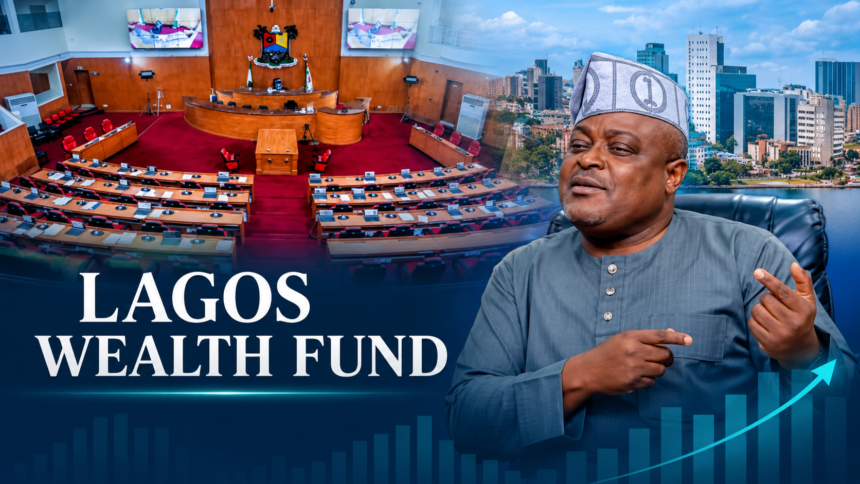
The Lagos State House of Assembly has passed the Lagos State Wealth Fund Bill, providing a legal framework for the establishment, management, administration and investment of a dedicated state wealth fund.
The development, announced by the Assembly on Monday, November 23, 2026, marks a significant step in the state’s plan to establish a long-term investment vehicle that will support infrastructure development, strengthen financial stability and preserve wealth for future generations.
According to the Assembly’s official announcement, the passage of the bill was one of the major highlights of its plenary proceedings.
The proposed Lagos State Wealth Fund is expected to operate as a strategic investment vehicle, allowing the government to manage and invest resources across different asset categories rather than relying exclusively on conventional budgetary spending.
However, the passage of the bill by lawmakers is an important legislative milestone, and the next steps towards its implementation will determine how the proposed fund operates.
What the Lagos State Wealth Fund Will Do
The Lagos State Wealth Fund is designed to create a structured system for receiving, managing and investing resources in a diversified portfolio of medium- and long-term assets.
Its central objective is to generate sustainable returns while supporting the state’s economic development and protecting resources for future generations of Lagos residents.
The proposal was developed around four major investment windows, according to details previously provided by the Lagos State Ministry of Finance.
These include infrastructure financing, economic stabilisation, long-term savings and strategic growth.
The infrastructure investment component is expected to support projects that can strengthen the state’s development and economic capacity.
The economic stabilisation window is intended to provide financial protection during difficult economic periods, helping the government manage unexpected fiscal pressures without placing excessive strain on public finances.
The long-term savings component focuses on preserving resources for future generations, while the strategic growth window is designed to support economic diversification and investment opportunities.
Together, these investment areas are intended to give Lagos a more organised approach to managing public wealth.
How the Wealth Fund Plan Started
The proposal did not emerge overnight. It followed several months of legislative consideration and consultations involving government officials, lawmakers and private-sector stakeholders.
On November 12, 2025, the Lagos State House of Assembly held a public hearing on the proposed legislation through its Committee on Finance.
The bill was titled A Bill for a Law to Establish the Lagos State Wealth Fund to Receive, Manage and Invest in a Diversified Portfolio of Medium- and Long-Term Assets for the Benefit of Lagos State and Future Generations of Its Indigenes and Residents, and for Connected Purposes.
During the public hearing, the Speaker of the House, Mudashiru Obasa, described the proposed fund as an important step towards protecting the state’s economic future.
The proposal subsequently progressed through legislative consideration, including a second reading and examination by the House Committee on Finance.
On June 4, 2026, lawmakers adopted the committee’s recommendations, with amendments, following the presentation of its report by the committee’s chairman, Hon. Obafemi Saheed.
Obasa also stressed the importance of ensuring that the fund’s governance structure reflected competence, experience and inclusiveness.
The Assembly’s latest announcement confirms that the bill has now passed another major legislative stage.
What the Lagos Government Has Said About the Fund
In February 2026, the Commissioner for Finance, Abayomi Oluyomi, explained the government’s vision for the proposed investment framework during a stakeholders’ harmonisation session organised by the Ministry of Finance.
The session was organised to bring together recommendations from different stakeholders and strengthen the proposed legislation before its final consideration by lawmakers.
Oluyomi explained that the fund was intended to safeguard Lagos‘ financial future through dedicated investment windows that would protect public resources, generate returns and reduce fiscal shocks.
He also emphasised the importance of private-sector participation in developing the investment structure.
“The private sector is the engine that drives economic growth, particularly in an economy as large as Lagos. That is why their participation in this process is very critical,” he said.
The commissioner further explained that the proposed framework draws inspiration from the Nigerian Sovereign Investment Authority, which manages Nigeria’s sovereign wealth fund.
What Happens Next?
With the Lagos State House of Assembly announcing the passage of the bill, attention will now turn to the remaining steps required to bring the proposed investment institution into operation.
The legislative passage should not be confused with the fund already being fully operational. Presidential-style approval is not involved in state legislation; the relevant next constitutional step is the governor’s assent.
Following assent, the implementation framework, funding arrangements, investment management structure and accountability mechanisms will be important considerations.
The government will also need to establish clear procedures for how resources enter the fund, how investment decisions are made and how returns are monitored.
Transparency will be particularly important because the fund is expected to manage public resources over an extended period.
For Lagos residents, the eventual impact will depend not simply on the establishment of the fund but also on how effectively it is managed, the returns it generates and the extent to which its investments contribute to sustainable development.
The Lagos State Wealth Fund therefore represents a significant proposal for the state’s economic future. Its success will ultimately depend on sound management, responsible investment decisions and accountability in the use of public resources.