


Yobe State Governor and Chairman of the Lake Chad Basin Governors’ Forum, Mai Mala Buni, has urged countries within the Lake Chad Basin to strengthen political, security and economic cooperation to confront the worsening challenges of terrorism, displacement, climate change and economic vulnerability across the region.
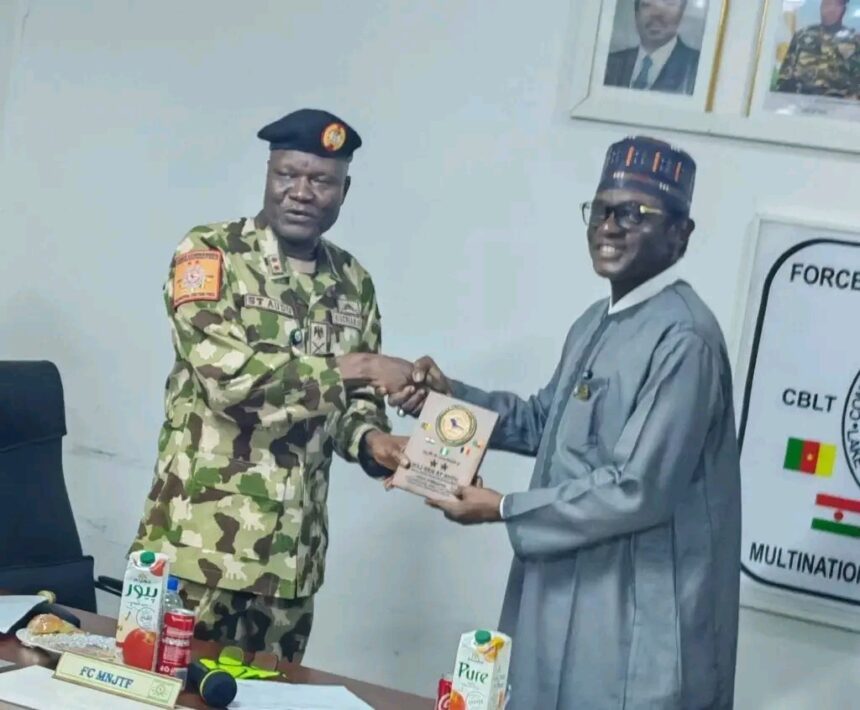
Buni made the call on Tuesday in N’Djamena, Chad, during separate visits to the headquarters of the Lake Chad Basin Commission and the Multinational Joint Task Force, where he assessed regional efforts to restore peace and improve security.
The governor’s position was contained in a statement issued on Wednesday by his Director-General, Press and Media Affairs, Mamman Mohammed.
The visit came as countries in the Lake Chad Basin continue to grapple with the effects of years of violent extremism, population displacement, environmental degradation and weak economic opportunities, challenges that have increasingly assumed a cross-border dimension.
Speaking at the headquarters of the Lake Chad Basin Commission, Buni congratulated its newly appointed Executive Secretary, Ibrahim Babani, and pledged the cooperation of the Governors’ Forum in advancing initiatives aimed at stabilising the region.
He described Babani’s appointment as coming at a critical period when countries in the basin needed stronger coordination and institutional collaboration to address their shared challenges.
“You have no doubt taken this responsibility at a consequential moment for the Lake Chad Basin,” Buni said.
He added, “One in which our shared security, stabilisation and development challenges demand stronger political coordination, deeper institutional partnership and a renewed sense of common purpose.”
Buni said the Governors’ Forum was ready to work closely with the commission to implement programmes that would contribute to peace, development and improved livelihoods for communities affected by insecurity.
According to him, the problems confronting the region could no longer be addressed effectively through isolated national interventions because insecurity, displacement, climate pressures, economic vulnerability and violent extremism frequently spread across national and administrative boundaries.
“Our response must, therefore, be swift and rooted in solidarity, coordination and collective action,” the governor said.
He stressed the importance of sustained collaboration among the countries of the Lake Chad Basin, saying regional institutions must be strengthened to enable them to respond more effectively to emerging security and humanitarian challenges.
Buni also commended President Bola Tinubu for his commitment to sustainable peace, security and economic development in the Lake Chad region.
He said the Federal Government’s support for multilateral cooperation, the Multinational Joint Task Force and regional stabilisation initiatives remained essential to achieving lasting peace and shared prosperity.
The governor urged the Lake Chad Basin Commission to expand its engagements with the African Union, United Nations Development Programme, international financial institutions, bilateral partners and other development stakeholders.
He said stronger partnerships would be necessary to mobilise the financial and technical resources required to implement development and stabilisation programmes across affected communities.
Beyond military operations, Buni said the region needed sustained investment in infrastructure, livelihoods and economic opportunities to address some of the conditions that contribute to insecurity and instability.
The governor subsequently visited the headquarters of the Multinational Joint Task Force in N’Djamena to review its achievements and challenges in the fight against terrorism.
The MNJTF brings together countries of the Lake Chad Basin in a joint effort to combat terrorist groups and other security threats affecting the region.
During the visit, Buni pledged to advocate for increased intervention by the Federal Government and other member states to strengthen the task force’s operations.
He identified resources, equipment and manpower among the key areas requiring greater attention if the regional force was to sustain its operations effectively.
Buni also raised concerns over the withdrawal of Niger Republic from the task force, indicating that the development would require serious attention from the relevant authorities because of its implications for regional security cooperation.
“I pledge to share your successes and challenges with President Bola Ahmed Tinubu, GCFR, especially the withdrawal of Niger Republic from the Task Force, the challenges of resources, equipment, manpower, among others,” he said.
The governor’s engagements in N’Djamena underscored the growing importance of regional cooperation in addressing security challenges that transcend national borders.
For communities around the Lake Chad Basin, years of conflict have resulted in displacement, loss of livelihoods and disruption of economic activities, while climate-related pressures have further increased competition over scarce resources.
Buni’s call therefore places emphasis on a broader regional strategy that combines security operations with stabilisation, humanitarian assistance, climate resilience and economic development.
The Lake Chad Basin Governors’ Forum has continued to serve as a platform for governors from affected states and regions to coordinate their positions and advocate for stronger regional and international support.
The forum’s collaboration with the Lake Chad Basin Commission and the MNJTF is expected to remain important as governments seek to consolidate security gains and create conditions for sustainable development.
For Buni, the path to lasting peace requires governments and regional institutions to move beyond fragmented responses and build a coordinated framework capable of addressing both immediate security threats and the underlying socioeconomic pressures affecting vulnerable communities.
West Trybe reports that the governor’s N’Djamena engagements highlight the need for stronger coordination among Lake Chad Basin countries as regional authorities confront terrorism, displacement, climate pressures and economic hardship.