

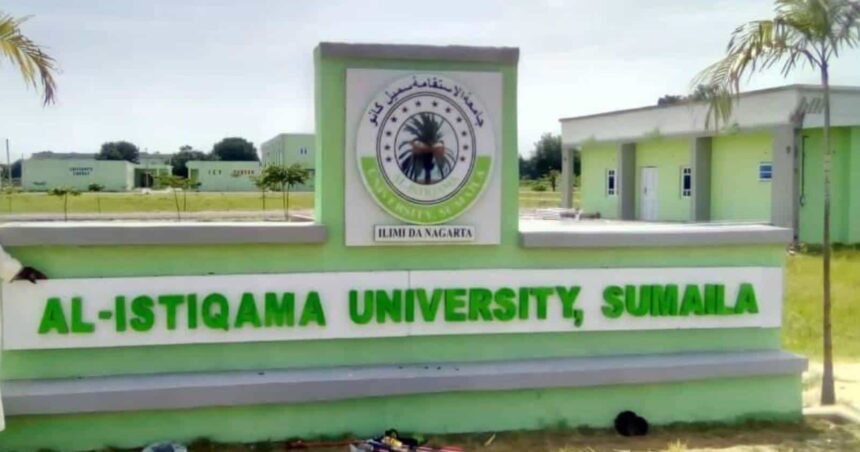
Alistiqama University, Sumaila, has graduated 1,104 students from the 2023, 2024 and 2025 academic sessions, with its chairman, Senator Abdulrahman Kawu Sumaila, saying the institution was established to bridge the rural-urban education gap in Kano State.
Kawu Sumaila, who represents Kano South in the Senate, said locating the university in a rural community was a deliberate decision aimed at bringing quality higher education closer to young people who might otherwise be forced to migrate to urban centres in search of educational and economic opportunities.
He spoke during the university’s combined convocation ceremony, where he said rural-to-urban migration had continued to place pressure on city infrastructure while depriving rural communities of the human capital required for sustainable development.
According to him, establishing a university of international standards in a rural environment was intended to reverse the trend by taking higher education directly to the people.
“By bringing a university of international standards directly to this rural area, we are reversing that trend, and we are proving that higher education, economic opportunity, and urban development demand, not just in rural communities, but right here in our local communities,” he said.
The senator said the institution was also created to empower young people and stimulate economic activities within the surrounding communities.
“With the University, we are empowering local youth, boosting the rural economy, and creating a sustainable ecosystem where knowledge is strong at home,” he said.
Kawu Sumaila attributed the progress recorded by the university to the contributions of its principal officers, community leaders, elders, institutions and governments.
“This dream could not have been realised without the extraordinary leadership of our principal officers, as well as generosity, guidance, and dedication of selfless leaders, reliable elders, institutions and government,” he said.
He said the university had evolved from a mission to expand access to quality higher education into an institution focused on academic excellence and character development.
“We began as a mission to expand access to quality, value-binding higher education in our nation, and today matured into a vibrant institution of academic excellence and character development,” he said.
The chairman also expressed appreciation to the former chairperson of the institution, His Royal Highness Alain Jamiro Abdul Kareem, for his leadership and contribution to the development of the university.
Kawu Sumaila said Abdul Kareem’s guidance had contributed to strengthening the institution during its development.
“It is not a big deal. I wish to place on record our tremendous appreciation to our former chairperson, His Royal Highness, Alain Jamiro Abdul Kareem, whose uniform leadership and personal guidance has given this university exceptional strength and patience,” he said.
Speaking at the convocation, Kano State Governor Abba Kabir Yusuf expressed satisfaction with the development of the university, saying its philosophy aligned with his administration’s efforts to expand educational opportunities in the state.
Yusuf said the institution’s decision to provide university education within a rural setting was consistent with his administration’s educational objectives, adding that his government would support its continued development.
The governor disclosed that his administration had paid for the continuation of the education of 85 medical and engineering students sponsored by the Kano State Government.
Yusuf also recalled the condition of the education sector when he assumed office, saying his administration responded by declaring a state of emergency in education.
“When I came onboard, education was in a near-comatose state. I introduced a state of emergency on education in the state,” he said.
The governor said the administration was now beginning to see the results of its interventions after three years in office.
“Today, three years down the line, we are celebrating our success,” Yusuf said.
The convocation brought together the university leadership, graduating students, their families, community leaders, government officials and other stakeholders to mark the institution’s academic progress.
The graduation of 1,104 students from three academic sessions also represents a major milestone for the university as it continues to expand its role in providing higher education outside Kano metropolis.
The institution’s rural location remains central to its stated objective of taking university education closer to communities where young people may otherwise have to relocate to major cities to pursue their studies.
West Trybe reports that expanding higher education institutions into rural communities can help bring educational opportunities closer to underserved populations while supporting local economic activity and strengthening human capital development outside major urban centres.